Explore expert insights from HealthStream on healthcare compliance, credentialing, clinical education, scheduling, and leadership. Find practical guidance to help healthcare organizations train, retain, and support their workforce.
Practical insights on healthcare compliance, workforce development, and clinical education from the experts at HealthStream.

Interoperability connects healthcare data across systems, helping providers reduce errors, eliminate redundant tests, and deliver safer, more coordinated care.
Data is essential in modern healthcare. But when that data is trapped in silos— inaccessible by clinicians and patients who need it—it can create dangerous gaps in care. This is where healthcare interoperability comes in.
Healthcare interoperability is a key requirement for a connected, efficient, and safe healthcare ecosystem. Without it, providers struggle to see the full picture of a patient's health, leading to redundant medical tests, medication errors, and delays in treatment. By enabling different systems to speak the same language, interoperability transforms fragmented data into actionable insights.
Healthcare interoperability refers to the ability of different information systems, devices, and applications to access, exchange, integrate, and use data in a cooperative and coordinated manner, within and across organizational, regional, and national boundaries. It enables the secure and seamless exchange of health information, ensuring that data is not only shared but also understood by the receiving system.
Interoperability is like the global banking system. You can use your debit card at an ATM in almost any country, even if that bank is different from yours. The machines communicate, verify your information, and complete the transaction seamlessly.
The healthcare industry is working toward that same level of fluidity. Clinical interoperability means that if a patient visits a hospital or an urgent care clinic across the country, their medical history travels with them. It ensures their care team has the right information at the right time, regardless of the software they use.
When providers lack access to complete patient records, safety can be compromised. Healthcare data interoperability can reduce medical errors by ensuring providers know about potential drug interactions or allergies before prescribing medication. It allows for smoother care transitions, such as moving a patient from surgery to rehabilitation, ensuring every member of the care team is on the same page.
Providers can spend a significant amount of time searching for information. Interoperability streamlines this by automatically populating patient records with data from outside sources. This reduces administrative overload, allowing clinicians to focus on patient care rather than data entry.
Redundant testing is a major source of waste in healthcare. If a system can see that a patient recently had blood work or an MRI at another facility, they can avoid repeating the test. This lowers costs for both the patient and the health system.
To improve community health, systems need to analyze data across large populations. The importance of interoperability in healthcare becomes clear when tracking disease outbreaks or managing chronic conditions like diabetes. Interoperable systems allow public health officials to aggregate data to identify trends and intervene earlier.
Achieving full connectivity happens in stages. There are four distinct types of interoperability in healthcare:
This is the basic tier. It allows one system to send data to another, and the receiving system can listen. However, the receiving system cannot necessarily interpret the data without a human. This is like a person sending a PDF document; the information is there, but it cannot be easily manipulated or analyzed by a computer.
This level defines the format of the data exchange. It ensures that data is organized in a consistent structure (like specific fields for patient name, date of birth, etc.) so that clinical systems can recognize and store it. Standards like Health Level Seven International (HL7) help achieve this.
This is the highest level of interoperability inhealthcare. It ensures that two systems not only exchange data but alsounderstand the meaning of that data. By using standardized coding vocabularies, such as Systematized Nomenclature of Medicine — Clinical Terms (SNOMED) and Logical Observation Identifiers, Names and Codes (LOINC), systems can interpret the clinical significance of the information, allowing for automated decision support and analysis.
This refers to the non-technical aspects—policy, governance, and legal frameworks—that enable seamless data exchange between organizations. It involves agreements on user permissions, privacy, and secure workflows.
One of the most common examples of interoperability in healthcare is when a primary care physician sends an electronic referral to a specialist. The specialist’s electronic health record (EHR) receives the patient’s chart directly, eliminating the need for faxing or mailing paper records.
HIEs are secure networks that allow physicians, nurses, pharmacists, and other providers to access and share health-related information electronically across a region or state.
This involves the exchange of clinical and administrative data between healthcare providers and payers. It streamlines processes like prior authorization and claims adjudication, reducing delays in patient care.
Hospitals and clinics automatically report data on reportable diseases, such as the flu or measles, to public health agencies. This automated flow of data is essential for timely public health surveillance.
Standardization is the glue that holds interoperable healthcare systems together.
HL7 is a set of international standards for the transfer of clinical and administrative data between software applications used by various healthcare providers.
Pronounced “fire,” this is the modern standard forexchanging healthcare information. FHIR uses web-based technologies, like those used by Google or Facebook, to make healthcare interoperability frameworks more flexible and easier to implement than older standards.
Application programming interfaces (APIs) allow different software programs to communicate. In healthcare, APIs enable third-party appsto connect to EHRs, allowing patients to download their health records to their smartphones.
Substitutable Medical Applications, Reusable Technologies (SMART) is a set of open standards used to integrate apps with EHRs, portals, HIEs, and other health IT systems. It provides a secure way for innovative apps to run across the healthcare system.
Despite the benefits, several challenges remain. These are the primary barriers to healthcare interoperability:
Many hospitals still rely on older, on-premise software that was not built to share data. Replacing these legacy systems is expensive and complex.
Even with standards like FHIR, different organizations may document data differently. One hospital might record “high blood pressure” while another uses “hypertension,” which makes automated matching difficult.
As data becomes more accessible, the risk of breaches increases. Balancing easy access with robust cybersecurity and compliance with HIPAA is a constant challenge.
Determining who owns the data—and who is allowed to share it—can be legally and ethically complicated. Competing health systems may also be hesitant to share data due to business concerns.
With a comprehensive view of patient history, providers can make more informed decisions. How interoperability improves patient care is evident when a physician can see a complete list of medications prescribed by other specialists, preventing dangerous interactions.
Patients no longer have to carry physical records from provider to provider or repeat their medical history at every appointment. This leads to higher patient satisfaction and engagement.
Whether a patient is at a routine check-up, in the emergency room, or receiving home health care, healthcare integration systems ensure their care plan is consistent and up to date.
Health systems can identify high-risk patients and intervene proactively, improving the overall health of the communities they serve.
Health systems can improve interoperability by doing the following:
Investing in cloud-based platforms and modern EHRs that support FHIR and APIs is the first step toward modernization.
When selecting new technology, organizations must prioritize vendors that commit to open standards and healthcare data interoperability. Avoid proprietary "walled gardens," or closed digital ecosystems, that restrict data sharing.
Establishing clear internal policies on data standardization, privacy, and sharing protocols ensures that technology investments translate into operational success.
Staff must be trained not just on how to use new software, but on the importance of accurate data entry to support interoperability in EHRs.
Data is essential in modern healthcare. But when that data is trapped in silos— inaccessible by clinicians and patients who need it—it can create dangerous gaps in care. This is where healthcare interoperability comes in.
Healthcare interoperability is a key requirement for a connected, efficient, and safe healthcare ecosystem. Without it, providers struggle to see the full picture of a patient's health, leading to redundant medical tests, medication errors, and delays in treatment. By enabling different systems to speak the same language, interoperability transforms fragmented data into actionable insights.
As healthcare continues to evolve, seamless data exchange and collaboration will become even more critical. Here are the major trends and innovations shaping the next generation of interoperable health systems:
Staff must be trained not just on how to use new software, but on the importance of accurate data entry to support interoperability in EHRs.
Initiatives like the Trusted Exchange Framework and Common Agreement (TEFCA) from the Office of the National Coordinator for Health Information Technology aim to create a single "on-ramp" for nationwide connectivity.
In the future, health data will integrate with data from social services, wearables, and environmental sources to provide a truly holistic view of health.
As the healthcare industry moves toward value-based care, interoperability will be less of an IT project more of a core business strategy. It is the foundation upon which the future of digital health will be built.
Interoperability is a journey, not a destination. While challenges regarding standards and legacy tech remain, the benefits of healthcare interoperability—safer care, lower costs, and better outcomes—make it an essential pursuit for any forward-thinking healthcare organization. By embracing modern standards and prioritizing connection, health systems can ensure that data serves its ultimate purpose: improving the lives of patients.

Learn the essentials of effective obstetric training, from evidence-based content to team training and simulation, for safer maternal and neonatal care.
Ensuring safety in maternal care is one of the most critical responsibilities for any healthcare provider organization. However, there are significant challenges in maternal care. More than 80% of maternal deaths in the United States are preventable. Also, obstetrics-related malpractice claims are common and are linked to breakdowns in clinical judgment and team communication. In this high-stakes environment, the most effective strategy for improving patient safety and team performance is being committed to providing high-quality, continuous training.
This article will outline the best practices in obstetric training that can lead to safer outcomes for mothers and newborns. We will explore the essential components of a training program designed to empower clinical teams, reduce risk, and elevate the standard of care.
Obstetric care is characterized by high stress and time-sensitive tasks. Emergencies can develop rapidly, and the team's ability to respond effectively is directly tied to the well-being of both the mother and the baby. A significant number of adverse maternal events are avoidable when clinicians have the right knowledge and skills at their disposal. This is where specialized training can help.
Effective training sharpens clinical judgment, reduces the likelihood of errors, and promotes a culture of safety. By implementing standardized care and risk reduction strategies, healthcare organizations can equip their teams to handle the complexities of labor and delivery with confidence. Following the best practices in obstetric safety is necessary for compliance but it's also about creating a system where every patient receives the highest quality care, every time.
A successful training program is more than just meeting a regulatory requirement. It requires using a multi-faceted approach that integrates evidence-based knowledge, teamwork, and practical skills development. Here are the core elements that every effective obstetric training program should include:
The foundation of a strong training program starts with having content that is consistent, current, and based on established clinical guidelines. When the entire interdisciplinary team—nurses, physicians, midwives, and support staff—is aligned on the same protocols, care variability decreases and patient safety increases. This content should be rooted in guidelines from respected professional organizations like the World Health Organization and the Association of Women’s Health, Obstetric and Neonatal Nurses (AWHONN).
An evidence-based interdisciplinary learning program ensures that every team member is working from the same playbook. This alignment is critical for everything from routine care, as outlined in the WHO recommendations for a positive childbirth experience, to managing complex emergencies, which is a focus of the AWHONN Obstetric Patient Safety Course.
Obstetric care is fundamentally a team effort. Effective communication and seamless coordination are vital, especially during high-pressure situations. Training clinicians as individuals is important but training them as a cohesive unit can be transformative. Team-based training clarifies team roles, enhances communication, and fosters a culture of psychological safety where every team member feels empowered to speak up.
Investing in the development of a high-functioning clinical team addresses the communication gaps that can lead to adverse events. Research on simulation-based team training shows that when teams practice together, they perform better together, leading to improved outcomes and a safer environment for patients.
Skills for managing low-frequency, high-risk events like postpartum hemorrhage, shoulder dystocia, or maternal cardiac arrest can diminish without regular practice. Simulation training provides a safe, controlled environment to build and maintain the muscle memory needed to respond effectively. It allows teams to practice their technical and communication skills without putting any patients at risk.
By using realistic scenarios for critical obstetrical emergencies, teams can build the competence and confidence needed to act decisively when it matters most. This includes specialized training in resuscitation care for maternal patients, which helps clinicians be prepared for the most challenging situations.
During an actual emergency, clinicians can experience significant cognitive load, which is the amount of mental effort and working memory resources a person uses while learning or completing a task. Having immediate access to protocols, checklists, and decision-support tools at the point of care is invaluable. Mobile-ready resources can provide easily accessible guidance and help clinicians follow best practices during particularly stressful moments.
A tool that provides real-time, step-by-step guidance helps clinicians confirm their next steps and adhere to established protocols. This approach complements a broader strategy of preparing for obstetric emergencies, which emphasizes readiness and rapid response.
Investing in a comprehensive training program is the first step. The next step is to measure its impact. Tracking key performance indicators is essential for demonstrating the value of your training and driving a cycle of continuous quality improvement.
Important metrics to monitor include rates of adverse events, obstetrics-related liability claims, and specific clinical quality measures like the Nulliparous, Term, Singleton, Vertex cesarean birth rate. Guidance on evaluating obstetric care highlights the importance of such metrics. By tracking these data points, healthcare organizations can see tangible evidence of their efforts. For example, some systems have seen their risk-adjusted rates of reduced negative events by 22% after implementing a standardized education program.
The best practice for providing safe patient care in obstetrics is having a dedicated, multi-faceted approach to training. By combining evidence-based content, collaborative team training, high-fidelity simulation, and point-of-care support, healthcare organizations can build capable and confident clinical teams. This investment is about both reducing risk and ensuring the health and well-being of mothers and their newborns.
To learn more about how you can implement these best practices and improve your Maternal and Perinatal Care, we are here to help you build a safer future for your patients.

Learn how healthcare CIOs can build an AI governance framework that reduces bias, ensures compliance, manages risk and delivers measurable outcomes.
Artificial intelligence (AI) is accelerating across every aspect of healthcare—from operational forecasting and revenue cycle automation to clinical decision support and ambient documentation. Yet without a clear, responsible AI governance strategy, the same technologies that promise efficiency and better outcomes can introduce bias and create regulatory exposure.
This guide lays out a pragmatic, enterprise-ready AI governance framework for health systems that chief information officers (CIOs) can lead; a framework anchored in ethical principles, strong oversight, measurable outcomes, and continuous improvement.
Health systems are deploying AI models capable of creating greater efficiency by triaging patient messages, streamlining the prior authorization process, and summarizing encounters between patients and providers. Some models can even predict readmissions. Generative systems are now drafting patient instructions and enabling ambient scribing. As the adoption of these AI models spreads, AI governance in healthcare must shift from aspirational to operational, ensuring that algorithms augment care safely, fairly, and reliably across diverse populations and care settings.
Unchecked AI can propagate inequities, surface hallucinated content, and drift as patient populations change. Poorly monitored models have the capacity to degrade performance, impair clinical workflows, and quietly violate both privacy and security standards. Beyond patient safety, the enterprise faces risk in vendor management, cybersecurity, intellectual property, reputational trust, and overall AI regulatory compliance in healthcare. CIOs need a CIO AI governance roadmap that treats AI like any other safety-critical technology—governed end to end.
Before scaling pilots, CIOs should align on a shared definition of clinical AI governance and scope: which tools qualify as AI, where they can be used, who is accountable, how models are evaluated, and what “go/no-go” criteria apply. Having a clear, systemwide vocabulary prevents shadow deployments and clarifies responsibilities across IT, clinical operations, compliance, and security.
What does AI governance mean for health systems? It’s a set of policies, roles, processes, and technologies that ensures the use of AI is safe, effective, equitable, secure, and aligned to mission—across the entire lifecycle.
Accountability starts at the top. Executive sponsorship from the CIO and chief medical information officer (CMIO) or chief nursing information officer (CNIO) establishes authority and expectations. Governance charters should specify decision rights, escalation paths, and the role of the board or a quality/safety committee in oversight. It is also crucial to decide who is responsible for managing data, building AI models, creating AI deployment pipelines, and conducting post market surveillance of AI. AI accountability by healthcare CIOs is not about owning every model but ensuring that every AI model has an owner and a documented lifecycle.
Ethical AI governance in healthcare hinges on fairness, nonmaleficence, beneficence, autonomy, and justice. Policies should require:
This is the heart of responsible AI implementation—embedding ethics in design, deployment, and monitoring, not as afterthought compliance checks.
For models that influence care, explainability is a safety and trust imperative. A key step toward achieving explainability is documenting model intent, data sources, training approach, validation results, known limitations, and instructions for safe use. It is essential to promote explainable AI in health systems so the audience (clinicians, patients, and executives) understands what each AI model does and knows how to challenge or override it. When feasible, publish AI model cards and provide instructions in plain language.
Enterprise standards need to be established for data lineage, provenance, and quality checks. Validation must be representative of the health system’s population and care settings, with subgroup analysis to detect bias. After thresholds for sensitivity/specificity, positive predictive value (PPV)/negative predictive value (NPV), calibration, latency, and uptime have been defined, codify these in your AI governance framework for health systems. When models are trained elsewhere and imported into the health system’s ecosystem, require external validation or transport testing.
How should a CIO roll out AI in a health system? Here is a framework:
Anchor AI investments to the health system’s strategic plan in relevant areas: quality and safety, access and capacity, workforce experience, financial sustainability, and equity. Use a structured intake process that asks: What problem are we solving? What outcome(s) will change? Which metrics define success? How will clinicians and staff use the tool? This ensures your AI strategy for health systems channels effort into high value, measurable outcomes.
Form an interdisciplinary governance committee consistingof both IT and clinical leadership (physicians and nurses) to address mattersrelated to patient quality and safety, compliance, privacy, security, datascience, patient advocacy, and health equity. Give committee members theauthority to approve use cases, set AI policy for medical technologies, andrequire risk assessments. Committee subgroups can be responsible for issuespertaining to clinical validation, data governance, and machine learning operations(MLOps).
Translate the health system’s AI principles into enforceable standard operating procedures (SOPs) that cover:
These policies operationalize AI governance best practices healthcare and reduce ambiguity for project teams.
An initial step is to create a tiered risk classification grounded in intended use, potential clinical impact, user population, and automation level. High risk tools require formal safety cases, user training, and fail safes. Be sure to standardize pre deployment checks for bias, robustness, and adversarial vulnerabilities. AI risk management in health systems should dovetail with the enterprise’s risk management, cybersecurity, and third party risk processes.
Monitoring isn’t optional. Systems should implement continuous performance tracking with drift detection, alerting, and periodic revalidation. Build in processes for collecting user feedback and incident reports. A vital component is linking monitoring to action: throttling, retraining, or initiating rollback when thresholds are breached. Track clinical and operational impact alongside equity measures to ensure AI clinical safety standards at health systems remain front and center.
Treat AI governance as a product. Conduct quarterly reviews of the health system’s AI-related policies, metrics, and portfolio. Organizations should incorporate insights gleaned from AI-related incidents, audits, and emerging AI regulations into employee training. Publish updates for all stakeholders to access and conduct refresher training courses for high risk workflows. This keeps health system AI oversight adaptive while providing consistency and clarity.
To promote adherence, it helps to define key AI roles and their related responsibilities:
Clear role boundaries prevent diffusion of responsibility and enable rapid decisions.
Standardizing platforms for data preparation, model training, registry, deployment, and monitoring can facilitate interoperability. Choose or create modular, API first architectures that integrate with identity and access management, audit logging, and change control. Establish requirements for observability, reproducibility, and versioning so that every model is traceable. Interoperability with electronic health records (EHRs), ancillary systems, and analytics platforms is essential to scale a framework for rolling out AI in hospitals.
Delineate how PHI is used to train, fine tune, and evaluate AI models. At the very least, health systems should require minimum necessary access, encryption at rest and in transit, robust de identification, and dataset governance (such as, lineage, approvals, and retention). Business associate agreements and data use agreements should reflect AI use cases, including generative systems, synthetic data, and model outputs that may re-expose sensitive content. Strong data governance is the bedrock of ethical AI governance in healthcare.
AI that lives outside the workflow rarely moves the needle. To address this challenge, embed outputs where decisions happen—within the EHR, messaging inboxes, or clinical dashboards—using standard terminologies and context. Provide inline guidance, clear confidence indicators, and one-click pathways to view rationale or report issues. Integration is the means through which AI strategy for health systems becomes day to day practice.
To ensure compliance, it’s necessary to track evolving regulatory stances on AI/ML-enabled medical software and decision support. This involves establishing internal criteria to iine when a tool may be regulated, as well as making sure model documentation, change management, and post deployment monitoring align with expected quality system practices. Even for tools outside formal oversight, mirror high reliability disciplines designed to protect patients and the enterprise.
Equity must be measured, not assumed. When appropriate, require subgroup analysis by age, sex, race/ethnicity, language, and social determinants of health (SDOH). Document mitigations (through reweighting, threshold tuning, and constraint optimization), and monitor equity impact over time. Pair algorithmic fairness with human factors: Training, cognitive load, and interface design all affect responsible AI implementation and patient safety.
Vendors and foundation models introduce supply chain risks. To counter potential threats, assess model provenance, training data claims, software bills of materials (SBOMs), and incident response processes. Test guardrails and jailbreak resistance for generative systems. Enforce security measures, including data residency, logging, and tenancy controls. Integrate AI services into enterprise vulnerability management and red teaming programs to meet AI regulatory compliance expectations and protect the system’s reputation.
To determine success, tie deployments to specific, clinically meaningful goals (for example, reduction in turnaround time, decreased documentation burden, improved screening rates). Report progress at regular intervals, attributing changes carefully to avoid overstating impact. This ensures AI governance in healthcare remains outcome oriented.
To accurately evaluate an AI model’s performance, be sure to track all pertinent features and operations, including discrimination, calibration, latency, uptime, and error types. Use alerts for data drift, concept drift, and bias drift. Schedule revalidation windows and require change logs for retraining or prompt updates. Maintain a model registry with version history and status.
When measuring user adoption, go beyond the basics by assessing factors such as satisfaction and time saved. Monitor rework rates, override patterns, and abandonment to assist in identifying data misfits and usability issues. Operational metrics help CIOs steer the portfolio toward tools that truly improve experience and efficiency.
One of the most effective ways to assess compliance is through the use of a scorecard for policy adherence. The scorecard can measure components of the model such as documentation completeness, risk classification, validation evidence, KPI monitoring, access controls, and audit trail quality. A “governance compliance score” shines a light on gaps that may exist and drives continuous improvement across the AI governance framework for health systems.
For the highest level of success, adopt MLOps and large language model operations (LLMOps) platforms that provide lineage, approval workflows, telemetry, access controls, and reproducible deployments. Ensure that platforms integrate with the health system’s EHR and identity systems. Use data catalogs for provenance and quality flags and implement red team harnesses and sandbox environments for AI risk management in health systems testing.
To gain desired buy-in from leadership across the enterprise, frame AI as a strategic lever for quality, access, workforce, and margin. Engage clinical and operational leaders early to co own goals and governance. Sharing a concise, board ready CIO AI governance roadmap with milestones, risk mitigations, and return on investment (ROI) hypotheses can help to forestall potential objections. Align messaging with patient safety and equity—values that transcend departments and budgets.
As models become more multimodal, context aware, and embedded in core workflows, governance will increasingly resemble high reliability engineering through continuous verification, rapid learning cycles, and tight coupling to safety and equity outcomes.
So, what is the best AI governance framework for healthcare? The winners will be health systems that operationalize AI governance best practices in healthcare with the same rigor they apply to infection control or medication safety. For CIOs, the mandate is clear: Lead with principles, codify those principles into policies and platforms, measure what matters, and improve relentlessly.
With a principled, pragmatic AI governance framework for health systems, CIOs can accelerate innovation while safeguarding patients, clinicians, and the enterprise—transforming AI from a set of scattered experiments into a trustworthy, enterprise scale capability.

Learn how continuous, role-specific training helps acute care hospitals reduce HIPAA breaches, close compliance gaps and stay audit-ready.
In acute care hospitals, HIPAA compliance challenges rarely stem from a single broken control — they emerge from everyday behaviors across a large, diverse workforce dealing with time pressure, technology change, and third-party dependencies.
Comprehensive policies and tools matter, but without continuous, role-specific education, even well-designed safeguards fail at the point of care. HIPAA training does check the regulatory checkbox, but it also helps to reduce compliance gaps, improve audit readiness, and lower breach risk across complex hospital environments.
The landscape of HIPAA compliance in acute care is shifting. According to recent reports from the Health and Human Services Office for Civil Rights (OCR), while hacking and IT incidents remain the largest category of breaches affecting 500 or more individuals, unauthorized access and disclosure continue to plague healthcare organizations.
For acute care facilities, the threat is twofold. External bad actors are constantly probing for weaknesses in cybersecurity, while internal staff may inadvertently cause breaches through simple errors. The 2021 HITECH Amendment has increased the pressure, requiring entities to demonstrate recognized security practices to potentially mitigate penalties. This means that healthcare HIPAA compliance is not only about preventing a breach, it is about proving that you did everything reasonably possible to train your workforce to prevent it.
Hospitals face unique hurdles that make data protection difficult. Unlike a private practice with fixed hours, acute care facilities operate 24/7 with shift changes, floating staff, and high patient volume.
In a busy unit, it is easy for staff to discuss Protected Health Information (PHI) in acute care settings loudly in a common area, leave a chart open at a nursing station, or hand discharge papers to the wrong family member.
Tablets, laptops, and mobile workstations on wheels (WOWs) are essential for care but easy to lose or leave unlocked.
High turnover and rotating residents can lead to HIPAA security and privacy challenges, such as “permission creep,” where staff retain access to data they no longer need.
Generic, one-size-fits-all training often fails to engage clinical staff, leading to low retention of healthcare compliance best practices.
Viewing HIPAA solely as a legal obligation is a mistake. Today, HIPAA risk management in healthcare is financially and operationally necessary. The costs of non-compliance can be significant. OCR resolution agreements can reach millions of dollars, not including the reputational damage and loss of patient trust that follows a breach.
Recent enforcement actions highlight that the OCR is looking closely at systemic failures, such as the lack of an accurate organization-wide risk analysis or failure to manage business associate agreements. When mitigating HIPAA risk in hospitals, leaders must understand that an untrained workforce is a liability. If staff cannot recognize a phishing email or do not understand the "minimum necessary" rule, the organization is vulnerable regardless of how sophisticated its firewalls are.
HIPAA mandates training for all workforce members and ongoing security awareness and training — not as one-time events, but at onboarding, after material policy changes, and throughout employment.
Education is the bridge between policy and practice. To effectively address HIPAA compliance challenges, training must move beyond passive reading of the regulations. It must change behavior.
Staff need to know exactly what constitutes a violation in their specific workflow.
Security awareness training helps staff recognize modern threats like social engineering and phishing, which are primary vectors for ransomware.
OCR settlements consistently require training updates, documentation, and proof of effectiveness — demonstrating education is an effective mitigation.
Regular training aligns with Security Rule expectations to prevent, detect, and correct security violations —reinforced by ongoing monitoring and sanctions.
Targeted education addresses specific HIPAA compliance gaps in acute care settings, such as proper disposal of PHI.
Reducing HIPAA violations through staff education requires a curriculum that is relevant. Clinical staff need scenarios that mirror their daily reality, not generic office examples.
For compliance leadership in healthcare, the goal is to implement a training program that is effective without being burdensome. HIPAA training strategies for acute care organizations should focus on efficiency and engagement.
Start with a risk assessment to identify where your vulnerabilities lie. Does your facility struggle with physical security or cybersecurity? Use this data to tailor your HIPAA compliance training in healthcare.
Not every employee needs the same level of training every year. Improving HIPAA compliance with ongoing education means using tools that assess a learner's current knowledge. If a nurse can demonstrate competency in a specific area, allow them to test out. This respects their time and reduces "seat time," allowing them to return to patient care faster.
In an acute care setting, staff are rarely sitting at a desk. HIPAA training for healthcare staff must be mobile-friendly and accessible in short bursts. This flexibility can increase participation rates and help prevent compliance training from becoming a bottleneck.
Regulatory bodies require proof of training. It is not enough to train; you must document who was trained, when, and on what topics. Automated tracking systems are essential for HIPAA workforce training requirements, ensuring you are audit-ready at a moment's notice.
Track completions, quiz performance, incident trends, and audit findings. Use results to refresh HIPAA compliance education content and prove “reasonable and appropriate” safeguards under the Security Rule.
HIPAA training is vital because acute care settings are high-risk environments for data breaches due to the volume of patients and staff. Proper training ensures that all workforce members understand how to protect patient privacy amidst the chaos of hospital operations. Without it, hospitals risk severe financial penalties and reputational damage.
Violations often stem from human error, such as discussing patient details in public areas, improper disposal of records, or falling victim to phishing scams. HIPAA compliance challenges also include lost or stolen unencrypted devices and failing to terminate access rights when an employee leaves the organization.
The entire workforce, including management, volunteers, and trainees, must be trained on your policies and procedures at onboarding, after material changes, and as appropriate to their functions. Document all training.
While HIPAA regulations do not specify an exact frequency, industry best practices and healthcare compliance best practices recommend training upon hire and at least annually thereafter. Additionally, training should occur whenever there is a material change in policies, new technology is introduced, or a risk assessment identifies a need.
Privacy topics (minimum necessary, authorizations, Right of Access, uses/disclosures), security awareness (phishing, passwords, log in monitoring, malicious software), business associate agreement responsibilities, incident reporting, and device handling—mapped to your risk analysis.
Building an effective compliance program is an ongoing process that requires vigilance, adaptability, and the right tools. By addressing the specific HIPAA compliance challenges inherent in acute care and prioritizing engaging, accessible education, hospitals can protect both their patients and their reputation. Using this proactive approach will pay dividends in fewer incidents, faster corrective actions, and a more resilient culture of privacy and security.
To see how adaptive, mobile-first training can improve your compliance rates, learn more about HealthStream's Compliance Courseware.

Explore key 2026 healthcare trends including AI in healthcare, cybersecurity, and workforce development. Learn strategies for compliance modernization.
Imagine a modern healthcare landscape where safety is absolute and quality is unwavering. This is the vision of a high-reliability organization—a system where excellence isn't just a goal, but the standard operating procedure.
However, achieving this state of "consistent excellence" is no small feat. As we look toward 2026, healthcare leaders face a complex web of challenges. They must navigate everything from engaging a burnt-out workforce to mastering AI in healthcare and ensuring robust healthcare compliance.
To understand how organizations are preparing for the future, we analyzed perspectives from more than 600 healthcare leaders across the nation. The findings are published in our 2026 Trends in Quality and Compliance report, which reveals a critical shift: successful organizations are moving beyond reactive problem-solving to proactive prevention. They are building cultures of accountability, prioritizing workforce readiness, and leveraging data to keep outcomes on track.
Here is a look at the emerging healthcare trends we uncovered in our report, and what leaders need to know to stay ahead.
One of the most significant hurdles facing leaders today is not a lack of content, but a lack of connection, according to our 2026 report. For the second year in a row, learner engagement remains the top challenge in workforce training, with 41% of respondents identifying it as their primary obstacle.
This is more than just an educational issue; it is a patient safety risk. A disengaged learner is less likely to retain vital healthcare compliance information, adopt new safety protocols, or feel connected to the organization’s mission. In a field where a single error can have life-altering consequences, safety training is synonymous with saving lives.
Staff members are clear about what they need: workforce development that is interesting, relevant, and connected to their daily reality. They want learning experiences that relate directly to their real-world responsibilities, not generic modules that feel like a "check-the-box" exercise.
When organizations get this right, the impact is measurable. Our data shows that 68% of leaders link effective training to improved employee retention. By investing in modern, interactive learning systems, organizations can demonstrate that they value their staff's time and professional growth. This approach addresses current healthcare workforce development trends by turning training from a burden into a powerful retention tool.
AI in healthcare promises to revolutionize efficiency, yet it brings a wave of hesitation. While AI can automate routine tasks and identify risks before they occur, trust in these systems remains fragile. Leaders must balance innovation with AI compliance to ensure ethical application.
Our findings reveal that more than half of healthcare leaders (53%) are worried about data privacy and security when it comes to AI in healthcare, while 52% are concerned about the accuracy of AI outputs. These fears are valid. Without rigorous governance, “black box” algorithms can obscure decision-making processes, potentially introducing bias that undermines health equity or errors that compromise patient safety.
However, the solution isn't to reject AI, but to govern it responsibly. This is one of the most critical healthcare AI trends in 2026 will bring: establishing clear frameworks that balance innovation with oversight. This involves:
When implemented securely, AI in healthcare becomes a powerful ally in quality and compliance. It can standardize knowledge sharing, tailor education to individual learning gaps, and provide data-backed insights via predictive analytics in healthcare safety to reduce human error. Furthermore, by addressing algorithmic bias proactively, leaders can advance health equity and ensure fair treatment for all patient demographics.
The digital walls of healthcare organizations are under constant siege. The sector now faces more cyberthreats than any other critical infrastructure industry. In fact, 11% of surveyed organizations experienced a cyberattack in the last year, with nearly half of those incidents disrupting operations.
In this environment, healthcare cybersecurity is no longer just an IT concern—it is a patient safety imperative. High-reliability organizations treat cyber hygiene with the same rigor as clinical hygiene.
Phishing remains the primary vector for these attacks. Encouragingly, leaders report that simulation-based training is highly effective. By sending mock phishing emails and providing immediate, non-punitive feedback, organizations help staff develop a “security mindset.” This is a cornerstone of effective healthcare cybersecurity training.
Effective programs move beyond annual compliance lectures. They integrate regular simulations, role-specific training, and clear reporting protocols. When staff feel empowered to report suspicious activity without fear of blame, the entire organization becomes more resilient. Investing in robust healthcare cybersecurity training ensures that digital transformation in healthcare organizations does not come at the cost of data security.
Healthcare compliance education is the bedrock of regulatory adherence, yet many current programs are falling short. Leaders rated the effectiveness of their compliance education programs at a moderate 7.6 out of 10, signaling significant room for improvement.
The feedback is consistent: programs need more structure, better tracking, and greater relevance to keep up with evolving healthcare policy. The days of static, one-size-fits-all presentations are over. To achieve true healthcare compliance modernization, education must be:
By prioritizing healthcare compliance modernization, organizations do more than just meet regulatory requirements—they reduce risk and elevate the standard of care. This approach also aligns with healthcare policy updates, ensuring that staff are always prepared for audits and accreditation reviews.
Perhaps the most alarming finding is the "readiness crisis" in leadership. Many organizations report having no formal program for leadership development or relying on training that is severely lacking.
This gap is critical because leadership is the scaffolding that holds high reliability together. Without skilled leaders to foster a culture of accountability and psychological safety, even the best systems will fail. Healthcare leadership development is essential for navigating the complexities of the modern landscape.
Developing leaders requires more than just promoting top clinicians into management roles. It demands a deliberate investment in “soft skills” like emotional intelligence, conflict resolution, and change management. It also requires specific focus on healthcare leadership and AI, equipping leaders to manage digital tools effectively.
Inclusive programs that offer opportunities for leaders at all levels—not just executives—are essential. This includes a focus on equity in healthcare workforce training, ensuring diverse talent pipelines are nurtured. By building a robust strategy for healthcare leadership development, organizations create a workforce capable of navigating healthcare AI trends in 2026 and beyond.
With 2026 underway, the imperative for healthcare leaders to take action is immediate. Achieving high reliability requires an integrated approach that connects workforce training, technology, and leadership.
To prepare your organization for the future:
The organizations that thrive in this new era will be those that view healthcare compliance and quality not as separate departments, but as the shared DNA of their operations. By leveraging trusted partners and data-driven tools, leaders can build systems where safety is the default, and excellence is the expectation.
The future of modern healthcare depends on resilient systems and empowered people. By addressing these healthcare trends head-on, we can build a foundation for care that is not only compliant, but consistently exceptional.
Want to dive deeper into these critical trends? Download the full 2026 Trends in Quality and Compliance report to explore all the data, insights, and strategies leaders need to drive excellence in their organizations.

Learn how CAQH credentialing works and how healthcare organizations can simplify provider enrollment paperwork, reduce delays and ease administrative burden.
Credentialing and enrollment are critical processes for healthcare organizations, but managing countless forms and requirements can be overwhelming.
Historically, credentialing and provider enrollment have involved a mountain of paperwork. Each health plan required providers to submit extensive documentation—from licensure and training to demographics and practice history.
That’s why the Council for Affordable Quality Healthcare (CAQH) launched its online provider data portal in 2002. This created a centralized source for provider data, streamlining what was once a fragmented and inefficient system.
While the process is simpler, it remains complex and highly regulated. To help clarify CAQH credentialing, we'll break down what it is, why it's important for onboarding and payer enrollment, and how organizations can manage the process efficiently.
CAQH is a nonprofit alliance of health plans and trade associations that develops tools, most notably the CAQH Provider Data Portal—formerly known as CAQH ProView—to simplify and standardize administrative processes in healthcare.
CAQH credentialing refers to providers using the CAQH Provider Data Portal to create a central, online profile with their professional information, including licenses, education, work history, and other credentials. Providers can update and attest to their information every 120 days. Participating health plans and networks can access authorized information to support credentialing and enrollment.
Providers and group administrators enter data once, and that information can then be securely shared with designated payers through CAQH's credentialing tools. Efficient enrollment can support provider readiness, reimbursement, and patient access.
The CAQH Provider Data Portal standardizes and centralizes provider data with a uniform application format aligned with national standards. This reduces variations in how organizations collect, store, and share provider information.
Payers can access provider information through the CAQH Provider Data Portal, while providers maintain accuracy by regularly reviewing and attesting to their information.
Enrollment teams can use CAQH data as part of network participation applications, payer enrollment, credentialing, and provider directory management. By reducing administrative delays, the process can help providers complete onboarding and begin seeing patients sooner.
Incomplete or inaccurate enrollment information can contribute to delayed reimbursement, staffing disruptions, and gaps in care delivery. Maintaining an accurate CAQH profile can help support the credentialing and enrollment process at multiple levels.
There is no federal mandate requiring providers to use CAQH. However, many commercial payers require providers to have a CAQH profile as part of their credentialing or enrollment process.
Healthcare professionals who may use the CAQH Provider Data Portal include physicians, nurse practitioners (NPs), physician assistants (PAs), certified registered nurse anesthetists (CRNAs), registered nurses (RNs), therapists, registered dietitians, behavioral health providers, respiratory therapists, and many others.
Requirements can vary by payer, provider type, and state. Providers should confirm CAQH requirements with the health plans or organizations with which they are seeking participation.
The CAQH Provider Data Portal centralizes information healthcare providers may need for enrollment and network participation.
CAQH profiles contain:
Setting up and maintaining a CAQH profile requires an initial investment of time, but a complete and accurate profile can help simplify future credentialing and enrollment processes.
Providers can register for a CAQH account and create their profile.
During registration, providers may need to provide identifying information such as their name, address, provider type, NPI, and licensing information. Once registered, providers can log in and begin completing their profile.
Providers complete the required sections of their profile and upload supporting documentation.
This may include:
Providers should save their work regularly and review the profile for missing or inconsistent information.
Providers can authorize participating health plans and other organizations to access their information through the portal.
Authorization requirements can vary, so providers should make sure the appropriate health plans or organizations have access to the information they need.
After reviewing their information, providers can complete the electronic attestation process.
Providers should address any errors or missing information before submitting their attestation. This confirms that the information in the profile is accurate to the best of their knowledge.
Providers should regularly review their CAQH profile and update information when circumstances change.
CAQH requires providers to reattest to their information every 120 days. Regularly reviewing the profile can help providers identify outdated information and maintain an active, accurate profile.
Payers or other participating organizations may request additional information or corrections.
Providers should respond to requests promptly, upload any required documentation, update their profile as needed, and reattest after making changes.
Despite the efficiencies created by the CAQH Provider Data Portal, providers and credentialing teams may encounter several common challenges.
Incomplete or inconsistent information can slow the enrollment process and create additional follow-up.
Providers should review their profile carefully before attestation and make sure information such as names, dates, licenses, employment history, and practice information is accurate and consistent.
Providers are required to reattest to their CAQH profile every 120 days. Missing a reattestation deadline can result in an inactive profile and may contribute to enrollment delays.
Calendar reminders and internal tracking can help providers and credentialing teams stay ahead of upcoming deadlines.
Licenses, insurance information, certifications, and other supporting documents should be current and uploaded correctly.
Providers should monitor expiration dates and respond promptly to requests for updated documentation.
If a provider does not authorize a health plan or other participating organization to access their information, that organization may not be able to retrieve the information needed for enrollment.
Providers should review their authorizations and confirm that relevant organizations have the access they need.
Healthcare organizations may face challenges when connecting CAQH information with internal credentialing, enrollment, or provider management systems.
Organizations can help address these challenges by standardizing data processes, improving system integration, and using credentialing technology that supports efficient provider data management.
Credentialing and enrollment are key parts of broader operational and financial priorities.
Delayed credentialing can delay payer enrollment, which can delay a provider's ability to bill for services. Maintaining accurate provider information and completing enrollment requirements efficiently can help organizations support provider readiness and timely reimbursement.
Accurate provider data can also support patient scheduling, provider directories, and access management.
HealthStream's suite of workforce readiness and onboarding solutions, including CredentialStream and CredentialMyDoc, supports provider credentialing and enrollment workflows.
These tools help organizations request, gather, validate, and manage provider information while tracking credentialing milestones and important dates.
Our solutions encompass everything organizations need to request, gather, and validate information about providers, creating a centralized source of truth to support downstream processes. HealthStream helps administrators streamline forms, securely store and organize provider data, stay on top of important dates, and automate processes.
While providers are ultimately responsible for maintaining their own CAQH profiles, medical groups, private practices, hospitals, and credentialing teams can take the following steps to help with the process:
CAQH plays an important role in provider credentialing and enrollment by giving providers and participating organizations access to centralized provider information.
Maintaining accurate provider data, completing required attestations, and responding to enrollment requirements can help healthcare organizations reduce administrative delays and support provider readiness.
For organizations managing credentialing at scale, technology can help centralize provider information, track important requirements, and simplify administrative workflows.
CAQH credentialing is the process of creating and maintaining a provider profile through the CAQH Provider Data Portal. Once the profile is complete, participating organizations can access authorized information they need for credentialing and enrollment. It gives you a single, reliable place to keep provider data current.
No. There's no federal requirement for every provider to use CAQH. That said, many health plans ask for a CAQH profile as part of their credentialing or enrollment process, so it often becomes a practical necessity depending on the payers you work with.
Providers must reattest to their CAQH profile every 120 days. Beyond that regular schedule, it's best to update the profile any time professional or practice information changes. Keeping the profile accurate between attestations helps avoid delays down the line.
A CAQH profile can hold a wide range of provider details, including demographics, licenses, certifications, education and training, work history, practice information, disclosures, and supporting documents. Together, these pieces give participating organizations the full picture they need.
CAQH is the organization that offers tools and services for healthcare administrative processes. CAQH ProView was the former name of the CAQH Provider Data Portal, the place where providers maintain their professional and practice information. If you knew it as ProView, it's the same resource under an updated name.
No. CAQH gives you a centralized source of provider information that participating health plans and organizations can use during credentialing and enrollment. Even so, payers may still have their own requirements and processes, so it's smart to confirm each payer's expectations.

Learn how the HITECH Act has transformed healthcare IT, strengthened HIPAA compliance, and will shape digital strategy in the future.
The healthcare technology landscape looks dramatically different than it did just 15 years ago. Electronic health records (EHRs) have become the backbone of modern medical practice, patient data can flow seamlessly between providers, and cybersecurity protocols protect sensitive health information with unprecedented rigor.
This transformation didn't happen by accident. A single piece of legislation fundamentally reshaped how healthcare organizations approach digital systems and data management, serving as a catalyst for many of the technological advances in place today.
The Health Information Technology for Economic and Clinical Health (HITECH) Act, introduced in 2009 as part of the American Recovery and Reinvestment Act (ARRA), stands as one of the most influential healthcare laws enacted in decades.
While many healthcare leaders recognize HITECH’s role in accelerating EHR adoption, the law's impact extends much further. It established the foundational framework for today's interoperability standards, strengthened privacy protections, and created accountability structures that still shape healthcare IT decision making.
As time passes, healthcare organizations face an increasingly complex digital landscape. New regulations such as the 21st Century Cures Act build on HITECH’s architecture, cybersecurity threats have become more elaborate, and the push toward value-based care demands sophisticated data analytics capabilities.
Understanding HITECH's legacy and ongoing relevance is about more than compliance. It's also about recognizing how this foundational law continues to influence strategic IT decisions, as well as operational excellence in healthcare.
For chief information officers and healthcare leaders navigating today's technology challenges, HITECH remains as relevant as ever. Its principles underpin everything from business associate agreements to breach notification requirements, making it essential knowledge for anyone responsible for healthcare IT strategy and compliance.
HITECH represents a comprehensive federal initiative designed to modernize healthcare through the adoption of strategic technology. As a component of the ARRA economic stimulus package, HITECH allocated more than $25 billion specifically toward healthcare IT transformation, making it one of the largest federal investments in health technology infrastructure to date.
HITECH wasn't simply about encouraging hospitals and clinics to purchase computer systems. The legislation established a framework for systematic healthcare digitization with five core objectives:
The HITECH Act created the “Meaningful Use” program, which provided substantial financial incentives for healthcare providers who could demonstrate they were using certified EHRs to improve patient care. Eligible professionals could receive up to $44,000 in Medicare incentive payments and up to $63,750 through Medicaid for successfully implementing and meaningfully using EHRs. These weren't just adoption bonuses—providers had to prove their systems enhanced clinical decision making, care coordination, and patient engagement.
Equally important, HITECH strengthened the Health Insurance Portability and Accountability Act (HIPAA). It expanded HIPAA’s reach to include business associates, introduced mandatory breach notification requirements, and established tiered penalty structures that could result in fines up to $1.5 million for willful violations. This enforcement mechanism gave HIPAA the “teeth” it had lacked, transforming compliance from a best practice into a business imperative.
The impact HITECH has had on healthcare cannot be overstated. The legislation achieved transformational change across multiple dimensions of healthcare delivery and data management:
HITECH’s most visible success was the dramatic increase in EHR adoption. Before the law was enacted in 2009, the rate of adoption was low. Slightly less than 17% of office-based physicians and somewhere between 10% and 30% of hospitals were using a “basic” EHR system. By 2017, according to The HIPAA Journal, 86% of office-based physicians and 96% of non-federal acute care hospitals had adopted certified EHR systems. This represents one of the fastest technology adoption curves in history—and not just in healthcare.
The Meaningful Use program distributed billions of dollars in incentive payments to providers who demonstrated that their EHR systems improved patient care. Stage 1 requirements focused on basic functionalities, such as electronic prescribing and clinical documentation. Later stages centered on more advanced capabilities, including clinical decision support, care coordination, and patient engagement tools.
HITECH significantly expanded HIPAA’s scope and enforcement power. Along with introducing mandatory civil penalties for violations, the law created tiered penalty structures based on violation severity. It also established the presumption that an unauthorized disclosure is considered a breach unless the organization where it occurred can prove otherwise.
Patients gained new rights as the result of HITECH. They had the right to receive electronic copies of their health records and request an accounting of disclosures, for example. They also had the right to restrict the sharing of certain information. When healthcare providers implemented EHR systems, they were required to provide patients with electronic access to their health information at minimal cost.
HITECH established penalty tiers ranging from $100 to $50,000 per violation, with annual caps as high as $1.5 million for repeated violations. These financial consequences created genuine accountability for privacy and security failures.
Business associates became directly liable for HIPAA compliance under HITECH. This expansion recognized that healthcare data processing increasingly involved third-party vendors, cloud service providers, and other types of technology companies—and they all should meet the same compliance obligations as those required of covered entities.
Before HITECH (2009)
After HITECH (2017+)
Healthcare leaders might assume that HITECH’s work is complete now that EHR adoption has reached near-universal levels. However, the Act continues to influence healthcare IT strategy in fundamental ways that far exceed technology implementation.
HITECH established the architectural framework that supports today’s most significant healthcare IT initiatives. For instance, the 21st Century Cures Act, which prohibits information blocking and mandates patient data access, builds directly on HITECH’s interoperability provisions. As another example, the Trusted Exchange Framework and Common Agreement (TEFCA) uses HITECH’s data-sharing principles as its foundation.
Modern interoperability requirements assume that healthcare organizations have the sort of digital infrastructure HITECH incentivized. Without certified EHR systems and standardized data formats, current initiatives like the FHIR (Fast Healthcare Interoperability Resources) API requirements would be impossible to implement effectively.
HITECH’s expansion of HIPAA is the primary legal framework that governs healthcare data protection today. The breach notification requirements, business associate liability provisions, and enforcement mechanisms established through HITECH still provide the regulatory foundation for responding to cybersecurity threats.
Healthcare organizations face hundreds of data breaches annually. The number of compromises reported in 2024 vary according to the source. In its 2024 Data Breach Report, the Identify Theft Resource Center reported 536 compromises in the healthcare sector. Meanwhile, as of January 2025, the Department of Health and Human Services (HHS) Office for Civil Rights (OCR) data breach portal showed 725 data breaches of 500 or more records in 2024.
With increased digitization of healthcare information comes an increased risk of breaches, and the trend in data breaches has been steadily increasing for more than a decade. HITECH’s presumption that unauthorized access constitutes a breach unless proven otherwise, combined with mandatory reporting requirements, ensures that organizations take proactive security measures rather than reactive responses.
The tiered penalty structure introduced in HITECH still drives security investments. Organizations that experience data breaches due to willful neglect face minimum penalties of $10,000 per violation, creating strong financial incentives for comprehensive cybersecurity programs.
Healthcare’s digital ecosystem includes hundreds of third-party vendors that provide everything from cloud hosting to AI-powered analytics. By extending HIPAA liability to business associates, HITECH ensures that this expanded vendor ecosystem maintains consistent data protection standards.
Healthcare organizations typically work with anywhere from 50 to 100 business associates, from EHR vendors to telehealth platforms and revenue cycle management companies. Each relationship requires a comprehensive business associate agreement (BAA) that meets HITECH’s expanded requirements. Failure to properly manage these relationships can result in significant consequences to an organization’s financial health and its reputation.
The 2021 amendment to HITECH provides some relief for organizations that implement recognized security frameworks, but it also emphasizes the importance of proactive risk management and continuous security monitoring.
Value-based healthcare delivery models require the sophisticated data analytics capabilities that HITECH made possible. Quality reporting programs, care coordination initiatives, and population health management all depend on the standardized data collection and EHRs HITECH compelled.
The Centers for Medicare & Medicaid Services' Quality Payment Program, which affects virtually all healthcare providers, builds on HITECH’s meaningful use framework. Providers must demonstrate they’re using health information technology not only to improve patient outcomes, but also to coordinate care and support clinical decision making.
Predictive analytics, artificial intelligence (AI) applications, and precision medicine initiatives all require the robust data infrastructure HITECH helped establish. Without standardized EHRs and interoperable systems, these advanced applications would lack the data foundation necessary for effective implementation.
Healthcare leaders face a complex landscape in which HITECH’s original objectives have evolved into sophisticated operational requirements. Success requires moving beyond basic compliance to strategic implementation of the legislation's underlying principles.
Technology infrastructure alone can’t ensure HITECH compliance or operational excellence. Healthcare organizations must invest in workforce education that covers more than system functionality. Comprehensive training programs should also provide instruction on privacy responsibilities, security protocols, and patient engagement strategies.
Effective compliance programs include regular training updates that reflect evolving threats and regulatory changes. While staff members need to understand their roles in maintaining data security, they must also be able to support patient access requests and identify potential compliance issues before they become violations.
Leadership development programs should ensure that managers understand their responsibilities for creating and maintaining a culture of privacy and security. This includes knowing when to escalate potential issues. Managers must also know how to respond to patient requests for information access and how to maintain documentation that demonstrates ongoing compliance efforts.
As cybersecurity threats have increased, healthcare organizations have become preferred targets of ransomware attacks because of their valuable data and operational vulnerabilities. Although HITECH’s security requirements provide a baseline, organizations need security awareness programs capable of addressing current threat landscapes.
Training programs should cover topics such as social engineering tactics, phishing recognition, mobile device security, and remote access protocols. Healthcare workers need practical guidance on protecting patient information in various work environments, from traditional clinical settings to remote telehealth scenarios.
Regular security assessments and tabletop exercises can help organizations identify vulnerabilities before they’re exploited. To ensure security awareness across all operational areas, these activities should involve both technical staff and clinical personnel.
The proliferation of healthcare technology vendors means organizations might work with dozens of business associates that have access to protected health information. Business associate agreements (BAAs) must reflect current security standards, compliance requirements, and operational realities.
Regular BAA reviews should assess whether agreements adequately address business practices and services such as cloud computing arrangements, AI applications, and remote access scenarios that may not have existed when the agreements were originally executed. Organizations should also verify that business associates maintain appropriate cybersecurity insurance and incident response capabilities.
Due diligence processes should include regular security assessments of business associates that incorporates verification of their compliance programs and a review of their vendor management practices. This layered approach to vendor oversight helps ensure that third-party risks don't compromise organizational compliance.
HITECH’s meaningful use concept emphasized that technology should improve patient care, not just document it. Healthcare organizations can—and should—leverage their EHR investments to assist with clinical decision making and population health management, along with predictive analytics initiatives.
Advanced EHR capabilities can also support quality improvement initiatives, care coordination programs, and patient engagement strategies. Organizations should regularly assess whether they’re maximizing their technology investments to reinforce strategic objectives.
In addition to helping organizations identify care gaps and predict patient risks, data analytics capabilities can be used to optimize resource allocation. These applications demonstrate the kind of meaningful use envisioned when HITECH was enacted, while supporting value-based care initiatives that improve both patient outcomes and financial performance.
Healthcare organizations need comprehensive support systems to maintain HITECH compliance while advancing their digital transformation objectives. HealthStream provides integrated solutions that address both regulatory requirements and operational excellence goals:
Comprehensive training programs ensure that all workforce members understand their privacy and security responsibilities under HITECH’s expanded requirements. Interactive modules cover breach notification procedures, patient access rights, and business associate management protocols.
Automated systems help organizations monitor compliance activities, track training completion, and maintain documentation that demonstrates ongoing adherence to HITECH requirements. Real-time dashboards provide visibility into compliance status across different organizational units.
Specialized training programs prepare privacy officers and business associate personnel to manage complex compliance scenarios. These programs address regulatory updates, enforcement trends, and best practices for risk management.
Staff development initiatives ensure that healthcare workers can effectively use EHR systems to support patient care and compliance objectives. These programs address both technical skills and workflow optimization strategies.
Executive education programs help healthcare leaders understand their strategic responsibilities for privacy, security, and digital transformation. These modules address risk management and resource allocation.
HealthStream enables both high-level governance oversight and frontline staff engagement through integrated platforms that support policy development, training delivery, and performance monitoring across all organizational levels.
The healthcare industry’s digital transformation journey began with HITECH’s vision of technology-enabled care delivery, but the destination continues to evolve. AI, precision medicine, and advanced analytics represent the next chapter of the story that HITECH began writing in 2009.
Healthcare organizations that understand HITECH’s foundational principles—meaningful technology use, robust privacy protections, comprehensive workforce training, and strategic vendor management—are better positioned to navigate emerging challenges and opportunities. The legislation's emphasis on improving patient outcomes through technology remains as relevant today as it was 15 years ago.
The regulatory landscape continues to build on HITECH’s framework with new requirements for interoperability, patient access, and data sharing that assume organizations have mastered the fundamentals. Organizations that treat HITECH compliance as a strategic foundation rather than a checklist requirement will find themselves better prepared for whatever comes next.
As healthcare continues its digital evolution, the principles that made HITECH successful—principles such as financial incentives aligned with patient benefit, clear accountability structures, and comprehensive workforce engagement—provide a roadmap for future success. Organizations that embrace these principles while adapting to new technologies and regulatory requirements will deliver better care while maintaining operational excellence.
Take a proactive approach to HITECH compliance and digital readiness. Explore how HealthStream can support your organization’s compliance, education, and digital transformation objectives with comprehensive solutions designed for healthcare’s ever-changing landscape.

Discover strategies for developing healthcare leaders, from first-time managers to executives, and build a resilient leadership pipeline.
In a world where every decision can impact lives, strong leadership at every career stage in healthcare is critical.
Whether navigating the early uncertainty of a first management role or steering an organization through transformation, healthcare leaders need support tailored to their specific leadership stage. New leaders wrestle with anxiety over earning trust from their team. Rising leaders face mounting pressure to make high-stakes decisions. Established leaders confront burnout and the fear of losing relevance. Future leaders grapple with uncertainty about their growth trajectory.
The goal isn't just about developing better managers. It's about ensuring healthcare organizations have the leadership capacity to meet the challenges they face today and in the future. When leadership development in healthcare organizations aligns with individual needs and organizational priorities, the results are measurable: stronger teams, improved retention, and better patient outcomes.
Leadership in healthcare isn't just about strategy and operations—it's deeply personal. At each stage, leaders encounter emotional challenges that can undermine confidence and performance if left unaddressed. Strategies for developing healthcare leaders should consider the emotional journey that employees manage as they progress in their career.
For those stepping into leadership for the first time, the weight of responsibility can feel crushing. New leaders often experience anxiety over decisions that directly, or even indirectly, affect patients and staff. There might also be a fear of rejection—the worry that they won't earn their team's trust or be seen as competent. This insecurity can lead to hesitation, overcompensation, or decision paralysis.
As healthcare professionals move into mid-level leadership roles, expectations rise sharply. Rising leaders face growing pressure to make the right calls while managing both up and down the organizational hierarchy. Despite their experience, some may struggle with self-doubt, questioning whether they'll be taken seriously or whether they're ready for the responsibility they've been given.
Even seasoned leaders—chief information officers (CIOs), chief nursing officers (CNOs), chief learning officers (CLOs), chief quality officers (CQOs) among others– aren’t immune to struggle. The ongoing pressure to perform and lead effectively can lead to emotional exhaustion. Established leaders may also fear stagnation—wondering if they're still relevant, if they can keep up with advancing technology, if they can continue to inspire, or if they've plateaued. This self-doubt can manifest as disengagement or a reluctance to take on new challenges.
High-potential employees eager to step into leadership roles can feel overlooked or frustrated by unclear pathways to advancement. They may doubt whether they'll receive the support and growth opportunities they need. This impatience can lead to disengagement or, worse, the decision to seek opportunities elsewhere.
Effective leadership development isn't one-size-fits-all. Employees who are different stages in their career require different strategies. This type of personalized leadership development in healthcare will benefit both the employee and the organization.
Early-career leaders benefit most from foundational skill-building. They need to develop self-leadership capabilities, understand team dynamics, and grasp the organizational culture. Training for these leaders should focus on practical management skills like delegation, communication, and conflict resolution. Pairing new leaders with mentors who can provide guidance and reassurance helps ease the transition into leadership.
Formal training programs—such as introductory leadership courses—can provide structure, while hands-on experience allows new leaders to apply what they've learned in real-world scenarios. The goal is to build confidence and competence in equal measure.
As leaders advance, the focus shifts to decision-making, team-building, and empowering others. Rising leaders need to refine their ability to make tough calls under pressure while learning to develop and support their teams. Coaching programs that provide personalized feedback and stretch assignments that challenge them to take on more complex projects are particularly effective.
Formal executive-level training can help rising leaders understand how their decisions align with broader organizational goals. Encouraging participation in cross-functional initiatives also strengthens their ability to collaborate and influence across departments.
For established leaders, the emphasis moves to strategic thinking, long-term planning, and succession planning. They need tools to enhance their ability to think several moves ahead, anticipate industry shifts, and cultivate a strong organizational culture. Leadership training at this level often includes executive coaching, participation in strategic planning sessions, and opportunities to mentor the next generation of leaders.
Established leaders also benefit from programs that help them manage burnout and maintain their sense of purpose. Encouraging them to focus on legacy—how they'll leave the organization better than they found it—can reignite motivation and reduce the fear of stagnation.
High-potential employees preparing for leadership roles need exposure to emerging trends, technological fluency, and adaptability. Programs focused on developing future healthcare leaders should emphasize change management, digital literacy, and strategic thinking. Stretch assignments that allow them to lead projects outside their comfort zone are invaluable.
Creating clear career pathways and providing visibility into leadership opportunities helps reduce uncertainty and keep future leaders engaged. Transparent communication about what it takes to advance—and how the organization will support that journey—builds trust and commitment.
While each stage requires tailored approaches, several core strategies apply across the board.
Leadership development in healthcare organizations works best when it's embedded in the culture. Organizations that prioritize continuous learning, transparency, and support create environments where leaders at all levels can thrive.
Senior executives play a critical role here. When CIO leadership drives innovation, CNO leadership champions clinical leadership development, CLO leaders design strategic learning initiatives, and CQO executives focus on quality improvement, they model the behaviors they want to see throughout the organization. Their involvement in leadership programs—whether through teaching, sponsoring projects, or sharing personal stories—signals that leadership development matters.
Data also plays a role. Tracking progress before, during, and after leadership programs helps organizations understand what's working and where adjustments are needed. Metrics like retention rates, promotion timelines, and engagement scores offer insight into program effectiveness.
Healthcare leadership development isn't just about filling roles—it's about preparing individuals to navigate complexity, inspire teams, and drive meaningful change. When organizations invest in personalized, stage-appropriate development, they build resilient leadership pipelines that can adapt to whatever comes next.
The challenges leaders face are real and deeply felt. Addressing those challenges with empathy, structure, and strategic support makes all the difference. Whether someone is stepping into leadership for the first time or steering an organization through transformation, they deserve development that meets them where they are and equips them for where they're going.
Healthcare organizations that consistently invest in leadership development will be better positioned to attract talent, retain top performers, and deliver exceptional patient care. The future of healthcare depends on the leaders you develop today.
Learn more about how HealthStream can help you build your leadership development program.

Learn how HITRUST helps healthcare organizations secure patient data, reduce risk and meet regulatory requirements with one trusted framework.
Healthcare organizations face an unprecedented challenge: protecting sensitive patient data while navigating an increasingly complex regulatory landscape. As cybersecurity threats continue to evolve, the consequences of a breach extend far beyond financial losses. For instance, a breach damages patient trust and has the potential to compromise care quality.
This complexity has led many healthcare leaders to adopt HITRUST certification as their comprehensive approach to security and compliance. Rather than managing multiple frameworks separately, HITRUST provides a single solution that demonstrates compliance with the Health Insurance Portability and Accountability Act (HIPAA), National Institute of Standards and Technology (NIST) guidelines, and dozens of other regulatory requirements through a single, certifiable process.
For healthcare chief information officers (CIOs) and IT leaders, understanding what HITRUST offers—and why it's becoming an industry standard—is essential for building a resilient, future-ready organization.
Founded in 2007 and originally known as the Health Information Trust Alliance, HITRUST has developed a cybersecurity framework specifically for organizations that handle sensitive information, particularly in healthcare. HITRUST created the Common Security Framework (CSF) to address the complexities of healthcare data protection and regulatory compliance.
The HITRUST CSF integrates requirements from multiple sources—including HIPAA, the NIST Cybersecurity Framework, ISO/IEC 27001, Payment Card Industry Data Security Standard (PCI DSS), and General Data Protection Regulation (GDPR)—into one cohesive framework. This integration allows organizations to demonstrate compliance with numerous standards through a single assessment process rather than managing separate audits and certifications.
HITRUST updates the framework regularly, using artificial intelligence, to incorporate emerging threats and evolving compliance requirements. This ensures organizations stay current with the latest cybersecurity standards and regulatory changes.
Many healthcare organizations assume they’re sufficiently protected as long as they comply with HIPAA regulations, but HITRUST offers a more comprehensive approach to security.
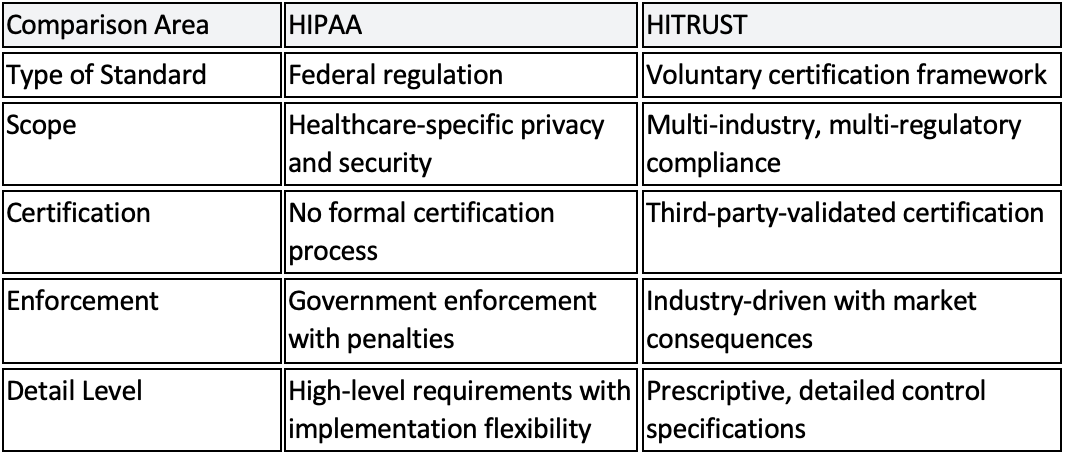
HITRUST provides a structured framework that supports HIPAA compliance by translating its broad guidelines into specific, measurable security controls. It helps healthcare organizations go beyond regulatory requirements with a unified approach to risk management and data protection.
The HITRUST CSF addresses security and privacy controls across multiple domains that organizations must implement to achieve certification, including:
The framework operates on a maturity model with five levels: policies, procedures, implementation, measurement, and managed practices. This structure allows organizations to demonstrate not just that controls exist, but that they’re effectively implemented and continuously improved.
Healthcare organizations face mounting pressures that make HITRUST certification increasingly valuable for strategic operations and risk management.
Ransomware attacks on healthcare organizations increased 278% from January 2018 through September 2023, according to the Department of Health and Human Services Office for Civil Rights. A 2023 report by IBM, which analyzed data breaches occurring between March 2022 and March 2023, stated that breaches in healthcare were the most expensive, with an average cost per incident of $10.93 million—a 53.3% increase over the previous three years.
Phishing campaigns specifically target healthcare workers, exploiting their access to valuable patient data. Meanwhile, insider threats—whether malicious or accidental—continue to represent a significant risk.
By implementing threat-adaptive assessments that evolve with the changing risk landscape, HITRUST takes a proactive approach to cyber defense. Organizations with a HITRUST certification had a 99.41% breach-free rate in 2024, according to HITRUST.
Healthcare organizations must navigate requirements from HIPAA, NIST, state privacy laws, Centers for Medicare & Medicaid Services (CMS) conditions of participation, and, increasingly, international standards for global operations. Each of these frameworks has unique requirements, creating a complex compliance scenario that strains organizations’ resources and increases the risk of gaps.
HITRUST streamlines this challenge by mapping controls to dozens of sources, making it possible to demonstrate compliance with multiple frameworks through just one assessment. This approach reduces redundant efforts while ensuring necessary compliance.
Large health systems, payers, and technology partners increasingly expect HITRUST certification from vendors and affiliates. This trend reflects the shared responsibility model in healthcare, in which data breaches at third-party vendors can impact the primary organization's reputation and regulatory standing.
HITRUST certification helps organizations demonstrate alignment with these requirements efficiently, reducing the time and resources needed to complete vendor questionnaires and security assessments for multiple partners.
Data breaches in healthcare receive significant media attention and regulatory scrutiny, often resulting in long-term damage to an organization’s reputation. Patients, providers, and partners often view security incidents as indicators of overall operational quality and trustworthiness.
HITRUST certification provides a credible, third-party-validated demonstration of an organization’s commitment to data protection. This certification differentiates organizations in competitive situations and builds confidence among stakeholders who rely on the organization’s security practices.
Achieving HITRUST certification typically takes six to 12 months, depending on the organization’s operations and structure, and the desired certification level. Healthcare leaders should approach this as a strategic initiative that requires executive support and cross-functional collaboration.
The first step is for organizations to define the scope of their assessment and conduct a readiness evaluation to identify current gaps. This phase involves mapping existing controls to HITRUST requirements and determining which certification level (e1, i1, or r2) aligns with the organization’s risk profile and stakeholder expectations.
The gap analysis reveals specific areas where current controls fail to meet HITRUST standards. The next step is to develop remediation plans to address these gaps, often requiring updates to policies, procedures, technical controls, and training programs.
At this point, organizations implement the required controls and gather evidence demonstrating their effectiveness. This phase requires coordination across IT, compliance, risk management, and operational teams to ensure the controls function as designed and to produce appropriate documentation.
A HITRUST-authorized external assessor conducts the formal assessment, reviewing evidence and testing control effectiveness. This independent validation ensures consistency and credibility in the certification process.
Upon successful completion of the previous steps, organizations receive a HITRUST certification that is valid for one year (i1) or two years (r2). Maintaining the certification requires ongoing monitoring, annual reviews, and demonstration of continued control effectiveness.
Organizations must complete interim assessments and full recertification to maintain their status. This process ensures controls remain effective, even as threats and regulations evolve.
HITRUST certification goes beyond technical controls, encompassing workforce readiness and ongoing education requirements.
HITRUST requires documented security awareness training for all personnel who have access to sensitive information. This training must cover current threat landscapes, organizational policies, and incident response procedures. Organizations are required to track completion rates, assess understanding, and provide regular updates as threats evolve.
Different roles within healthcare organizations require distinct training and competency validation. For example, clinical staff need training on privacy practices and secure communication, while IT personnel require technical security training and incident response procedures. Administrative staff need training on social engineering recognition and data handling practices.
To achieve and maintain HITRUST certification, organizations must document role-specific competency requirements and keep records of both staff qualifications and ongoing education.
HITRUST certification depends on real, measurable engagement rather than static policy documents. Organizations must demonstrate that their staff keeps current on security awareness and can effectively respond to evolving threats and changing procedures.
By integrating security training with existing professional development programs, healthcare organizations can ensure their staff maintains security awareness while clinicians maintain both clinical competencies and security awareness.
HealthStream provides comprehensive solutions that support HITRUST readiness through integrated education, credentialing, and compliance management capabilities.
Security awareness and compliance training modules help organizations meet HITRUST requirements for documented staff education. These modules cover current threat landscapes, regulatory requirements, and organizational policies with tracking capabilities that demonstrate ongoing compliance.
Role-based learning paths and assessments enable organizations to customize training based on specific job functions and access levels. Healthcare organizations can ensure clinical, administrative, and technical staff receive appropriate education while maintaining documentation required for HITRUST certification.
Credentialing and performance tracking capabilities support the competency documentation requirements inherent in HITRUST frameworks. Organizations can link security training completion to credentialing processes, ensuring staff maintain both professional qualifications and security awareness.
Policy management tools help organizations maintain the documented policies and procedures required for HITRUST compliance while making sure staff have access to current information and acknowledge policy updates.
These integrated capabilities reduce the administrative burden of HITRUST compliance while enabling organizations to demonstrate the workforce readiness that certification requires.
HITRUST represents more than a compliance checkbox. It’s an enterprise-grade framework that helps future-proof healthcare organizations against evolving risks, regulatory complexity, and digital transformation challenges. The certification process creates systematic approaches to risk management that strengthen operational resilience while giving organizations the opportunity to demonstrate their commitment to data protection.
Healthcare leaders can begin by assessing their organization’s compliance gaps and engaging with internal stakeholders to build support for the certification process. These conversations should include IT leadership, compliance teams, risk management, and clinical operations to ensure readiness throughout the organization.
HealthStream’s education and credentialing solutions provide the workforce development foundation HITRUST certification requires. By integrating security awareness training with their professional development programs, organizations can build a culture of security preparedness that supports not only certification requirements but also operational excellence.
The investment in HITRUST certification pays dividends through reduced cybersecurity insurance costs, streamlined vendor relationships, enhanced competitive positioning, and, most importantly, the confidence that comes from implementing proven security practices in an increasingly complex threat environment.

Learn why quality management is vital for skilled nursing facilities to improve resident outcomes, ensure safety and raise overall care quality.
Delivering the best care to patients is a top priority for all healthcare facilities. For skilled nursing facilities (SNFs), providing safe and effective care is particularly essential. SNFs have a vulnerable population of residents who are often medically complex with multiple comorbidities and impaired functional abilities.
That’s why quality management matters. It’s the secret sauce that helps SNFs deliver safer care, better results, and more meaningful experiences for every resident.
At its core, quality management in healthcare is a structured framework for measuring, assessing, and improving care. For SNFs, this means creating a systematic process to ensure every resident receives the highest standard of service. It moves beyond simply meeting minimum requirements—it fosters a culture of continuous improvement in all aspects of your operations.
This involves several key activities:
Think of healthcare quality management as a continuous cycle. For example, if you notice a rise in resident falls, a quality management approach would involve investigating the root causes—perhaps related to staffing levels, environmental hazards, or medication side effects. Based on these findings, you would implement targeted interventions, such as enhanced staff training or room modifications, and then monitor fall rates to measure the success of your changes. This ongoing process defines a commitment to excellence.
A robust quality program is essential for protecting residents and improving their health outcomes. When quality management is prioritized, it creates an environment where resident safety in SNFs is not an afterthought but an essential part of the care delivery process. The benefits are clear and directly impact both residents and the facility itself.
Effective quality programs in nursing homes lead to:
Ultimately, healthcare quality management is the engine that drives better results. It provides the structure needed to turn goals for resident safety into measurable, real-world improvements.
SNFs operate within a complex regulatory landscape. These standards are not just rules to follow—they are foundational to ensuring a consistent level of care and safety for all residents. Adhering to these requirements is a critical component of any SNF quality management program.
Key regulatory bodies and standards include:
Understanding these healthcare quality reporting requirements is the first step. A successful quality program integrates these standards into daily operations, ensuring that compliance is a natural outcome of providing excellent care, not just a separate task.
True quality extends beyond clinical metrics to honor the individual needs and preferences of each resident. Person-centered care in skilled nursing is a philosophy that places the resident at the heart of every decision. Integrating this approach with compliance creates a powerful framework for exceptional care.
Consider these best practices for quality management in healthcare:
By combining a person-centered approach with rigorous compliance, SNFs can create a safe, respectful, and high-quality living environment for every resident.
The landscape of quality management in SNFs is evolving, driven by the shift toward value-based care and the availability of new technologies. Value-based care models reward healthcare providers for the quality of care they provide, not the quantity of services. This aligns financial incentives directly with positive resident outcomes.
The future of healthcare quality management will be shaped by:
For SNF leaders, preparing for this future means investing in technology and fostering a data-driven culture. By embracing these changes, you can position your facility to thrive in a healthcare system that increasingly prioritizes and rewards quality.
Learn more about how HealthStream can help your organization with quality management.

Explore the risks of DIY healthcare compliance training and get practical tips to build a sustainable, effective program that protects data security.
Healthcare compliance training demands precision and agility. Regulations shift quickly. Industry standards evolve. What felt current just months ago can suddenly become outdated. And never forget the near constant pressure to “do more with less.”
In this environment, it makes sense that many healthcare leaders roll up their sleeves and build training programs themselves. A DIY approach can be resourceful, cost-effective, and tailored to the unique needs of your staff. But creating and maintaining a healthcare compliance training program is more complex than it may seem. Over time, a DIY approach can unintentionally create gaps in education, increase compliance risk, and consume valuable time that could be devoted to higher-impact initiatives.
In this post, we’ll examine the most common pitfalls of healthcare compliance training and share practical tips for building a program that’s both sustainable and effective.
When leaders choose to develop compliance training entirely in-house, the intention is usually admirable: to build a custom, efficient plan that aligns with the organization’s values while also conserving resources. But DIY training can fall short strategically in ways that aren’t always apparent at first.
Here are four common challenges that can undermine even the most well-intentioned efforts:
Even the most well-intentioned DIY compliance training programs can face significant operational challenges. These issues can affect the efficiency, reach, and long-term sustainability of your training efforts. Here are some of the most common operational pitfalls:
Beyond strategic and operational challenges, DIY healthcare compliance training programs can create significant legal and oversight risks.
Ensuring that your training can withstand scrutiny is critical. Here are three common pitfalls:
Regulators and auditors increasingly expect organizations to demonstrate that their compliance training is not only completed but also effective. DIY programs often lack formal metrics or reporting systems to prove that employees understand and can apply the training. Without clear evidence, organizations may struggle to demonstrate compliance during audits or investigations.
A DIY approach can lead to uneven application of policies and training requirements across departments or roles. If some employees complete training and others do not, enforcement becomes inconsistent. Inconsistent enforcement can weaken the credibility of the compliance program and potentially expose the organization to regulatory scrutiny.
Even minor errors or omissions in training content could carry significant legal risk. A single inaccurate policy explanation or overlooked regulatory update can lead to noncompliance fines and reputational damage. When leaders create all content internally, the burden of accuracy rests solely on their shoulders, increasing potential liability.
These pitfalls of DIY compliance training underscore the complexity of the work.
A more effective approach is to leverage expertly developed training content for the foundational compliance training that every healthcare organization needs. With the basics covered, compliance leaders can dedicate their time and energy to creating content that is tailored to their organization’s initiatives—training that addresses specific policies, unique risks, or organizational culture. This approach not only reduces workload but also enhances engagement, accelerates competency, ensures consistency, and makes it easier to track and report completion.
By combining content from a trusted authority like HealthStream with organization-specific training, you can create a healthcare compliance training program that is both efficient and meaningful. It’s a path that balances compliance, engagement, and practicality—freeing up compliance leaders to do what they do best: shape a culture of compliance that protects both staff and patients.
Learn more about HealthStream’s Compliance Solutions.

Learn how negligent credentialing increases risk for hospitals and how rigorous verification protects patients and your organization.
A hospital's core responsibility is to provide safe and competent care.
This duty extends beyond the operating room and the patient’s bedside; it begins with the rigorous process of verifying the qualifications of every healthcare provider providing patient care. When this process fails, the consequences can be devastating for patients and the organization alike. This failure is known as negligent credentialing.
Negligent credentialing occurs when a healthcare organization fails to properly investigate a provider's background, qualifications, and competence before hiring them or granting privileges. It's a breach of the hospital's legal duty to ensure its staff is qualified to provide patient care. If an unqualified or incompetent provider harms a patient, the hospital can be held directly liable for that harm, separate from any medical malpractice claim against the provider.
Understanding the risks associated with negligent credentialing is the first step toward protecting your patients, your reputation, and your organization's financial health. This guide will explain what constitutes negligent credentialing, its severe consequences, and the steps hospitals can take to prevent it.
The legal foundation of negligent credentialing rests on the principle of corporate negligence. Courts recognize that hospitals have an independent duty to patients to ensure the competency of their medical staff. This means the hospital itself, as a corporate entity, can be held liable for its own carelessness in the credentialing and privileging process.
A hospital commits negligent credentialing when it fails to conduct a "diligent inquiry" into a practitioner's background. This duty applies during both the initial provider onboarding and credentialing process and at the time of reappointment or renewal.
A successful negligent credentialing lawsuit typically requires a patient to prove four key elements:
This failure can manifest in several ways, such as overlooking a history of malpractice claims, not verifying residency or fellowship training, or ignoring red flags from peer reviews.
The credentialing process isn't a one-time event. The risk of negligence continues with re-credentialing, privileges renewal, ongoing peer review, and monitoring practices.
Manually tracking expiration dates for licenses, certifications, and other qualifications is a significant challenge. Delays in this process can create compliance gaps, leaving the hospital exposed. Furthermore, the reliance on manual processes often leads to redundant credential documentation and administrative inefficiency, which increases the likelihood of errors and oversights.
Effective credentialing renewal best practices require a system that proactively manages these deadlines and ensures continuous compliance.
When a hospital fails in its credentialing duties, the fallout extends far beyond a single patient's harm. The consequences can threaten the organization's operational and financial stability.
Preventing negligent credentialing requires a proactive and systematic approach. Hospitals must build a robust framework that prioritizes compliance, thoroughness, and continuous oversight.
Compliance is non-negotiable. Hospitals must strictly adhere to all federal and state regulations, as well as the standards set by accrediting bodies they are accredited by. This includes fulfilling all regulatory compliance, credentialing requirements, and staying informed about changes, such as those related to credentialing standards in interstate licensure compacts. A deep understanding of these rules forms the bedrock of a defensible credentialing program.
One of the most significant hurdles in this area involves primary source verification challenges, which can be time-consuming and complex to manage manually.
Given the complexity and high stakes, many organizations turn to expert help. Partnering with a provider credentialing company or using a credentialing verification organization (CVO) can offload the administrative burden and reduce risk.
Furthermore, automation in provider credentialing software is a powerful tool for preventing errors. Automated systems can streamline workflows, send alerts for expiring credentials, provide ongoing monitoring for sanctions, hardwiring your peer review process (Ongoing Professional Practice Evaluation [OPPE], Focused Professional Practice Evaluation [FPPE]), and ensure no step in the verification process is missed. This technology is essential for implementing continuous monitoring of provider credentials, which moves compliance from a periodic check to an ongoing state of readiness.
Negligent credentialing represents one of the greatest liabilities a hospital can face. The financial, legal, and reputational consequences of a single failure can be immense. While the responsibility to vet providers is significant, it is not insurmountable.
By establishing rigorous verification protocols, adhering to all regulatory standards, and using modern tools, hospitals can protect themselves and their patients.
Credentialing automation can help your organization manage the complexities of compliance and mitigate the risk of malpractice due to credentialing errors. Investing in these systems and processes is an investment in patient safety and the long-term health of your organization.
Want to learn more? Watch our webinar, “The Hidden Dangers of Negligent Credentialing: Is Your Organization Next?”. We dive into some real-world examples of negligent credentialing and discuss how to implement credentialing safeguards that will protect your organization.





