Explore expert insights from HealthStream on healthcare compliance, credentialing, clinical education, scheduling, and leadership. Find practical guidance to help healthcare organizations train, retain, and support their workforce.
Practical insights on healthcare compliance, workforce development, and clinical education from the experts at HealthStream.

Care transitions can lead to unnecessary readmissions. Explore key questions and possible solutions to transition of care issues and problems.
This blog post excerpts an article by Randy Carden, Ed.D; Senior Research Consultant,
HealthStream, in the Q3 2015 issue of PX Advisor, our quarterly magazine designed to bring you thought leadership and best practices for improving the patient experience.
Why Are There Issues with Transitions of Care? Where Are We Vulnerable?
What makes care transition points so difficult? Why are the "hand-offs" prone to issues? Several points of vulnerability are listed below.
Challenges with the Elderly
The elderly experience more difficult transitions than younger patients due to multiple health issues, possible cognitive slippage, dependency, and multiple medications. It is estimated that almost two-thirds of readmissions from nursing homes could be avoided.
Brief Medical Encounters
Our current model tends to be typified by brief medical encounters where we focus on treating disease states rather than the person.
Education
Patient education and specifically poor health and healthcare literacy are related to transition issues and increased probability of readmission.
Failures in Follow-Up, Support and Coordination of Care
Patients often have issues with remembering post-discharge instructions and following discharge plans. This can have profound implications, because most of the time the patient bears much of the responsibility for his or her care.
Medication Errors
Medication errors were found to be present in about half of all discharged patients. These errors were more common in patients with poor health literacy and lower numeracy or the ability to use and understand numbers.
Fragmentation of Care
Historically, hospitals and post-acute providers have not been well-connected. There has been a failure to account for challenges that may occur once patients are sent back into the community.
Social Challenges
Lack of social support can be a major problem. Basic things like transportation, food preparation, following dietary restrictions, and taking medications properly often prove to be overwhelming.
Possible Solutions to Transition of Care Issues and Problems
What is to be done to help remedy the situation? The following culture change ideas have been suggested as ways to improve the transition from hospital to other providers or the community.
Enhanced Communication
One of the most effective interventions would be more effective communication. A recent study by Record et al. (2015) supports the proposal for improved communication. They found that a post-discharge physician-initiated telephone call was related to higher scores on the 3-item Care Transitions Measure (CTM- 3), which assesses patient perception related to readiness for the transition from hospital to home. Higher scores predict reduced likelihood of a visit to the emergency department within 30 days of discharge.
Patient as Consumer
A recommended culture change is the change in orientation from patient to consumer. Recent positions by the Joint Commission and CMS may help reinforce this change in our thinking. The Joint Commission is advocating for better collaboration and coordination around transitions to reduce readmissions. Furthermore, the relatively recent advent of the CAHPS surveys is playing an important role in establishing the patient as consumer. CAHPS surveys allow patients as consumers to evaluate care based on standardized items that are comparable nationally. These new initiatives associate reimbursement with outcomes and are receiving profound attention.
The best chart is rarely the newest or most colorful. Learn how to select the right chart for your healthcare data, in a guest blog from Juice Analytics.
This is the third in a series of guest blogs from Juice Analytics.
The best chart is usually not the newest, most elaborate, or most colorful. In fact, it's often the opposite. You don't order a medical test for a patient just because you can--don't just use the sexiest chart available either. So, how do you determine which chart is right for your audience?
Here's are a few steps to use when creating charts or displaying information.
Think People First
First rule or step. It's not about you or your capabilities. Its about getting your audience to value what you're trying to communicate. Consider these questions as they can impact things like the type or sophistication of your chart
As it relates to how questions relate to chart selection see the graphic below. In many ways the question we're answering for our audience informs how we should display the information. Note specifically in the lower question how "time" and "trend" suggests that this will be a chart specifically related to trends like a line graph.
Selecting Chart Types
With questions and audience knowledge under your belt, you can start to consider what charts make the most sense. Here are the major chart types as illustrated by the folks at Extreme Presentation and their Chart Chooser Tool. With a chart category in mind, such as comparison or relationship, you can start to define how basic or rich it can be. If it's a paper based report or presentation for first time readers, a pretty basic selection is probably in order. However, if its to be displayed on an iPad, by folks familiar with the data you have more latitude to incorporate interactivity or sophistication.
Formatting
Once the chart type is selected you need to format it. In many ways the colors selected, text written, labeling and font used should reinforce what is being communicated by the chart and visa vera. The chart and its formatting should co-exist well.
Here are some resources to help with how your text should be displayed as well as how to apply color purposefully.
How to apply fonts -Simple Font Framework
How to use color - Color has Meaning
Simplicity
"Perfection is achieved, not when there's nothing more to add, but when there is nothing left to take away." -- Antoine de Saint-Exupéry
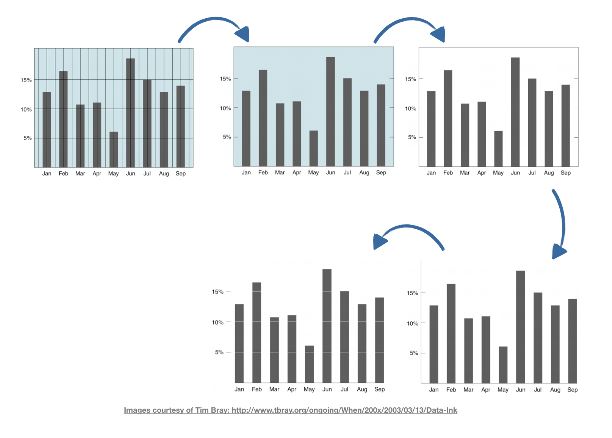
It's a good habit to make your last step all about simplifying your chart display. It used to be the case that Excel included all this extra formatting that needed to be removed. This isn't the case any longer, but check out the Data to Ink principle below in practice. If it doesn't add anything for the user than remove it. Less is always more, especially decision makers.
Feedback
Applying these steps to your chart selection and information sharing will take you a long way. For the first couple of times think about getting feedback from your peers or audience themselves to see if they walk away with the intended interpretation.
Once you beyond these initial steps consider an Edward Tufte class, some data visualization books, like Data Fluency or others to continue to advance your skills. Happy charting!
About Juice
Juice is an expert in designing and building web applications that connect people with data. We work with clients across industries including healthcare, digital advertising, and other data-rich businesses. Founded in 2004, Juice has offices in Nashville, Atlanta, and Washington, D.C.
Our people, our platform and our passion are all dedicated to building data products that people love to use. To us, this means finding better ways of capturing the excitement of finding an insight and sharing it with a colleague. This means telling a story using data that unfolds as your understanding grows. This means delivering data products that make your customers say, "Wow!"
HealthStream—which made a minority equity investment in Juice last year—was instrumental in a Juice headquarters relocation to Nashville one year ago, with both companies recognizing the potential of Juice and its products to support HealthStream's network, including Nashville's data-rich healthcare industry.

See standards of performance examples for healthcare on safety awareness and sense of ownership, from HealthStream Coaching's best practices.
This blog post continues our series of HealthStream Coaching's patient experience best practices. Every week we share information from our coaches that demonstrates their expansive understanding of the challenges faced by healthcare organizations and the solutions they have identified for improving the patient experience and patient and business outcomes.
Standards of Performance can be used in numerous ways to help select applicants who are well suited to the healthcare organization's culture. As we look at best practices for using healthcare standards of performance, we will share some specific examples. This week we examine standards for safety awareness and sense of ownership.
Report all accidents or incidents promptly.
Correct or report any safety hazard you see.
Use protective clothing, gear and procedures when appropriate.
Safety is an integral part of the healthcare environment, incorporated into virtually everything we do. We are educated about its necessity, instructed on how to maintain safety, responsible for it and monitored by government agencies to ensure we are in compliance. Our organization must be 100 percent committed to providing a safe workplace for all employees, customers and visitors.
Our customers take safety for granted, as they should. After all, they have entrusted not only their health but also their wellbeing to us. Practicing safety means that we will always be watchful for potentially hazardous situations wherein the customer's welfare might be compromised. In addition, we have to report all accidents and incidents promptly.
Accidents usually happen as a result of actions and attitudes that can be eliminated. First, we never take unnecessary chances. We are familiar with and observe policies and procedures relating to safety issues, both hospital-wide and in our department. We practice safety as a courtesy to co-workers, our patients and all other customers.
Our personal safety is another aspect to consider. As clinicians, we protect our back when lifting, pushing, pulling or carrying, and we never fail to ask for help when necessary. We stay aware of potential chemical hazards. Machinery is inspected to ensure it is in good working order, and we use it in the proper manner. Lastly, we stay prepared for emergencies by knowing the correct and prompt actions to take.
Take pride in this organization as if you own it. Accept the responsibilities of your job.
Adhere to policies and procedures. Live the values of this organization. Do the right thing.
In a high performing culture, every employee acts like an owner. What does this involve? First, we take pride in our organization because we have a stake in its future. Second, as owners we are also proud of the meaningful work we do because it is a direct reflection of the organization. It matters not what job we have because each and every person is capable of impacting the care we deliver through service excellence - everyone makes a difference by acting as an owner.
When we take ownership of our job, we commit to high performance in providing service and compassionate care; we have a vested interest in whether or not patients are satisfied and loyal. The vision and future of the organization become our own. We embrace the empowerment that allows us to make decisions and undertake the activity necessary to accomplish important goals.
Ownership also involves practicing teamwork for the good of all, and looking beyond assigned tasks in support of colleagues. We keep our work area and surrounding environment clean and safe. Doing the job right the first time is part of being an owner. Plus we never say, "It's not my job." If we personally are unable to meet a request, we have ownership of finding someone who can.
We provide care in a timely manner, meeting customers' needs as soon as possible. Attention to details helps us exceed expectations. Finally, we always conduct ourselves as professionals and owners of our work environment.

See standards of performance examples for healthcare on elevator etiquette and privacy, from HealthStream Coaching's patient experience best practices.
This blog post continues our series of HealthStream Coaching's patient experience best practices. Every week we share information from our coaches that demonstrates their expansive understanding of the challenges faced by healthcare organizations and the solutions they have identified for improving the patient experience and patient and business outcomes.
Standards of Performance can be used in numerous ways to help select applicants who are well suited to the healthcare organization's culture. As we look at best practices for using healthcare standards of performance, we will share some specific examples. This week we examine standards for elevator etiquette and privacy.
If you are at a facility that has an elevator, be sure to follow proper elevator etiquette. Always smile and speak with fellow passengers. Hold the door open for others.
When transporting patients in wheelchairs using an elevator, always face them toward the door of the elevator and exit with care. If transporting a patient in an elevator who is in a bed or on a stretcher, politely ask others to wait for another elevator. Pause before entering an elevator so you do not block anyone's exit. Step aside or to the back to make room for others.
Walk departing guests to the elevator.
Since elevators are often the primary means of transportation between floors in a healthcare organization, we are most likely to initially encounter our customers in this setting. It follows that observing the rules of elevator etiquette is a wonderful opportunity to create a favorable first impression.
As an elevator door opens, we should pause briefly before attempting to board so that we don't obstruct the way for people who are departing. Once inside, make room for others who are waiting to board and hold the door or press the "door open" button for them. We are expected to greet fellow elevator passengers in a friendly manner by making eye contact, smiling sincerely, and introducing ourselves. Experts tell us that communication is vastly influenced by our tone of voice. Remember that customers can easily pick up on friendliness - or not - in the voice that greets them.
We shouldn't monopolize space in the middle of the elevator so that we can exit quickly upon stopping; this behavior creates an impression of inconsideration on our part, and of a "me first" mentality. Allow patients and those with disabilities space by the elevator door.
Lastly, it is always, our responsibility to walk a customer to the elevator upon being asked for directions to it. As we accompany that person, we introduce ourselves with a sincere smile and ask if there is anything else that we can do for that customer, as a demonstration that "we have the time."
One last rule of high performance elevator etiquette: safeguard customer confidentiality. We never discuss patients, their care, or diagnostic treatment information on elevators. In order to preserve the integrity of our healthcare organization, we also refrain from gossip in this setting about customer's families, physicians, our leaders or coworkers. In addition, we should refrain from talking about sensitive hospital business or confidential data such as employee performance problems.
Make sure that patient information is kept confidential. Never discuss patients and their care in public areas.
Knock before entering. Close curtains or doors during exams and procedures. Provide a robe or second gown if the patient is ambulating or in a wheelchair. Make sure all gowns are the right size for the patient.
Providing privacy in the healthcare environment is critical to high performance. First, we are mandated by law through HIPAA to protect the privacy of our customers' health information and records. Second, patient satisfaction surveys identify how well we demonstrate our concern for privacy, allowing us to make the necessary changes to fulfill expectations. Ours must be an environment of "no excuses" because we have the information we need to be accountable to patients. Finally, the HCAHPS initiative will tell potential customers whether or not they can expect their privacy to be respected if they choose our facility, thus directly influencing their decision.Patients have the right to modesty and privacy in personal care. We must always ensure that people receive treatment in a dignified way that does not embarrass, humiliate or physically expose them. By definition, modesty is about respecting our patients. The use of Words that Work helps the patient understand that their privacy is being respected.
Examples of Words that Work
I will shut the door while I take your health history so it can be kept private.
Here is an extra gown for you to ensure that you are properly covered while walking in the halls - I am concerned about your privacy.
I am pulling the curtain to ensure you have privacy during _____________.
Would you like the door/curtain closed so you can have more privacy?
I am putting this blanket over you while I take you to _________ so you will have more privacy.
Finally, our customers recognize and remember the behaviors that show consideration for their privacy. These actions foster trust because they inherently promote the patient's peace of mind and lessen anxiety about being in a place where dignity can be easily compromised. Trust helps bring down the stress level because the customer feels respected. Finally, showing that we have a high regard for our patients' privacy allows us to connect personally with them, thereby making a substantial difference in their healthcare experiences.

Get specific healthcare standards of performance examples for attitude and appearance from HealthStream Coaching's patient experience best practices series.
This blog post continues our series of HealthStream Coaching's patient experience best practices. Every week we share information from our coaches that demonstrates their expansive understanding of the challenges faced by healthcare organizations and the solutions they have identified for improving the patient experience and patient and business outcomes.
Standards of Performance can be used in numerous ways to help select applicants who are well suited to the healthcare organization's culture. As we look at best practices for using healthcare standards of performance, we will share some specific examples. This week we examine standards for attitude and appearance.
Attitude:
Attitude takes into account three things: our body language, our friendliness and our willingness to connect with our customers.
The body language that goes along with the words that we are speaking greatly influences how we are understood. In fact, experts tell us that how we speak is just as important as what we are saying! Our customers are our reason for being in the healthcare environment; our attitude should always be one of concern, respect and genuine caring.
As a customer yourself, do you remember those places of business where the staff was friendly and went out of its way to acknowledge you? Of course you do, since this was an environment where you felt welcomed. We exhibit friendliness by smiling warmly, introducing ourselves immediately, and never, ever ignoring someone. All our customers are equally deserving of attention.
Finally, we show the right attitude by meeting the needs of our customers or finding someone who can. We go out of our way to be helpful; for example, we don't point the way-we accompany the customer to where they need to go. In addition, we always thank them for choosing us to provide their healthcare experience.
An attitude of service excellence is further exhibited by showing interest when a customer speaks to us. Each one, without exception, should be treated as if he or she is the most important person in our facility; and rudeness is never acceptable. We are attentive to the customer's immediate need, or gladly take the individual to someone better equipped to provide the service. We always apologize for problems and inconveniences, and enthusiastically carry out service recovery.
Lastly, we recognize that our customers have a sense of urgency and show them that we value their time. Customers are not an interruption of our work; they are our focal point, and caring for them with an attitude that shows we value them should be our daily goal.
Appearance:
How long does it take to make a first impression on a customer? Just seven seconds, according to popular research. How our customers perceive us in that brief time is very important because it sets the stage for their entire healthcare experience. A first impression is sometimes referred to a "moment of truth" because customers believe that what they are hearing, seeing or feeling is reality - that is, the truth of the situation. No matter that their first impression is merely a snapshot of less than one moment in time. It is perceived as genuine: who we are, the quality of service that we deliver, or our physical environment of care. Needless to say, making that first impression a good one is crucial.
Moments of truth are directly impacted by the appearance of staff as well as that of the workplace, both of which are a direct representation of our organization. When we dress appropriately for the job and wear our name badges so that they are easily readable, we project professionalism to our customers. We not only create a good first impression, but we also reinforce our culture of quality through attention to personal appearance. The same principle applies to our healthcare setting. When we take pains to keep our workspace uncluttered and to pick up trash in hallways and public areas, we are sending a positive message to those who enter the doors of our facility for the first time. We should always take pride in how we present ourselves and in the facility itself. Doing so conveys respect for customers and their expectations.

See healthcare standards of performance examples on commitment to coworkers and customer waiting, from HealthStream Coaching's best practices.
This blog post continues our series of HealthStream Coaching's patient experience best practices. Every week we share information from our coaches that demonstrates their expansive understanding of the challenges faced by healthcare organizations and the solutions they have identified for improving the patient experience and patient and business outcomes.
Standards of Performance can be used in numerous ways to help select applicants who are well suited to the healthcare organization's culture. As we look at best practices for using healthcare standards of performance, we will share some specific examples. This week we examine standards for Commitment to Coworkers and Customer Waiting.
Treat one another as professionals deserving courtesy, honesty and respect. Welcome newcomers.
Avoid last-minute requests and offer to help fellow employees whenever possible.
Cooperate with one another. Don't undermine other people's work; praise whenever possible.
Do not chastise or embarrass fellow employees in the presence of others.
Address problems by going to the appropriate supervisor.
The word commit is defined as "to pledge or engage oneself and to entrust". So in terms of this definition, commitment to coworkers entails pledging our support, demonstrating our engagement in their welfare, and trusting that they will do likewise.
First, pledging support implies that we will be team players and treat coworkers as professionals. What do good team players do? Well, they demonstrate support by offering to help others when it is needed and when it is possible. They show respect for others' time by promptness in arriving at work and meetings, by striving not to be unexpectedly absent, and by taking reasonable breaks. They cooperate with one another by communicating and offering constructive feedback. Lastly, team members treat problems as opportunities for solutions, using the power of the team to arrive at a solution and perform for the good of all.
Treating coworkers as professionals means that we will praise when it is due, and not say or do anything to intentionally offend fellow employees. We speak to and treat one another with respect, realizing that occasionally conflict will occur but professional courtesy is due at all times.
Educate families about processes and provide a comfortable atmosphere for waiting customers.
An acceptable waiting time for scheduled appointments is 10 minutes; it's one hour for non-scheduled appointments.
Offer refreshments and an apology if a wait occurs. Always thank customers for waiting.
Update family members periodically - at least hourly - while a customer is undergoing a procedure.
Many studies have been done about how we perceive time when we wait, referred to as the psychology of waiting. Here are a few interesting facts:

Physicians deserve recognition like all staff. Learn multiple ways to reward and recognize doctors and boost physician engagement in healthcare.
Doctors, just like all of your staff, deserve and want to be recognized and rewarded for their contributions to the organization. The Leadership Group recommends developing multiple ways to recognize physicians. The following are some suggestions:
In Conclusion--Why Focus on Rewards and Recognition
Reward and recognition is but one part of the larger framework of employee satisfaction, but it is a vital factor in the process. Motivation, personal enrichment and self-esteem, commitment and loyalty are all by-products of employee recognition. Plus, it becomes a powerful recruiting tool for those who see satisfied employees practicing ownership and being celebrated for their efforts.
Effective recognition programs require planning and careful thought on the part of leaders who are responsible for nurturing the process. HealthStream recommends that you construct a variety of formal and informal initiatives for leaders to implement, in addition to their own personalized department-specific programs.
Through celebrating your employees, you will find that your organization enjoys a happier, more joyful work environment. Demonstrating the value placed on staff can result in lower turnover rates, improved productivity, higher patient satisfaction, and other superior performance measurements.
Reward and Recognition Training
We teach key skills, approaches, techniques, and best practices to help leaders effectively reward and recognize high performers. Elements of this training include how to harvest reward and recognition opportunities, thank you notes as a key engagement tool, formal recognition programs that support a patient focused culture, and informal methods that create a custom, individualized approach to thanking team members in your employee family.

Considering Magnet recognition? Learn seven essential steps to take before starting a Magnet journey, from an article by Creative Healthcare Management.
This blog post is an excerpt from an article by Gen Guanci, MEd, RN-BC, CCRN, Creative Healthcare Management, in the current issue of PX Alert, HealthStream's quarterly e-newsletter devoted to the wide range of challenges, situations, and issues that have an impact on the patient experience.
There's no doubt about it: the pursuit of Magnet® designation has a lot more in common with a marathon than it does with a sprint. Here are some tips for preparing for a Magnet journey.
1: Conduct a Readiness Assessment
Some people refer to this as a gap assessment. Regardless of what you call it, it's vital that you fully understand the point from where you're starting, where you need to go and where your current challenges are. The wise organization has this assessment completed by an external, non-biased individual. If you do this, be sure the individual has many years of experience in a wide variety of organizations that have been successful in attaining Magnet® designation. When looking for an external consultant, your first question should be, "What's your track record for helping organizations attain Magnet®?
2: Create your Budget
Your overall Magnet® journey budget will have elements that are dependent upon your readiness results. In addition, it will be a multi-year budget. Items you want to be sure to include are as follows:
Other budget considerations include printing or electronic document set-up costs, marketing costs (both before and after designation), celebration costs when you receive your designation, and costs to sustain your designation. If you don't know these numbers, check with an experienced Magnet® consultant. It's essential that your numbers are realistic.
3: Educate Yourself
When it comes to participating in a Magnet® journey, there is no such thing as too much education. I have seen four program revisions in the 15+ years I have been involved in Magnet®. This requires that I constantly refresh my knowledge. Education is available in a variety of methodologies. You can attend workshops and webinars, read the wide variety of articles available, or even join a learning community.
4: Educate Others
It's obvious to most people that an organization embarking on a Magnet® journey must educate its nurses; however, your educational initiatives should go well beyond this group. Be sure to include all of the organization's stakeholders, since the designation is for the entire organization. The best course of action is for the Magnet® program lead to see that all departments, leaders, executives, medical staff, and even the board of directors/trustees get educated about what it takes to achieve Magnet®. The wise program manager tailors the message to the audience and includes the "what's in it for me" message.
5: Network
Visiting other Magnet® organizations and networking with people who have been directly involved in a successful Magnet® journey are two extremely helpful things to do. If your organization is a community hospital, your biggest benefit would come from speaking to those from a similar community hospital as opposed to a large academic medical center. When you do your visit, whether in person or virtually, be sure to set up an opportunity for staff from your organization to speak to peers at the networking organizations. When staff members hear the Magnet® journey stories from peers, it really helps to unify the team around a common goal.
6: Create a Project Plan
Time flies while on the Magnet® journey. Deadlines that might seem a long way off have a way of rapidly sneaking up on you. The creation of a project plan or specific timeline is crucial. Be sure to include the following major milestones or journey phases:
Each of these phases has several components to them, so be very specific. The more detail you have, the higher the likelihood will be that you will not overlook something essential to your success.
7: Involve the Clinical/Direct Care Nurses
Successful Magnet® organizations involve staff at every opportunity. At site visit, staff will need to be able to speak to how they were involved in items, such as the development of the professional practice model, and how they are involved in decision-making. Whenever possible, always ask yourself, "Which clinical nurse should be involved in this?"
The full article also describes:

Preventable errors cost lives and dollars. Learn how continuing education (CE) helps improve patient outcomes amid the changes of the Affordable Care Act.
In the landmark report published in 1999 from the Institute of Medicine (IOM), To Err is Human: Building a Safer Healthcare System, it was noted that:
More recently in September 2013, the Journal of Patient Safety published an article estimating that over 400,000 patients die each year in the US due to preventable medical errors.
The 2010 Affordable Care Act has initiated broad and transformational change to our healthcare system, with reimbursements shifting from fee-for-service care to value-based care.
In response to the changes upon us, the Robert Wood Johnson Foundation (RWJF) and the Institute of Medicine (IOM) launched a two-year initiative to assess and provide thought leadership on transforming the nursing profession. The Future of Nursing: Leading Change, Advancing Health stated:
Transforming the health care system to provide safe, quality, patient-centered, accessible, and affordable care will require a comprehensive rethinking of the roles of many health care professionals, nurses chief among them. To realize this vision, nursing education must be fundamentally improved both before and after nurses receive their licenses.
The Future of Nursing: Leading Change, Advancing Health delivered 8 key recommendations:
We offer a variety of courses such as license renewal, human trafficking, and pharmacology, many of which arem provided by ANA, AWHONN, and the S.T.A.B.L.E Program. If that interests you, check out NurseGrid Learn.
As a clinical leader within your organization, how do you champion change? How do we support the need to ensure optimal patient outcomes, while minimizing overall costs across all departments?
Fostering a culture of lifelong learning and enabling staff to lead change, as well as engage in their own path to knowledge acquisition is a critical step towards the future of Nursing.
Sources:
1. James, John T. Journal of Patient Safety: A New, Evidence-based Estimate of Patient Harms Associated with Hospital Care. September 2013. Volume 9; Issue 3. p. 122-128.
2. Institute of Medicine (IOM). To Err Is Human: Building a Safer Health System. Washington: National Academy Press; 1999.
3. Institute of Medicine (IOM). The Future of Nursing: Leading Change, Advancing Health.
Washington: National Academies Press; 2011.
Do employees know your healthcare organization's vision and top objectives? Learn six goal-setting practices that align staff with your key goals.
Are your employees aware of your healthcare organization's vision and top objectives? If your organization is like most hospitals and healthcare organizations, employees do not have any insight into your key objectives. While there's a lot of talk in healthcare about the importance of setting and measuring goals, many hospital objectives don't make it past the C-suite for myriad reasons, including lack of clarity, relevance, and follow-through.
Our recent white paper, Making Goals Matter: The Power of Cascading Goals in Healthcare,by Dorothy Duncan, Product Manager, HealthStream, featured the following guidelines for setting organizational goals.
With so much change and uncertainty occurring in healthcare, having a strong goal system enables organizations and their employees to connect in meaningful ways. It motivates individuals to create and participate in a strong culture of performance. Cascading goal systems ensure that when a goal leaves the executive suite, it is tied to people and processes all the way down the line. It is in this setting that staff begin to understand the difference their work makes outside of their daily domains. Organizations that become skilled at administering results-focused goal systems also gain a clearer vision of their strengths and weaknesses.
In addition to this list, the white paper includes:

Which tool best improves patient experience in the emergency department? Learn how purposeful rounding helps ED leaders and staff.
Blog post by: Eric W. Heckerson EdD, RN, FACHE, Senior Manager of Learning and Content Development at HealthStream.
Leaders often ask which tool is most effective for improving the patient experience in the emergency department. If they were to select and implement just one item with the most impact for enhancing service in the ED, what would it be? The answer to that question is simple. By far, the most powerful tactic that high-performing leaders can employ to create a patient-centered service culture is rounding. While simple in its premise, the implications and effects of purposeful rounding are remarkably effective. Every leader, staff member, and physician in the ED can use rounding in their practice and should consider how the various types of rounding might work for them in their departments.
Rounding Defined
Rounding can take on many forms and functions in a hospital; to optimize its effects and ensure the activity is meaningful, rounding should be conducted with a clear purpose in mind. Purposeful rounding is connecting with another person (either staff or patient) with a specific reason or outcome in mind. Leaders can use rounding as the platform for communicating messages and eliciting feedback from others, depending on the type. Information gathered from rounding should be used to improve the department and its operation.
While having an insight into the definition of rounding is helpful, it is also important for leaders to understand what rounding isnot. Rounding is not "management by walking around" or a casual stroll through the department greeting folks as they pass. It is not simply asking, "How are you doing?" in the elevator, saying hello to a patient, or sitting down to have lunch with a direct report in the cafeteria. While such activities are appropriate and generally helpful, purposeful rounding on staff and rounding on patients are much more focused, intentional, and subsequently more effective in changing behavior and achieving desired outcomes.
Types of Rounding in the Emergency Department
Four types of rounding are particularly effective in the emergency department setting:
Regardless of the type of rounding, there are five steps leaders should follow and apply to the process. The first is to build a relationship (with staff or patient). The second is to set expectations with the person being rounded on, so he or she understands the goal and purpose of the process. The third step requires focusing the inquiry, which allows the leader to adapt questions to focus on a particular topic or purpose. The fourth step is to close the encounter by thanking the person and outlining what you intend to do with the information shared. Finally, the fifth (and arguably most important) step is to act on the information appropriately. These five actions can guide the interaction, but leaders should keep the process natural and relaxed. The hurried and hectic world of healthcare can tempt leaders into simply "checking the box" and going through the motions; resist that temptation and take the time to really get to know the other person. Also allow time for him/her to get to know you.

Hourly rounding promotes patient-centered communication between staff, patients and families. Learn how it improves patient experience and outcomes.
We are currently focusing on hourly rounding as a component of improving the patient experience. Hourly rounding is a structured means of promoting patient-centered communication in a healthcare setting between staff, patients, and their loved ones to ensure the best outcomes.
The Benefits of Hourly Rounding
When consistently and effectively applied, Hourly Rounding will:
Using Hourly Rounding for Results
Hourly Rounding should be considered critical to an organization's commitment to patient centered excellence. BLG recommends following a process of:
Five Key Actions to Remember for Hourly Rounding
We call these the Five P's. Many organizations use varying actions (e.g., 3 P's, ICARE). What we find to be most important is not the name or acronym, but ensuring these five comprehensive actions take place every hour.
1. Pain - Ask the patient if they are having any pain. If they were recently medicated, ask what their pain level is currently. Discuss pain goals and options with the patient and family. Notify RN if pain not improving. "We want you to be as comfortable as possible."
2. Potty - Ask the patient if they need any assistance going to the bathroom. "We will check on you every hour and address any needs that you may have." "Your safety is always our concern, we will be happy to assist you to the bathroom."
3. Positioning - Look at the patient. Pull them up in the bed if necessary. Turn their pillow over. Reposition them to enhance skin integrity. "We will constantly check your position to make sure that you are comfortable."
4. Personal Items - See if all personal items are within reach. "Do you have everything that you need?" "I want to make sure everything is within reach for you."
5. Privacy - "I'm going to pull your curtain (shut your door) for your privacy."
Contact HealthStream to speak to a solutions expert learn more about our courses related to the Benefits Of Hourly Rounding In Nursing.





