Explore expert insights from HealthStream on healthcare compliance, credentialing, clinical education, scheduling, and leadership. Find practical guidance to help healthcare organizations train, retain, and support their workforce.
Practical insights on healthcare compliance, workforce development, and clinical education from the experts at HealthStream.

Explore how the five QAPI domains can significantly improve care quality in skilled nursing facilities. Transform your approach to patient care now.
As healthcare leaders, your commitment to excellence in patient care is paramount. One of the keys to achieving this is through a robust Quality Assurance and Performance Improvement (QAPI) program. The five domains of QAPI—Design and Scope, Governance and Leadership, Feedback, Data Systems and Monitoring, Performance Improvement Projects, and Systematic Analysis and Systemic Improvement—are foundational to the success of any skilled nursing facility. Let's delve into why each domain is vital and how they collectively enhance care quality.
Design and Scope set the stage for your QAPI efforts by ensuring that every aspect of the regulation is audited year-round. Collecting and comparing data against benchmarks or thresholds allows you to pinpoint areas needing performance improvement. This ongoing scrutiny ensures that no stone is left unturned, fostering a culture of continuous enhancement in care quality.
Effective QAPI implementation starts with strong governance and leadership. As part of the governing body, it's your responsibility to arm your team with the necessary tools and training to carry out QAPI initiatives. Leveraging the HealthStream Quality Manager's QAPI management tool, will help you to take a significant step in this direction, facilitating a structured and comprehensive approach to quality management.
Feedback, Data Systems and Monitoring is essentially an extension of the Design and Scope domain. It emphasizes the need for data collection from multiple sources, akin to gathering evidence from all possible angles during an investigation. By obtaining data from diverse sources, you can piece together a more accurate and comprehensive picture of your facility's performance, leading to more informed decisions and effective improvements.
Performance Improvement Projects (PIPs) are often what first come to mind when thinking of QAPI. These large-scale projects aim to tackle problematic aspects of care head-on. However, due to their complexity, it's recommended to run no more than three PIPs concurrently. The HealthStream QAPI management tool streamlines this process, guiding your team through each step and ensuring that efforts are effectively coordinated.
Finally, Systematic Analysis and Systemic Improvement hold the key to understanding your progress. No matter how much data you collect, consistency in measurement is crucial. Think of it as a quality scale you check several times a year—you need to measure consistently to accurately assess improvements or declines. Our QAPI management tool serves as that quality scale, offering you the insights needed to make meaningful progress.
Incorporating these five domains into your QAPI program is not just about compliance; it's about building better healthcare systems and improving patient outcomes. By leveraging the QAPI management tool, you're equipping your team with the resources and guidance needed to embark on this vital journey toward excellence.
You can learn more about the ways in which HealthStream Quality Manager (formerly known as abaqis) makes it easier than ever before to achieve success in meeting these requirements. Request a demo, or read how HealthStream has helped other skilled nursing facilities in achieving their goals.

Explore the essential role of revenue cycle onboarding in healthcare. Improve your team's performance and enhance patient satisfaction today.
In the fast-paced world of healthcare, having a well-trained and efficient workforce is crucial to ensuring high-quality patient care and operational success. One of the most critical areas requiring specialized knowledge and skills is the revenue cycle. Proper onboarding of new hires in this department can make all the difference in streamlining processes, minimizing errors, and maximizing revenue. It is critical to understand why revenue cycle onboarding is so vital, and how it can benefit healthcare organizations. Let's explore.
Revenue cycle onboarding is the process of training new employees on the various functions and responsibilities involved in the healthcare revenue cycle. This includes everything from patient registration and billing to coding, claims processing, and collections. The goal is to equip new hires with the knowledge and skills they need to perform their roles effectively and efficiently.
Effective revenue cycle onboarding is essential for healthcare organizations to operate efficiently, minimize errors, and optimize revenue. By investing in comprehensive onboarding programs, healthcare providers can ensure that their new hires are well-equipped to handle the complexities of the revenue cycle, leading to improved compliance, increased efficiency, better financial performance, and better patient experiences.
Is your organization ready to improve its revenue cycle onboarding process? HealthStream can help you ensure financial viability for your organization with greater competency amongst your team. HealthStream's solutions can help your organization improve quality and productivity, and define career paths and progression - all through education. Learn more about how HealthStream can support your onboarding needs and elevate your organization's success.
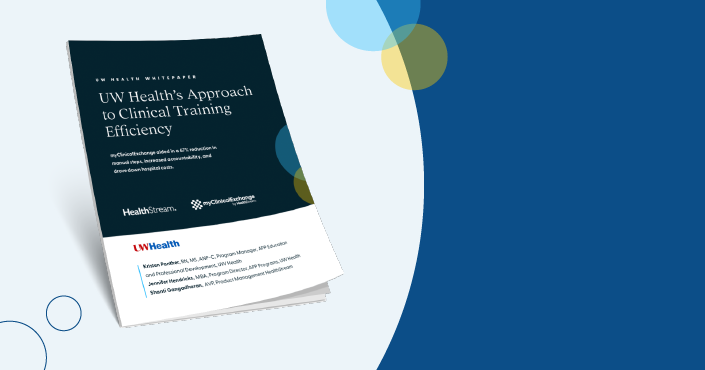
Explore how myClinicalExchange transforms clinical placement challenges into streamlined solutions, enhancing education and operational efficiency.
Building a competent, compliant, and confident workforce starts with a foundation of support for all of the processes that are necessary to educate students as well as manage and document that process. HealthStream's myClinicalExchange can help users transform this function into an efficient and less chaotic process while saving both time and money. This helps healthcare organizations achieve the ultimate goal of being able to create the kind of student experience that leads to strong clinical outcomes.
A HealthStream webinar entitled "Clinical Placement for the Future of Healthcare: A Customer Discussion With CommonSpirit MT Region and UW Health" shared strategies to enhance clinical evaluation training and advanced clinical supervision training. The webinar was moderated by HealthStream's Caroline Acree, Senior Product Marketing Manager for Clinical Development and featured:
The process for clinical skills training, evaluation, and placement in most healthcare organizations can best be described as chaotic and nearly impossible to manage manually, and yet, that is how many organizations are doing it. There are numerous education requests coming from multiple sources requiring several approvals and manual verifications and processes for documentation. Overlapping tasks and manual documentation make the process unwieldy and makes accurate documentation nearly unachievable.
myClinicalExchange transforms the clinical placement process into a systematic and streamlined solution by standardizing the process for all users. The centralized process also makes it easy for leaders to quickly ascertain whether or not all of the tasks that need to be completed by the student before beginning their clinical or online clinical rotation plan have been completed and properly documented. In addition, Gangadharan shared that myClinicalExchange can be customized to include metrics that are important to academic and clinical partners allowing both to get accurate reports.
Panther shared that at UW Health, decreasing variation in the placement process was a key priority. With dozens of affiliation agreements, 7 hospitals and more than 80 clinics, there were multiple points-of-entry for learners. To further complicate the issue, there were two different human resources systems. This made it difficult to ensure that everyone had the right paperwork or to even know how many students were in each clinical rotation. myClinicalExchange helped UW to streamline the process, reduce risk and centralize communication.
Robertson shared that at CommonSpirit MT Region they were also able to streamline their processes. With multiple affiliation agreements and programs that range from EMT training to nursing and medical students, they were able to standardize and centralize the way in which students were placed across the entire system.
The fact that information inquiries might come from a number of different sources has also contributed to the chaos of this process. Robertson shared that requests can come in from unit managers, preceptors, and program chairs. With myClinicalExchange, CommonSpirit MT Region was able to reduce the number of channels for requests making it possible to focus on the rotation and how to better accommodate students. Hendricks shared that changing the process for inquiries meant that UW Health was able to standardize documentation and better direct learners to existing openings and future workforce needs.
Safer, high-quality care as a result of a more efficient clinical placement process is a huge benefit of myClinicalExchange and the great news is that it does not come at the cost of more time and expense. Gangadharan shared that onboarding time typically averages about 4.25 hours per student. The time savings with myClinicalExchange is substantial. The required time for onboarding drops to just 1.5 hours per student. That is a whopping 65% drop in time which corresponds to roughly $22,000.00 per year. Overall, myClinicalExchange improved clinical rotation plans and clinical evaluation training and achieved a 67% reduction in manual steps, which drove down hospital costs even further.
Hendricks shared that UW Health achieved similar savings and as a result they were able to forego hiring an additional administrative assistant. Instead, they focused those resources on a program support specialist who brings a higher level of support for the learning process, including professional development for preceptors.
Both Hendricks and Robertson shared that the time savings also enabled their organizations to build stronger relationships with their academic and clinical partners.
Preparing students for their future clinical placements can feel chaotic and overwhelming, but it is possible to impose some order on the process while reducing risk and improving your organization's ability to onboard students and easily create accurate reports for your organization and its' clinical and academic partners. myClinicalExchange can help build competence and compliance while helping to reduce the time and costs associated with the process.
To read more about UW Health's approach to clinical training, download the white paper here. You will learn more about efficient ways in which to implement clinical management training and clinical preceptor training and strategies that will lead to reduced costs and improved efficiency.

Prepare for state surveys using mock assessments with HealthStream's Quality Manager to reduce deficiencies and improve readiness.
As a leader in healthcare, ensuring regulatory compliance for your skilled nursing facility is paramount. One of the most effective ways to achieve this is through mock surveys. These proactive assessments not only prepare your team for official inspections but also foster a culture of continuous improvement. To excel with mock surveys, you need a system that integrates your team, encourages discussions on addressing known issues, tracks progress, and nurtures community-wide growth.
You might be wondering how your current mock survey process measures up.
If not, you're not alone. Many facilities have turned to HealthStream's Quality Manager (formerly known as abaqis®), which uses the same algorithm as state surveyors. This tool shows you how many residents will be interviewed and helps determine the resident sample, effectively giving you a "study guide" for your compliance "test."
A customer spotlight for Presbyterian Senior Living highlights their successful utilization of Quality Manager to uncover issues for remediation prior to the actual assessment, resulting in deficiency-free surveys at three different facilities in the first year. With these successes, their level of commitment to completion of mock surveys has increased substantially and overall satisfaction is high.
This method is well-loved by many administrators because it genuinely prepares them for state surveys. It also simplifies the preparation process and is tailored to meet particular needs. By investing in a reliable mock survey system, you can ensure your facility not only meets regulatory standards but excels in providing quality care.
Having a dependable system like HealthStream's Quality Manager allows you and your team to prepare for survey before it occurs, getting you one step closer to maintaining compliance and peace of mind for the quality of care your team provides to your residents and community.

Revamp your student onboarding with cutting-edge solutions that enhance workflow and cut costs. Discover the benefits firsthand.
The student rotation experience can feel chaotic for healthcare organizations, schools, and the students themselves, but HealthStream and myClinicalExchange can help your organization create a customizable, reliable and efficient process while saving time and reducing costs.
In a HealthStream webinar, leaders from Prisma Health shared real-life examples of how they were able to streamline processes and enhance patient care with myClinicalExchange.
The webinar was moderated by Caroline Acree, HealthStream's Senior Product Marketing Manager and featured presenters:
Gangadharan shared that healthcare leaders across the industry are being asked to do more with less. Working with limited resources translates to leaders needing to maximize their time, stretch their budgets, and be creative with their resources.
She went on to describe myClinicalExchange as a web-based platform that is able to bring students, clinical sites, and academic partners together while supporting the entire clinical rotation process with scheduling, tracking, onboarding and reporting. Gangadharan also shared that myClinicalExchange supports a broader vision as it can identify potential nurse residency grads and ensure that students and future employees have the optimal supporting education. Leaders can use myClinicalExchange to support students as they progress through their journeys and retain great talent.
Carey shared that Prisma Health has been through a recent merger that doubled the size of their system and their program. At the beginning of their journey in 2015, they were a single health system with six hospitals, about 150 physician practices, and 4,000 students per year. Now there are 13 hospitals, 300 physician practices and 8,000 students per year.
She went on to say that they are currently supporting 270 affiliation agreements and have students from over 100 programs. Their largest program is undergraduate nursing and their program also supports two medical schools.
Prior to implementing myClinicalExchange, Carey would have described the process at Prisma Health as chaotic. They had large numbers of students and were attempting to support those students as well as clinical sites, and academic partners with manual processes. They were managing an enormous repository of spreadsheets, paper files, and source documents. The manual processes made it challenging to share information and the student services staff were frequently left scrambling to pull required reporting information together.
myClinicalExchange can help simplify and streamline a process that has been characterized as chaotic and unmanageable. The goal is to create an optimal experience for students and build a pipeline of future clinicians. It helps users to:
Dr. Hairston began with a pilot of myClinicalExchange - an approach that she highly recommends - before launching the program across the entire organization in 2015. Carey also added that Prisma Health appreciated that myClinicalExchange was specifically designed for healthcare users and that they found other platforms insufficient as they were not able to be customized to suit the unique needs of healthcare organizations. She is particularly grateful for the feature that allows her to manage Prisma Health's 270 affiliation agreements.
In addition, a scheduling feature allows them to refine scheduling down to the department and unit, as well as by date and time. There are also compliance checklists that can be customized to meet the unique requirements of their program.
Gangadharan also added that the customization capabilities extend to other aspects of an organization's workflow, making it possible to capture all of the unique aspects of an organization's workflow. "When we go through an implementation, we really work with each partner to incorporate all of the different elements of their workflow," said Gangadharan. She went on to add that myClinicalExchange is scalable and as an organization grows, it is possible to seamlessly add programs, partners, affiliations, services, and additional facilities just as Prisma Health has done.
Removing the chaos from your student onboarding process will likely feel like a win for most organizations, but calm is not the only benefit. Implementing myClinicalExchange creates efficiencies that result in significant savings for users. Gangadharan shared the specifics of the impressive savings seen by myClinicalExchange customers.
Prior to implementing myClinicalExchange, users reported an average of 4.25 hours to onboard each student. Thanks to the efficiencies created by myClinicalExchange, users were able to reduce their onboarding time to just 1.5 hours per student. Users reported between a 60% and 75% average reduction in onboarding time which translates into a savings of $22,000.00 per year.
Ready to take control over your chaos? Get a first-hand look at how myClinicalExchange eliminates the chaotic student onboarding process and puts you in the driver's seat of the entire clinical placement experience. Book a demo today.

Learn about new CMS staffing standards for long-term care facilities and find out how HealthStream can streamline your compliance process.
Beginning in August, long-term care facilities will be required to demonstrate an increase in RNs and nurse aides to the Centers for Medicare and Medicaid Services (CMS). The rule also contains a provision requiring state Medicaid agencies to report on the percentage of payments for Medicaid-covered services that are spent on compensation for direct care workers. In addition, there are updated requirements for Facility Assessments. It is a daunting challenge and a recent HealthStream webinar provided insight and recommendations into the new rule for long term care leaders.
The webinar was led by HealthStream's Caroline Acree, Director of Marketing for Quality and Compliance and featured presenter, Tracy Cooley, RN, BSN, Senior Success Manager, HealthStream.
CMS recently released the final rule (CMS 3442-F) on minimum staffing standards and it requires a significant increase in RN hours. "The new rule requires a registered nurse to be on-site 24 hours per day, seven days a week to provide skilled nursing care to all residents per their care plans. This exceeds the current requirement of 8 hours per day, seven days a week," said Cooley.
Cooley went on to explain that the standards were developed using case mix adjusted data sources and facilities are required to meet the staffing standard regardless of the case mix of their own facility.
CMS has proposed a staggered implementation for the new rule. Rural facilities will have three to five years to implement the requirement and non-rural facilities will have 2-3 years from the publication of the final rule.
Further, CMS has indicated that these are minimum standards which are subject to re-evaluation and are expected to increase over time.
The final rule also contains a provision requiring state Medicaid agencies to report on the percentage of Medicaid payments covering compensation paid to direct care workers. This provision will not be implemented until June 21, 2028. States will then be required to make this payment information available on public-facing websites. Furthermore, CMS has stated that the information needs to be clear, easy to understand, and verified quarterly. CMS will also report this data on their website.
If this sounds expensive, that is because it is. CMS estimates that implementation will cost long term care facilities 43 billion dollars over a ten-year period. They further expect that facilities will have three approaches to funding the new rule.
There will be waivers and exceptions, but CMS will be deciding whether or not to grant them on a case-by-case basis.
Workforce development will likely be a key strategy of long term care facilities as they plan to implement the new rule. CMS supports the implementation of workforce development programs and is launching a comprehensive workforce development initiative. They are also exploring the possibility of providing technical assistance through existing Quality Improvement Organizations (QIOs). In addition, CMS is launching a campaign to help workers pursue careers in nursing homes. The campaign will support recruiting, training and retention of long term care staff.
Facilities will also need to use their Facility Assessments to develop and maintain a staffing plan to maximize recruitment and retention of direct care staff. The staffing plan must be documented and is considered to be a demonstration of a good faith effort to hire staff.
CMS has also finalized several updates to the Facility Assessment requirements. Facilities must now demonstrate that they use evidence-based methods when creating care plans for residents, including those with behavioral health issues. This assessment must be used to determine the specific needs of residents on each unit. Facilities will also be required to consider input from nursing home leadership, management and direct care workers. They have also added that facilities consider input from residents, family members, resident representatives, and representatives of direct care staff.
The requirements of the new rule are likely to feel overwhelming for long term care leaders, but HealthStream has solutions that can greatly simplify the implementation of the new rule. HealthStream's Quality Manager has an interactive Facility Assessment template which includes a comprehensive staffing plan template.
In addition, Quality Manager's MDS Resident Population Profile includes MDS resident-based data to address the regulation requiring the use of evidence-based methods to inform care planning decisions. The MDS Resident Population Profile is based on a year's worth of stays and provides a quantitative picture of the types of care being provided. Users can see this profile within the Facility Assessment Workflow in the Quality Manager system and is also available as a standalone report.
Cooley encouraged leaders to begin preparing to address the new rule and suggested that leaders:
Reach out to HealthStream today to learn more about how Quality Manager can help your facility meet these updated requirements.

CredentialStream is recognized as the top choice in healthcare credentialing for Summer 2024. Learn about its advantages and join our community.
The G2 Summer Awards have arrived, and we're thrilled to announce that CredentialStream® by HealthStream® has been awarded a new badge of excellence! Our credentialing software has earned the Summer Leader badge in the Healthcare Credentialing Software category for the past two years. This news follows our recent win of G2's 'Users Love Us' badge and ‘Spring Leader 2024', honors based on significant positive customer reviews.
The Summer Leader 2024 badge is a prestigious accolade given by G2, a trusted platform for software reviews and ratings. G2 scores products and sellers based on reviews gathered from the user community, as well as data aggregated from online sources and social networks.
This achievement reaffirms our commitment to delivering credentialing solutions that ensure provider competency and improved experience. It signifies that our solution not only meets but exceeds user expectations, providing a seamless and rewarding experience in managing the entire provider credentialing process.
When asked by G2 what they liked best about CredentialStream, our customers highlighted excellent automation, flexibility, and responsive customer service. These features have made CredentialStream an indispensable tool for credentialing coordinators. CredentialStream offers several key benefits, making it the go-to choice for healthcare credentialing.
Here's what you can expect when you choose CredentialStream:
At HealthStream, we strive to enable our customers to credential providers with ease. For us, there's no better compliment than a happy customer, and we are grateful for the positive feedback we have received. The achievement of the Summer Leader 2024 badge is a testament to our commitment to excellence in healthcare credentialing.
For more information about CredentialStream and to read user reviews, visit our G2 profile. We look forward to welcoming you to the CredentialStream community.

Stay up-to-date with important updates on HIPAA compliance that affect healthcare providers and patients in 2024. Be prepared for what's coming.
As healthcare continues to evolve, so must the regulations that govern it. This year marks a significant transformation for HIPAA compliance, with substantial changes on the horizon that will impact healthcare providers, patients, and the broader healthcare technology industry.
The last significant update to the HIPAA Rules came in 2013 with the HIPAA Omnibus Final Rule, which introduced new regulations mandated by the Health Information Technology for Economic and Clinical Health (HITECH) Act. Since then, the healthcare landscape has undergone tremendous changes, necessitating a fresh look at HIPAA regulations to address new challenges and opportunities.
In April 2024, a final rule was published to strengthen reproductive healthcare privacy. These changes, effective from June 25, 2024, and enforceable starting January 1, 2025, include:
The Office for Civil Rights (OCR) has also clarified that any unauthorized disclosure of reproductive health care data will be treated as a notifiable data breach under the HIPAA Privacy Rule.
On April 26, 2024, the Federal Trade Commission (FTC) issued a final rule updating the Health Breach Notification Rule. This rule now includes health apps and other technologies not previously covered by HIPAA, such as websites collecting health data but not operated by HIPAA-regulated entities. Key updates include:
Looking forward, several more changes are expected in 2024. Following a request for feedback from HIPAA-covered entities in 2018, the OCR proposed new regulations in December 2020 aimed at reducing administrative burdens and enhancing patient rights. Proposed changes include:
Implementing these changes will require significant effort from healthcare organizations. Updated HIPAA policies and procedures will need to be communicated to patients and health plan members, and employees will require further training. Training courses will need to be updated, as updated training is to be provided whenever there is a material change to HIPAA policies.
Since the last major update in 2013, the Security Rule has remained relatively unchanged. However, 2024 will likely bring substantial revisions driven by a new Healthcare Sector Cybersecurity concept paper. This initiative outlines steps to enhance cyber resiliency and patient safety, including:
Additionally, the finalized HPH Cybersecurity Performance Goals (CPGs) announced in January 2024 outline high-impact practices divided into Essential and Enhanced CPGs, with the goal of mitigating cyber threats effectively.
Under the HITECH Act, OCR is mandated to conduct periodic audits of HIPAA-regulated entities. In 2024, these audits will focus on HIPAA Security Rule compliance, ensuring that healthcare organizations adhere to the latest standards and are prepared for future challenges.
The recent and anticipated changes to HIPAA regulations in 2024 represent a significant shift towards enhanced privacy, security, and patient empowerment. Healthcare organizations need strategies to stay informed and proactive while implementing these changes to maintain compliance and continue providing high-quality care.
Learn about how HealthStream's ComplyQ can help your organization stay compliant with ever-changing regulations.

Explore practical strategies to enhance communication skills in healthcare and foster a supportive environment. Start improving today.
Clear, effective, and transparent communication is critical in healthcare. It is essential to clinical quality and safety, and it also crucial to the professional growth and self-assurance of clinicians throughout their careers. It is vital that leaders have strategies for proactive versus reactive communication. A recent HealthStream webinar shared strategies for creating an environment of empathy and support to improve communication and boost self-assurance while reducing turnover rates.
The webinar was moderated by Raegan Phillips, HealthStream's Marketing Coordinator, Clinical Programs, and featured presenters:
Billingsley shared the "why" for Perception Strategies and Task to Touch. "My why is the goal to equip staff with practical communication strategies and tools that promote successful conversations and provide the ability to handle conflict," said Billingsley. She believes that it is important to share the "why" as it provides clarity which can boost communication and trust, creates a strong motivator, and promotes team unity. Leaders need to create a productive and engaged culture and that begins with building confidence through communication.
Citing the research of Malcolm Newell on adult learning, Billingsley urged healthcare leaders to remember what adult learners want, specifically:
A one size fits all approach does not work for the varying needs of adult learners. In addition, a recent Microsoft survey found that goldfish have slightly longer attention spans (9 seconds) than humans (8 seconds) making short lessons focused on a single topic crucial for adult learners.
Billingsley went on to share that characteristics such as emotional intelligence, good communication skills, and problem-solving abilities are contributing factors to resiliency - a major topic in post-pandemic healthcare. As communication failures are frequently identified as a significant contributor to workplace failures and conflict, it makes sense that improving communication can build resiliency and improve job satisfaction.
She encouraged leaders to build communication skills by focusing on improving listening skills, focusing on the way forward and selecting only a few reliable communication sources.
Emotional intelligence is fundamental to good workplace communication and "aha" moments help us to learn from experiences. Billingsley defined emotional intelligence as the ability to understand and manage emotions effectively. It helps us moderate how we come across to our colleagues. An "aha" moment is a moment of sudden clarity, insight, or inspiration that provides insight, recognition, and/or comprehension. "In training, we try to create conditions and use scenarios where "aha" moments are likely to happen," said Billingsley.
The National Institutes of Health conducted a time-motion study amongst nurses and found that nurses spent about three hours of every 12-hour shift communicating. Given the significant amount of time that nurses spend communicating, what are the specific skills that nurses feel they need to improve? When asked, nurses said that they need help navigating conflict, responding to dismissive providers, strategies to address difficult patients, and how to have conversations during which they may be concerned, uncomfortable, or addressing a safety issue. Nurse managers and educators reported needing help with giving and receiving feedback, successful handoffs, clear communication, conflict management, and patient advocacy.
Task to Touch lessons address a variety of healthcare communication topics including effective communication skills for conflict resolution, empathy training to help better manage emotional patients, and models for successful handoffs between clinicians. Lessons include real-life scenarios and instruction on how to improve each interaction.
Ficarra announced that beginning in July, HealthStream will be launching a new 15-video Task to Touch video communication series. The series focuses on three main areas.
Task to Touch has also made a free communication guide available. The two-page guide can serve as the foundation for a communication tutorial.

Learn about AIM's Patient Safety Bundles that improve maternal health outcomes and potentially save lives. Contact HealthStream for further information.
The Alliance for Innovation on Maternal Health (AIM) provides education and resources to make birth safer, improve maternal health outcomes, and save lives. Their newest resource is the AIM Patient Safety Bundle Learning Modules which was introduced in a recent HealthStream webinar.
The webinar was moderated by Allison Keys, HealthStream's Campaign Marketing Manager for Clinical Programs and featured presenters:
Wright shared an overview of AIM, HRSA and Maternal and Child Health Bureau. HRSA provides grants with the goal of supporting healthy communities and people, improving health outcomes, and addressing health disparities. The mission of Maternal and Child Health Bureau is to improve the health and well-being of America's mothers, children and families. She went on to say that Maternal and Child Health Bureau's strategic plan is focused on four goals:
The initiative began in 2011 when the American College of Obstetricians and Gynecologists (ACOG) convened the Council on Patient Safety and Women's Healthcare - AIM's predecessor. In 2018, funding was continued with the goal of developing patient safety bundles and providing resources and assistance for states implementing the bundles.
The AIM Technical Assistance Center provides technical assistance and resources in support of entities implementing the AIM Quality Improvement Initiative. They provide technical assistance and some funding to those states that are not funded directly by the government. Allen pointed out that the assistance provided by the TA Center directly supports AIM's mission - to support best practices that make birth safer, improve maternal health outcomes, and save lives.
Allen went on to share the Technical Assistance Center's desired outcomes:
Allen explained that Patient Safety Bundles are structured ways of improving processes of care and patient outcomes. While Patient Safety Bundles are not new, AIM is likely the first to apply them to obstetric and maternity care. She went on to describe the bundles as descriptive rather than prescriptive. The bundles include collections of evidence-informed best practices which address clinically-specific conditions and high-risk periods of time in pregnant and postpartum people. Allen also clarified that evidence-informed best practices are informed by previous research, but not necessarily limited by it, allowing for the inclusion of lived experience and patient values as well as clinical expertise. In addition, this evidence is supported by a broad range of work groups and disciplines to ensure a comprehensive approach.
Taylor shared that AIM resources are open and free and can be found on the AIM website, and on the organization's Vimeo channel. In addition, each Patient Safety Bundle has a library of resources including implementation details and resources, data collection plans, an implementation webinar, a change package with ideas to help kickstart the initiative, an introductory video, and a learning module for each of the core Patient Safety Bundles. In addition, there is a podcast where listeners can learn from a wide variety of subject matter experts.
Each AIM Patient Safety Bundle features a comprehensive 40-minute overview of the bundle topic, and includes multi-disciplinary quality improvement strategies. The learning modules can be found on HealthStream and Nursegrid. Each of the eight learning modules includes a pre-test of 10 questions, 30 minutes of video course content, and a post-test consisting of the same 10 questions featured in the pre-test. Users earn one CME credit per module. Chandra also added that the modules include a comprehensive set of FAQs and a social media kit to help implement the learning modules.
These Patient Safety Bundles are complimentary for HealthStream customers. Users may simply sign on to access the catalog of content. Leaders may choose to assign this learning to staff or staff may elect to self-enroll. To learn more about the AIM Patient Safety Bundles and how to improve outcomes, ensure safer births, and save lives, contact HealthStream today.

Explore key insights on how revenue cycle training can enhance patient safety and quality of care. Connect with HealthStream for guidance.
Your revenue cycle staff may not be the first thing that comes to mind for patient safety, but they are actually essential to improving it. Education is an integral strategy when developing this indispensable team.
During a recent HealthStream webinar, experts shared best practices to help leaders highlight patient safety with their revenue cycle staff. The webinar was moderated by HealthStream's Caroline Acree, Director of Marketing for Quality and Compliance and featured presenters:
FinThrive provides structured, personalized training focusing on the revenue cycle experience. Educational content is available for beginning, intermediate and advanced students, and is customized for all types of learners with visual, auditory, and hands-on content.
FinThrive has a dedicated team of subject matter experts who are engaged in ongoing research to ensure that content is up-to-date in the challenging and constantly evolving world of healthcare finance.
At first glance, patient safety and the revenue cycle do not appear to intersect, but revenue cycle staff can have a meaningful impact on patient safety. While everyone in the organization can have an impact on financial efficacy, it is also true that revenue cycle staff are important to outcomes and patient safety. When those staff are scheduling and registering patients, they are responsible for capturing a significant amount of information that becomes part of the patient record.
Arrowood pointed out that patient financial services staff are frequently in a position to discover the existence of duplicate patient records and provide assistance in merging them. They are also able to identify prescription dose errors, incorrect allergy information, incorrect treatment outcomes, and missing lab and pathology reports, all of which can significantly impact patient care and safety. In addition, patient financial staff can identify incorrect patient demographic information and missing or incorrect social determinants of health. Gurzynski-Wells added that inefficient prior authorizations can create delays and even prevent care for patients.
These experts urged leaders to improve awareness of these issues with education. Simply becoming aware of the downstream impact of this kind of error can make a difference in staff practice. It is essential to build employee understanding of the fact that everything they do impacts the care and safety of the patient and not just their financial experience.
With medical errors estimated to be the third leading cause of death in the U.S., the importance of correctly identifying patients, identity verifications and the elimination of duplicate records becomes more of a priority. Confirming patient data and changing it as necessary helps to ensure that the Master Patient Index (MPI) is correct. Doing so can also help ensure that no one is able to misappropriate another patient's identity or insurance information which helps reduce the likelihood of insurance refunds, investigations, audits, and sanctions.
Gurzynski-Wells also pointed out that this is an opportunity to record how a patient self-identifies in terms of their gender identity and sexual orientation. Taking the time to do this can help alleviate LGBTQIA disparities in patient care.
Patients who are misidentified for any reason during the course of care are at risk of fragmented or incorrect care that may compromise their health and safety. Walter also pointed out that it can result in a loss of trust which may compromise their willingness to seek needed care in the future.
Arrowood described Clinical Documentation Integrity (CDI) as a chart review process that supports accurate coding, and data collection which, in turn, supports accurate billing. CDI also helps to ensure that data collected for research purposes is accurate. CDI is essential to administrative data collection that supports a clean claims process. The integrity of the data is critical as it supports clinical outcomes, financial performance, and accuracy of patient status information.
Education is essential to ensuring that staff are trained on how to prevent some of the patient safety issues created by poor documentation practices. Walter recommended that organizations work to align policies and procedures with the ever-changing regulatory and payor policies She also encouraged organizations to have great onboarding and training programs and additional resources. In addition, Walter recommended random audits to help keep pace with the rapid change in healthcare.
She also encouraged leaders to help revenue cycle staff understand the "why" behind the processes to prevent errors. It is important to help them understand how their work fits into the big picture. Improved opportunities for learning and growth can also translate into improved staff retention.
Improving revenue staff confidence can help ensure reduced denials and improve patient outcomes and safety. To learn more about how HealthStream and FinThrive can help your organization implement more effective revenue cycle education, reach out to HealthStream today.

Discover how streamlined assessments can improve compliance and the quality of care in skilled nursing facilities. Enhance your procedures today.
As the landscape of healthcare continues to evolve, the importance of thorough and consistent facility assessments in skilled nursing facilities cannot be overstated. Leaders in healthcare must ask themselves several critical questions: How are we keeping track of our facility data? What does our facility assessment look like? Who is responsible for completing these assessments? What systems can we trust to transmit data through the Minimum Data Set (MDS) or to handle Electronic Medical Records (EMR)?
As the new CMS 3442-F Final Rule goes into effect in August 2024, facilities must be prepared to address the enhanced facility assessment requirements. Even with the staggered implementation timeline, having the right tools in place to maximize efficient response will be critical.
A reliable system for facility assessments eliminates the guesswork and reduces the burden of paperwork. For example, HealthStream's Quality Manager (formerly known as abaqis) streamlines this process by integrating MDS data and performing necessary calculations on your behalf. This automation transforms complex data into an easy-to-digest report, enabling you to focus on evaluating and addressing areas for improvement rather than spending time on number-crunching tasks.
Adopting such systems offers considerable benefits, including:
Quality Manager's Facility Assessment Tool includes:
Investing in a dependable system like HealthStream's Quality Manager can be a game-changer for skilled nursing facilities, ensuring that leaders can allocate their time and resources efficiently while maintaining compliance and enhancing the quality of care provided to residents.





