Explore expert insights from HealthStream on healthcare compliance, credentialing, clinical education, scheduling, and leadership. Find practical guidance to help healthcare organizations train, retain, and support their workforce.
Practical insights on healthcare compliance, workforce development, and clinical education from the experts at HealthStream.

Past retention tactics can't stem today's turnover. Use these seven evidence-based nurse retention strategies to keep healthcare employees happy and engaged.
The nurse retention strategies that worked in the past cannot dampen the kind of turnover that healthcare is facing. Healthcare organizations that want to retain employees need to implement stronger, evidence-based strategies.
It's estimated that over 260,000 nurses leave the profession annually and are not being replaced as quickly as they leave. In turn, new academic nurses do not have the same experience level as more mature nurses. For skilled nursing, the median turnover rate is 43.9. Each percentage change costs about $379,000 on average, which means an average loss for a hospital of about $5 to $8 million annually, not to mention the erosion in quality of care.
It's time to act on the problem. Organizations with lower turnover have found these 7 actions to be vital to boosting retention:
STANDARDIZE SHIFT MANAGEMENT WITH
WakeMed did, and saved 2.1 million per year while reducing nurse overtime by 71%.
Contact HealthStream to speak to a solutions expert learn more about our courses related to Nurse Retention Strategies.

Sweeping HIPAA updates are expected from HHS. Learn what to know now and how to begin preparing your healthcare organization for the coming changes.
It has been some time since there were any major updates to the Health Insurance Portability and Accountability Act (HIPAA), but it is expected that the Department of Health and Human Services will announce some of the most sweeping changes seen since its 1996 enactment. The law created national standards that protect sensitive patient health information from being disclosed without the patient's knowledge or consent.
The new final rule is expected to be published in March. The effective date will be 60 days after the publication of the final rule, but regulated organizations will then have another 180 days before enforcement will begin. (This will put actual enforcement somewhere between late October and late November of 2023 depending on when the final rule is published.)
Healthcare leaders are very familiar with the current provisions of this law, but what is likely to change when the final rule is published? What follows are some of the highlights.
There are quite a few changes in the proposed rule and the enforcement process would likely begin before the end of the calendar year. So… what should leaders do to prepare themselves and their staff for these proposed changes?
HealthStream's Policy Manager can help your organization stay up-to-date by ensuring that this and other policies are always current and readily available to your staff. In addition, ComplyQ provides an engaging and adaptive approach to compliance training. Both solutions are kept up-to-date which eliminates the administrative time spent on tracking the nearly-constant regulatory changes and the updated training requirements that follow. Having current information on this and other mandates can help your organization remain in compliance and avoid fines and litigation.

NREMT permanently waived distributive learning restrictions in 2022. Learn how EMS organizations can optimize competency and reduce training costs.
A recent decision by the National Registry of Emergency Medical Technicians (NREMT) has paved the way for some significant changes in how and where EMS providers may be trained. As of September of 2022, NREMT has permanently waived the limits on distributive education giving these first responders more options when pursuing continuing education, recertification, state licensure, refresher, and re-entry training. The removal of these restrictions offers EMS providers and the agencies for which they work greater flexibility when pursuing education and can result in substantial cost savings for their employers.
The decision to remove these restrictions could not come at a better time. Pandemic restrictions had made in-person training nearly impossible and like virtually every other segment of the healthcare industry, there are staff shortages of both providers and instructors making in-person training increasingly impractical and difficult.
Removing requirements for synchronous, in-person training is an important first step as it means that agencies will no longer need strategies to address the inherent difficulties in scheduling and executing in-person training for these first responders. EMS providers need a broad scope of knowledge that covers assessment and clinical skills as well as the critical thinking skills that will keep both them and their patients safe in the often-chaotic circumstances in which they work. So, with barriers to distributive learning now removed, what is the best approach to EMS training?
HealthStream's EMS Program is a comprehensive online program that includes more than 70 hours of courseware. The content is approved by the Commission on Accreditation for Pre-Hospital Continuing Education (CAPCE). Using HealthStream's EMS program means that EMS providers and emergency management leaders can be confident that their training is relevant, medically accurate, and properly referenced.
HealthStream's EMS Program is as comprehensive as it is flexible. It covers all five of the NREMT components:
HealthStream's EMS Program is designed to meet recertification requirements for all EMS personnel. The 70 hours of CAPCE-approved courseware is available on an easy-to-navigate platform that can be accessed anywhere on any type of device. In addition to the existing CAPCE-approved content, the program also offers users the option to create their own content that can help agencies address the unique requirements of their organizations and/or municipalities.
It also takes the guesswork out of record-keeping. Managers can monitor and document individual and department-wide progress through the solution's easy-to-use reporting features.
The solution is comprehensive and cost-effective. Leaders can be confident that:

Favoritism in scheduling fuels toxic culture. Learn how nurse leaders can use healthcare-specific scheduling to foster a fair, inclusive environment.
Having an effective and healthcare-specific workforce scheduling system is an essential component to helping nurse leaders foster a fair and inclusive environment for their staff.
Research indicates that favoritism exists within the nursing profession between supervisors and their nurses. Some managers knowingly play favorites with the nurse staff, while some do so inadvertently. Regardless of the intent, favoritism in a healthcare environment should be avoided because of its negative impact on an organization's culture and, ultimately, on patient care.
"It can be problematic in leadership when the nurse leader is perceived by staff as treating some people better than others, especially in giving assignments and shift scheduling," wrote Rose O. Sherman, EdD, RN, NEA-BC, FAAN, in a 2021 Emerging Nurse Leader article. "The implications of favoritism are far-reaching in their influence to promote a toxic culture that destroys engagement, commitment, and integrity."
Nurse leaders who are supportive and promote fairness in the workplace help create an environment where all staff feel safe and engaged in their roles. It cannot be overstated how much of an influence a nurse leader's actions have on staff morale and patient outcomes.
Have you ever noticed that certain nurses always seem to be allocated the best shifts, have their pick of the most desirable annual leave slots or have a less demanding workload than the rest of the team? Or have you observed that certain nurses always get called in for overtime (and incentive pay)? Do you know if your scheduling practices are causing your healthcare team to feel the burden of picking up last-minute shifts?
Now is the perfect time to ask yourself these questions and evaluate whether the processes used to schedule the staff in your facility can be improved.
One thing to consider is that the nurses who are called most often for overtime might feel burnt out and irritated. A study published in JAMA Network Open in 2021 discovered that burnout is highly prevalent among U.S. nurses who leave or who are considering leaving the profession. Their data showed that nurses who worked more than 40 hours per week had a greater likelihood of identifying burnout as a reason they left their job compared with those who worked less than 20 hours per week.
"Health systems should focus on implementing known strategies to alleviate burnout, including adequate nurse staffing and limiting the number of hours worked per shift," they recommended.
Meanwhile, resentment and frustration can be building among staff whose schedule requests are rarely granted, as these practices can be perceived as favoritism and, in some cases, even be deemed as discrimination.
"Hospitals need to take both long- and short-term measures to address critical workforce issues so they can continue to provide safe, high-quality care now and in the future," Deborah J. Bowen, FACHE, CAE, president and CEO of American College of Healthcare Executives (ACHE), said in a
Workforce challenges are considered the top issue on the list of hospital CEOs' top concerns in 2022, the ACHE said. One key concern is the healthcare personnel shortage. In 2021, the turnover rate for staff RNs increased by 8.4 percent, resulting in a national average of 27.1 percent, according to the 2022 NSI National Health Care Retention & RN Staffing Report.
"The nurse scheduling problem (NSP) has received a great amount of attention in recent years," researchers wrote in a Journal of Industrial Engineering International study.
Favoritism, whether it's perceived or actually happening, is one factor contributing to nursing turnover and the more it exists within an organization, the more often nurses leave. It should also be noted that favoritism can sometimes exist in the eye of the beholder. So even the appearance of preferential treatment can create tension among staff members.
"Higher levels of favoritism within the organization are strongly linked with nurses' turnover intention," according to a 2020 study published in the Nursing Forum journal. "Improving the channels of communication among the healthcare team is vital to promote inclusivity among healthcare workers and enhance organizational viability."
As healthcare facilities make an effort to curb favoritism in scheduling, they will recognize the benefits of having a healthcare-specific scheduling system.
It's not uncommon for healthcare organizations to utilize scheduling systems that are not specific to the industry. If your facility relies on those tools, it could create more complications than you might have expected. Non-healthcare systems often do not have the sophistication needed to handle the complex scheduling needs of healthcare workers.
ShiftWizard(™), by HealthStream, is created specifically for healthcare and has an easy-to-use messaging center designed to improve work-life balance and streamline communication. Additionally, because ShiftWizard was developed by healthcare professionals, it has been carefully designed to help leaders quickly and easily identify who has the ideal credentials for each shift, how many hours each staff member has worked, and who is available to pick up last-minute shifts. These features combined allow the tool to help managers create a fair scheduling process.
And with mobile access and user-friendly apps, ShiftWizard gives team members access to their schedules anytime, anywhere and allows staff to swap or pick up shifts conveniently.
ShiftWizard's tool fosters an environment of fairness and transparency:
When it comes to scheduling, supporting your staff is critical to maintaining team morale. That's why ShiftWizard has been crafted to improve the scheduling process for you and your team. Whether your facility is a smaller healthcare setup, a single department, a team of nurses, or an entire hospital system, we're ready to show you exactly how ShiftWizard can streamline scheduling, improve staff satisfaction, and increase fairness.

New Joint Commission standards aim to reduce healthcare disparities across hospitals and care settings. Learn what your organization should do now.
This blog is taken from a recent HealthStream webinar entitled "New Joint Commission Standards Aim to Reduce Healthcare Disparities: 6 Things Your Organization Should Do Now." The webinar featured Kathy Poston and Shaifali Ray. Both presenters are Vice Presidents, Client Delivery for Chartis Just Health Collective.
The health care industry continues to develop strategies that will address health disparities. National organizations are committing those health equity strategies into regulations and standards. Beginning in 2023, The Joint Commission will be incorporating health equity into its accreditation standards. These new standards will apply to accredited ambulatory, behavioral health and human services organizations, critical access hospitals, and acute care hospitals and will aim to reduce healthcare disparities.
This briefing focused on these new standards. HealthStream partner, Chartis Just Health Collective, shared considerations beyond "check the box" strategies and focused on tactical actions health care organizations can take right now to meet these new standards.
Poston began by defining health equity in terms of what it is and is not. "Health equity is a transformation of the organization's culture, strategy and operations to create a healthcare system that is free of bias, discrimination and health care disparities," said Poston. She encouraged leaders not to think of health equity as simply a department, training program, educational program, checkbox activity, project or methodology.
The Joint Commission is bringing this issue into even sharper focus for hospitals by developing accreditation standards for leadership, patient rights and medical records. However, the Joint Commission is not the only agency that has developed health equity standards for healthcare organizations. Ray identified some additional agencies and accrediting bodies that will be focusing their attention on this issue.
As health equity becomes more of a focus for regulators and accrediting bodies, the Joint Commission has identified three focus areas. Ray shared that these standards became effective in January and they focus on three areas:
Ray and Poston then turned their attention to steps that hospital leaders should take today to prepare for these new standards.

Unconscious bias can lead to false assumptions and worse outcomes for minority groups in healthcare. Learn how to reduce its effect on provider interactions.
By Jennifer Stoop, Product Manager, Compliance & Partner Content, HealthStream
Are your actions or judgments influenced by stereotypes? Have you ever been in an exam room, either as a physician or a patient, and been influenced by stereotypes? You may not think so, but the answer to both of these questions is "yes." Unconscious bias impacts everyone, and no one is exempt.
Unconscious Bias
Unconscious bias is defined as ideas about certain groups of people that individuals have without being aware of them. Our brains use and recognize patterns among information, events, or people to allow for quick decision making. Research has shown that our brains make decisions up to 10 seconds before we even realize it, meaning our decisions actually take place in the unconscious. When automatic processing is influenced by stereotypes, unconscious or implicit, bias is activated.
There is increasing evidence that unconscious bias leads to false assumptions and negative outcomes for minority groups in healthcare settings. This contributes to health disparities, where certain groups experience inequalities in the provision of and access to healthcare. Health disparities are commonly considered to be an issue of race or ethnicity, but people are subject to unconscious bias based on many factors, including:
What Unconscious Bias Looks Like in Healthcare
There are myriad instances where unconscious bias negatively impacts the healthcare patients receive. For example:
In 2016, the Journal of Clinical Oncology released a study of black cancer patients and their physicians. The study found that providers who were marked as "high" in implicit bias were less supportive of their patients and spent less time with them. Black patients picked up on those attitudes, viewing physicians "high" in implicit bias as less patient centered. Patients also had less confidence in their treatment plans, felt it would be difficult to follow the treatment plan, and had difficulty remembering what their physician said. The study concluded that patients who interacted with physicians with high implicit bias walked away from the interaction feeling as though the physician did not care about them, could not be trusted, and offered a treatment plan that may not work.
Changing Bias in Healthcare
So how do healthcare organizations create change around bias? It requires much more than a vision statement, a diversity committee, and training program. There must be a commitment to a culture change by building institutional capacity for change and creating equitable environments.
Physician vulnerability to unconscious biases is heightened by the conditions under which they work today, including high levels of stress, frequent distractions, and brief visits that leave little time to get to know patients. The focus should be on reducing the impact of unconscious biases on physician-patient interactions and medical decision-making. That process can begin just by recognizing that unconscious bias not only exists, but exists within us, no matter how much we don't want to believe they do.
Physicians must see their patients as individuals rather than part of a faceless group. This can be done by not only identifying each patient's unique qualities and/or features, but also putting yourself in their shoes. The black female patient becomes Sandra, a school-age teacher who has 2 kids of her own, had to take off work to come to the doctor's office, and needed to find childcare.
Another strategy is to consider the opposite conclusion when making decisions. When data seems to point to one conclusion, take a minute to look for data that supports the opposite conclusion before making a final decision. You can also counter stereotypes by spending time with individuals from groups you have bias toward; This can give you a deeper understanding of the differences. It also allows you to explore new perspectives and increases the opportunity for positive physician-patient interactions.
Unconscious biases are real, exist within all of us, and can have significant negative impacts on the quality of healthcare that patients receive. With meaningful effort, we can work to counteract these biases and improve the interactions between physicians and patients. Learn more about HealthStream training to combat bias and support diversity.

See how acuity-based scheduling can boost safety and staffing efficiency with practical steps and examples.
There are multiple variables to balance when constructing shift schedules for healthcare staff. One key factor for hospital managers to consider is patient acuity, and yet there is much discussion about how to consider it when making staffing decisions.
"There's essentially a tug-of-war in the practice of measuring patient acuity between the desire to objectively determine required nursing work and the need to rely on the professional judgment of nurses to know which patients need more or less of their time," wrote Rebecca A. Paulsen, MS, RN, CPN, Senior Director, Medical/Surgical Services at Children's Mercy Hospital in Kansas City, MO, in a 2018 paper.
Upon her review of the literature, Paulsen concluded that even though it is not perfect, factoring patient acuity into staffing decisions is a better approach than relying solely on nurse-patient ratios or financial targets to determine unit-level nurse staffing needs.
Relying on nurse-to-patient ratios as a way to shape healthcare staff schedules is a major topic within the industry. Some are in favor of mandating nurse-to-patient ratios, believing that it promotes patient safety. Meanwhile, some who oppose the ratios say that the approach is a one-size-fits-all model and it does not consider patient acuity.
"Ratios are a static and ineffective tool that cannot guarantee a safe healthcare environment," Mary Ann Fuchs, DNP, RN, former president of the American Organization for Nursing Leadership, an affiliate of the American Hospital Association, said in a 2021blog post. "Care is team-based, and a lack of flexibility to provide staffing based on the acuity of the individual patient needs jeopardizes safe patient care."
Everyone does acknowledge that staff scheduling in a nursing work environment is complex. The link between staffing and patient health as well as nurses' health has been studied by numerous researchers. "The strong and consistent association between nurse staffing and patient outcomes cannot be ignored," said Christopher R. Friese, Ph.D., RN, AOCN, a professor at the University of Michigan School of Nursing and School of Public Health, in a U of M article.
A recent study, funded in part by the National Institute of Nursing Research, described the importance of improving hospital nurse staffing. They examined the variation in patient-to-nurse staffing in New York hospitals and its association with adverse outcomes (i.e., mortality and avoidable costs). Their findings revealed that nurse staffing varied across hospitals ranging from having 4.3 to 10.5 patients per nurse. Notably, each additional patient per nurse increased the likelihood of patient death, length of hospital stays, and chances of being readmitted to the hospital within 30 days.
"Our estimates of potential lives and costs saved substantially underestimate potential benefits of improved hospital nurse staffing," concluded the authors, who published their data in May 2021.
In a separate analysis, researchers said, "The nurse-patient ratio is a direct determinate of the effects of psychological, mental, emotional health and nurse productivity in the workplace, which also determines the patients' overall health."
The length of hospital stay for adult inpatients is expected to rise by 8% over the next decade, due to increased chronic conditions. Hospital patients are sicker and more medically complex than they were before the COVID-19 pandemic, driving up hospital costs for labor, drugs and supplies, according to a recent AHA report.
Hospital patient acuity as measured by average length of stay (ALOS) rose almost 10% between 2019 and 2021, including a 6% increase for non-COVID-19 Medicare patients as the pandemic contributed to delayed and avoided care, the report further noted.
This rise in patient acuity will likely exacerbate capacity constraints that hospitals and healthcare organizations are already experiencing.
To address some of the challenges facing the healthcare system, states are adding new requirements for hospitals and healthcare facilities to better support staff and ensure adequate patient care. State lawmakers continue to deliberate about how to address hospital staffing plans, with numerous states already mandating staff ratios while other states push to include such legislation (API Healthcare, 2014).
The new staffing laws can be categorized into one of three approaches:
"Healthcare organizations will likely need to reevaluate their service distribution and service line prioritization given the rapidly increasing complexity of patients, increased inpatient volume, and increased length of stay," said Gia Milo-Slagle, Senior Director of Product at HealthStream. "The mix of patients is different at each hospital but the healthcare landscape is evolving for everyone."
Acuity-based scheduling has been studied as an approach to nurse staffing. Some health systems actually already rely on patient acuity systems. Research supports that it should be considered as part of a multifaceted solution to healthcare workforce challenges and poor patient outcomes.
"Acuity is a way of viewing the whole picture with the inclusion of the nurse, the patient, and the actual nursing environment. Not all locations or types of patients are the same, so having a tool that can adjust and assist in mapping out the right assignments could be the intervention that can boost satisfaction, promote safety, and enhance the quality of care within a healthcare organization (Acar & Butt, 2016)," wrote Demitria Idella Stafford of Abilene Christian University in a doctoral project that involved a systematic review of acuity-based staffing in acute healthcare environments. "The use of acuity in patient care assignments can be critical to the safety and quality of care that patients receive, which influences nursing satisfaction (Acar & Butt, 2016)."
A 2018 pilot study found that an objective patient acuity tool used for a medical-surgical floor could increase nurse assignment equality, improve nurse satisfaction, and improve nurses' perception of patient safety.
To help facilitate effective and efficient healthcare scheduling, managers need the right technology as it can make or break a shift.
In a webinar on scheduling solutions, Sloane Johnson, RN, Solution Executive for HealthStream, said, "Complicated features and functionality are a requirement today, but not at the expense of ease of use. For example, rules-based guidance and intuitive navigation help managers make informed decisions."Having a scheduling solution that leverages your facility's data, including patient forecasting, acuity, and staff credentials, and is easy to use takes the stress out of acuity-based scheduling while streamlining communication and lessening workloads.
HealthStream offers leading technology solutions, such as ShiftWizard and Acuity and Assignment Manager, that provide real-time, acuity-based scheduling as well as tools to help streamline staff communications and increase productivity. ShiftWizard, a fully customizable scheduling solution, includes rules-based scheduling options, third-party integration capabilities, 24/7 calendar access, and AI-based analytics and forecasting.

Nurse strikes are becoming more common. Learn how HR teams can expedite license verification for temporary staff and keep care running during a strike.
More than 7,000 nurses from Mount Sinai's main campus in East Harlem and Montefiore in the Bronx walked off the job in early January. The three day strike ended with an agreement of a 19% wage increase, benefits that match or exceed those of peer institutions, and more than 170 new nursing positions. (cbsnews.com)
Nurse strikes like these are expected to be on the rise for a variety of reasons. In a survey released by betternurse.org in April of 2022, it was found that:
While we can't stop these strikes from happening, we can definitely be better prepared for these events. During the Mount Sinai strike, hundreds of traveling nurses were brought in to fill positions, meaning hundreds of licenses needed to be verified and verified quickly. If you find yourself in this position, a manual verification process is going to slow you down and pose threats to patient care.
Validating Traveling Nurses
While it is a standard practice among nursing unions to give management 10 days' notice before a strike, that's really not a lot of time for HR and Compliance teams to verify licenses for hundreds of traveling nurses. Manual primary source verification is not only more time-consuming, it's also more error-prone. While strikes are scary, license verification doesn't have to be, not with Workforce Validate.
About Workforce Validate
Workforce Validate helps HR teams, compliance teams, and all healthcare administrators automate what can be a very manual process - license and certification verification and exclusion monitoring. Workforce Validate can track licenses, flag odd results that you might miss, and perform exclusion checks against state sanctions, state and federal exclusions, and OIG/SAM.
From initial onboarding to ongoing monitoring, Workforce Validate ensures each member of your staff is clear to be on the floor, so that HR teams can:
With access to over 900 board sanction sites, more than 70 federal and state exclusion lists (including OIG and SAM), and over one million healthcare professionals validated to date, you can be sure Workforce Validate has the information you need for the license verification process to get travel nurses on the floor, fast.
Why?
Because the solution offers:
Workforce Validate is easy to install and even easier to use. Visit our website for helpful videos on how to get started. From there, get in touch with us, we'd love to walk you through a demo of the solution. Rest assured we're here to help you navigate today's and tomorrow's nursing shortage.

Learn how APIs can streamline healthcare learning workflows, reduce errors and speed onboarding across systems.
You've likely heard that APIs can magically transform business, reduce waste, speed processes, and improve bottom lines. What does this mean for healthcare, and specifically for healthcare learning? Let's explore the advantages of using APIs and some specific use cases to illustrate the wide variety of ways in which they can help transform your learning workflows.
APIs, or Application Programming Interfaces, are program code -- functions and procedures -- that enable internal and/or external developers to create, read, update, or delete (CRUD) specific data you wish to make accessible to them. To use the analogy of a restaurant, a menu is offered to a customer, who then chooses what they want to eat. To place the order, the customer will only need to interact with their server, but there are many others working in the kitchen to ensure the meal gets to them correctly and in a timely manner. While they recognize the work being done behind the scenes to ensure their meal is cooked perfectly, a customer only has to work with their server to get that meal.
APIs work in a similar fashion. Much like the customers at a restaurant, all a client has to do is choose from a specific "menu" of data offerings. Once they've made their "order" through a virtual request (usually a ticketing system), the "chefs" running the API will know what to do to prepare the data as ordered. It is a fast and convenient way to provide clients with exactly what they want, all while providing a level of service and expertise that you would expect from any top-notch establishment.
Of course, this is only a simple analogy of the way that APIs operate - in reality, there are a wide variety use cases for APIs in healthcare learning. Let's review some of them to give you a better idea of how they can transform your business and save money at the same time.
New User Registration and Course Assignment
The most frequently requested API use-case in learning is for new user registration and course assignment. Because manual processes require typing a lot of information or sending batch files, it is prone to errors and requires a timeline that can potentially take days. With an API, a nurse can accept an offer or an assignment and the institution's HR system instantly sends a virtual registration form to the API. Within seconds, the new nurse will receive an email to begin training. No gap between hiring and training means the employee can be on the floor faster, helping patients sooner, and generating revenue sooner.
De-Registration of Users
Similarly, exiting learners can be managed via API. Not only can the process occur quickly, it can be set up to occur in tandem with other automated termination workflows, such as disabling email, badge, and internal systems access when an employee terminates. When done manually, the batch process for learning system termination is usually separate and slow, which introduces risk of error into the workflow.
Grant Access to Systems Based on Completion of Training
Another frequently requested use case is to check course completion programmatically before granting access to certain clinical systems. For example, a hospital enables access to their EMR (electronic medical records) system only after completion of a suite of 10 EMR courses, each of which must be completed in sequence. In a manual process, reports would need to be generated each day to determine who had completed the courses and were eligible for access. With APIs, code can be written to ensure checks occur hourly, so there is no delay in providing practitioners with the access they need. If a learner completes the course, the EMR system is enabled for that learner and notifications are sent out automatically. For subscription services, the EMR team may opt to place a single request to monitor each new practitioner's record, so a notification can be sent the moment the subscribed learner completes all 10 courses. In both cases, the practitioner can begin using the EMR sooner, perhaps days sooner. They are on the floor faster, helping patients sooner, and generating revenue sooner.
External Learning Events
Many learning events and conferences are now offering attendees QR codes to make the process of adding newly earned CE, CME, or certifications to their learning system almost instantaneous. The attendee simply points their cell phone camera at the QR code, which contains the information needed to send the credit to the learning system instantaneously via API. This can create an enormous time savings for the team accustomed to receiving manual requests.
Reporting and Dashboards
Dashboards and reports are integral tools for managing the learning workflow for your practitioners, and they rely on the most up-to-date information possible. With APIs, not only can you generate information automatically, you can customize it according to your needs. For example, you can provide an executive dashboard with all resuscitation completions, a list of nurses with certifications expiring in the next two weeks, or a notification reminding learners of the classes they need to complete in the next two weeks. All of these tasks can happen automatically with APIs, eliminating the need for downloading data, manipulating spreadsheets, creating pivot tables, and generating reports.
Connect This with That
This is a catch-all bucket for all the other workflow requests that APIs are great at managing. Perhaps learners at your institution complete training on multiple systems and you want all of the completions to flow to a single system-of-record. This is a perfect task for APIs. Perhaps learning is one step in a chain for the onboarding process, the completion of which triggers yet another step in the chain. These use cases can easily be managed with an API.
Headless LMS
With APIs, some learning systems will let you use their back-end database and business logic to build your own custom front-end, tailored perfectly and specifically to your business needs and use cases. This can be an attractive option for an organization with a highly skilled team that can design a lightweight front-end to specification without having to maintain back-end code or databases.
These examples are just a fraction of the tasks that APIs can help automate. The result is a reduction in errors, waste, and frustration, faster completion time for tasks, reduced time between hiring and training, getting practitioners on the floor faster, and generating revenue sooner.

See what today's provider enrollment professionals say about provider data management and the diligence, attention to detail and patience their roles require.
Medical Services Professionals (MSPs) throughout the country agree their jobs require a lot of diligence, attention to detail, and patience. And since MSPs are tasked with the responsibility of ensuring patient safety, we're on an ongoing mission to provide them with actionable data they can use to improve their processes. That's why 2022 marks the sixth year of our Annual Report on Provider Enrollment, our annual survey to uncover top enrollment trends so organizations big and small can learn how to best serve their customers.
This year, we surveyed over 500 Provider Enrollment experts, the majority of whom were part of a physician or medical practice who are standalone, a corporate location of a health system (including health system-based CBOs), and hospitals that are part of a health system. Let's take a look at our survey results with a focus on our key findings regarding Provider Data Management.
Some of you may be rolling your eyes, of course, it is! But how important do our survey respondents really feel it is? Three quarters (76.6%) of surveyed Provider Enrollment professionals rated the importance of Provider Data Management as extremely important. Less than one-fifth (18.3%) rated it as very important, and only a few rated it as only somewhat important (2.5%). As the rate of importance continues to grow, so does the need to implement systems that facilitate comprehensive data management that can be trusted.
Top Provider Data Management initiatives included:
Notably, the third bullet found the largest increase of importance rating from previous years, growing 5.5% since 2017.
Every organization faces different hurdles when it comes to effectively managing its data. When asked to identify the biggest obstacles to Provider Data Management within their organization, responses were fairly evenly distributed (respondents were asked to select all that apply):
Additional, less popular responses included: lack of vision from leadership in the organization, 13.8%, political resistance to change from internal stakeholders and/or providers, 11.6%, or other, 15%. What is clear from this data is that many of these hurdles can be addressed, be it through implementing a new solution, working internally to align priorities, or editing policies in place to clarify what provider data management entails for an organization.
When asked about the importance of standardizing provider data management, 81.7% of respondents agreed it is either "somewhat" or "very important." This shows a 3.4% growth since 2017.
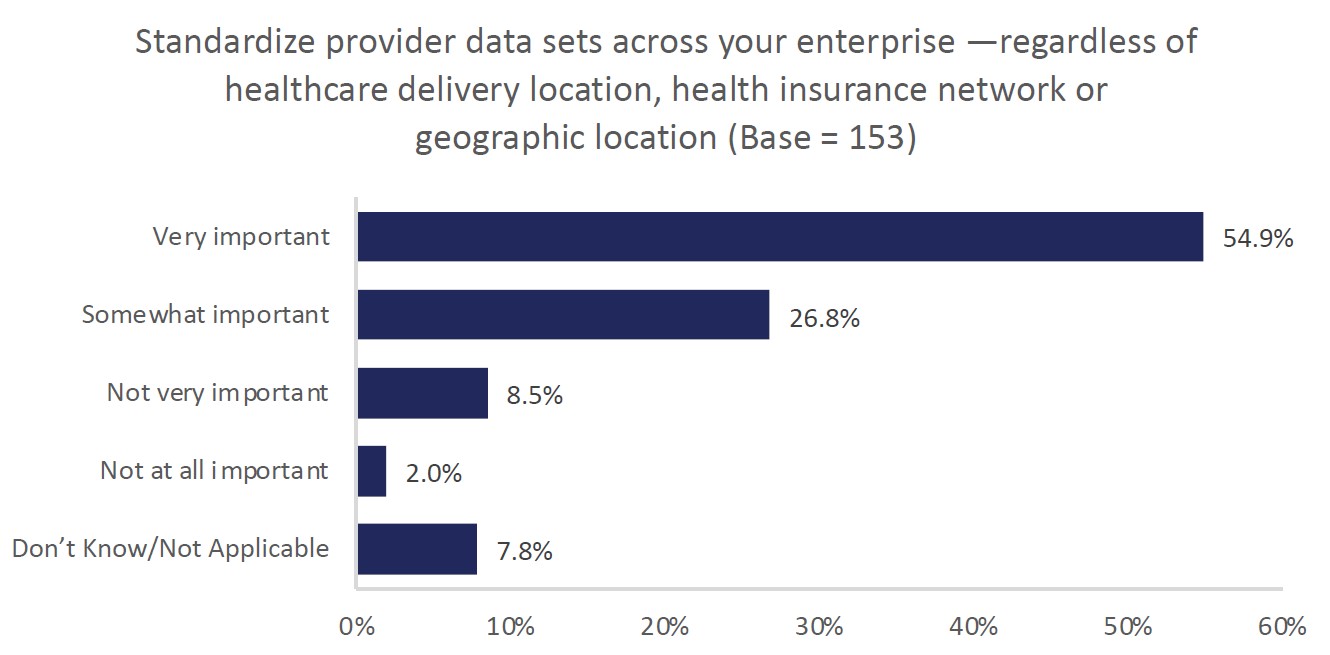
Being that one of the reported impediments organizations face is a lack of a clear definition of what provider data management is, it follows that respondents agree that standardizing the procedure is important. With standardization comes accountability, the ability to track, and more overall clarity. With today's MSP's never-ending list of responsibilities, organizations could stand to benefit from implementing solutions that facilitate their data management so there are fewer errors down the line.
As we get ready to head into the new year, organizations are looking for ways to become more efficient while protecting their bottom line. Provider data management is a critical component of the healthcare setting. The better that data is handled, the better the outcome. Our survey uncovered much more about how different organizations work within their provider data management constraints. Get all the details by downloading the report, or watch the webinar uncovering the results. We hope you find this information as valuable as we did, and if you have any questions, we're only a phone call away.

Healthcare fraud, or false claims, is an expensive crime affecting individuals and organizations. Learn the types of medical fraud and what to watch out for.
In this day and age, there are countless types of fraud we need to be wary of - identity theft, cashier's check fraud, phishing, and more. Another very real and malicious kind of threat is healthcare fraud. According to one legal definition, healthcare fraud is defined as "a crime in which healthcare claims are dishonestly filed to profit illegally from the payments received." It is an expensive crime that leads to a loss of nearly $60 billion per year. And it affects both individuals and businesses alike, potentially raising health insurance premiums, exposing patients to unnecessary procedures, and even increasing taxes.
In this post, we'll discuss different healthcare fraud scenarios along with tips on how to protect your organization.
Types of Healthcare Fraud
Both patients and medical providers can commit healthcare fraud by intentionally deceiving the healthcare system to receive payments or benefits not legally granted to them. There are a few different kinds of healthcare fraud or false claims. The ones committed by medical professionals typically fall under four different categories:
The potential damage of false claims is so large, that a federal statute, The False Claims Act (FCA), was enacted back in 1863 in response to defense contractor fraud during the American Civil War.
According to the Department of Justice, "the FCA provided that any person who knowingly submitted false claims to the government was liable for double the government's damages plus a penalty of $2,000 for each false claim. The FCA has been amended several times and now provides that violators are liable for treble damages plus a penalty that is linked to inflation."
The FCA also allows private citizens to file suits on behalf of the government against those who have defrauded the government called Qui Tam suits. "Private citizens who successfully bring Qui Tam actions may receive a portion of the government's recovery." In fact, many fraud investigations and lawsuits arise from such Qui Tam actions, with the Department of Justice obtaining more than $5.6 billion in settlements and judgments in 2021 alone.
Examples of Healthcare Fraud
It's difficult to imagine defrauding the healthcare system, yet it happens every year. Here are three recent examples of false claims and what the outcome was for each perpetrator.
Summary: Dignity Health, a for-profit health system that operates three hospitals, was found guilty of knowingly submitting false claims to Medi-Cal for "enhanced services" they purportedly provided to patients from 2/1/2015 to 6/30/2016. "These health care providers siphoned critical Medicaid funding for their own gain instead of using it to provide health care services to patients most in need," said U.S. Attorney Martin Estrada for the Central District of California.
Summary: In its first settlement of a civil cyber-fraud case, the Department of Justice brought Comprehensive Health Services LLC (CHS) to justice. Allegations state that CHS submitted claims to the State Department for the cost of a secure electronic medical record (EMR) system to store confidential patient information, and it was found that CHS failed to consistently store patient information in the secure EMR. It was also found that CHS gained access to controlled substances not approved by the FDA, without the proper permissions, and supplied the unapproved controlled substances to patients under State Department and Air Force contracts.
Case 3: Michigan Doctor to Pay $775,000 to Resolve False Claims Act Allegations
Summary: Vinay K. Malviya M.D., a gynecologist oncologist, was found to knowingly submit false claims for payment for federal health care programs related to radical hysterectomies when only simple hysterectomies were necessary. Claims also state that the chemotherapy services ordered by the doctor were in excess of what was medically necessary, and also that evaluation and management services were not performed or completed as needed.
One thing is clear, false claims are expensive and potentially damaging to patients. As Medical Services Professionals (MSPs), one of your key responsibilities is keeping patients safe. So, how can you keep your organization protected from healthcare fraud? It all starts with Workforce Validate.
About Workforce Validate
Workforce Validate empowers organizations to prevent fraud, reduce risk, and build a culture of compliance. From initial exclusion checks to ongoing monitoring, Workforce Validate ensures each member of your staff is clear to be on the floor and in compliance with healthcare requirements and standards. Once implemented, Workforce Validate works in three simple steps:
You review any exclusion flags and take action to ensure your staff and providers are up to par.
With access to over 900 board sanction sites, more than 70 federal and state exclusion lists (including OIG sanctions and SAM exclusions), and over one million healthcare professionals validated to date, you can be sure Workforce Validate has the information you need to prevent threats from entering your workforce.
Active, ongoing monitoring of your workforce is a key component of managing the risk inherent in providing healthcare today. Learn more about how Workforce Validate can help you prevent fraud, ensure compliance for your workforce, and ensure quality care in one fell swoop.

Get answers to the top five privileging questions from our Privileging 101 webinar series, from requirements to procedures and medical staff policies.
In our Privileging 101 webinar series, we covered a variety of topics, like legal aspects of privileging, the anatomy of a privilege delineation, and much more. As you can imagine, we received many follow-up privileging questions when the series concluded. Below, you can find some of the most frequently asked questions and our answers to them. For a deeper dive into all questions asked, check out the series Q&A session.
Question #1
When it comes to telemedicine and virtual visits, does this require separate or specific privileging outlined in the privilege set? What certifications or requirements can be waived for telemedicine (i.e., life support certifications, etc.)?
If a provider is delivering healthcare services both in-person in a facility and other services are provided virtually, typically, the virtual services would not need to be privileged separately. If a provider is delivering services only virtually, they would then need appropriate privileges for the services to be provided.
Any requirements that would only be important if a provider was delivering services in person could be waived. This could include health screening, vaccinations, life support certifications, etc. activities that may not be required for telemedicine.
Question #2
Should education be verified through the National Student clearinghouse?
Yes, you can verify education through the National Student Clearing House. It can also be verified by pulling an AMA profile for your MD providers, and/or by pulling an AOA for your DO providers. You can also verify their education by outsourcing it to the Provider's Educational Institution.
Question #3
What is the difference between the Centers for Medicare & Medicaid Services (CMS) Conditions For Coverage (CFCs) and Conditions for Participation (CoPs)?
Both CFCs and CoPs are the health and safety requirements put in place by the CMS. They are the foundation for protecting the health and safety of beneficiaries while improving the quality of care. Organizations must meet these requirements in order to participate in both Medicare and Medicaid programs.
Conditions for Coverage define the covered services within Health Care Organizations that are covered/eligible for payment by Medicare and Medicaid.
Conditions of Participation are the Federal Standards that Health Care Organizations are required to be in compliance with, in order to receive Medicare and Medicaid certification and payment. There are specific CMS CoPs related to Privileging:
Condition of Participation: Governing Body
Condition of Participation: Medical Staff
Question #4
Is there a CMS requirement for the automatic suspension of a provider's privileges if they do not complete their patient medical records within 30 days post-discharge?
Enforcing suspension of Privileges due to medical records delinquency is at the discretion of the hospital's medical staff. Many hospitals choose to enforce this type of suspension to encourage completion of medical records within 30 days, so they are able to bill Medicare within the required timeframe to maintain their Provider Interim Payment (PIP) status.
Tips:
Question #5
Does the CMS define who the responsibility falls on for the review of privilege forms every two years? Is it the responsibility of the CVO, MSO, Medical Director, Department Chair, or someone else?
There are no regulatory requirements that specifically state the titles of clinical leaders who must participate in the process of reviewing privilege forms. The organized medical staff should have a policy regarding the review of privilege forms, so you should refer to your policy to determine if your medical staff has defined any clinical leaders as required members for participating in this process.
Once privilege forms have been developed, the medical staff should have a plan for regular review and updating of all privilege forms in order to keep privilege forms relevant and in alignment with current requirements. Some privilege forms will require annual review while others may be reviewed every two years.
Also, in between formal review periods, the medical staff should have policies and procedures in place for when new technology, equipment, or procedures are introduced, which would require new privileges to be added to their delineations. They must determine that the privilege/procedure in question should be added to the scope of services for the medical staff, and they must develop criteria for what providers will be eligible to apply for the new privilege or procedure.
More Q&A
These are just five of the privileging questions we received at the close of our Privileging 101 webinar series. To access more questions and answers, listen to our bonus Q&A webinar session. If you still have some unanswered questions, worry not, that's what we're here for. Just give us a shout and we'll do all we can to get you the answers you need to become a privileging pro!





