Explore expert insights from HealthStream on healthcare compliance, credentialing, clinical education, scheduling, and leadership. Find practical guidance to help healthcare organizations train, retain, and support their workforce.
Practical insights on healthcare compliance, workforce development, and clinical education from the experts at HealthStream.

Learn what home health care nurses do, why demand is growing as the U.S. population ages, and what to consider before choosing this nursing career path.
As the U.S. population ages and the proportion of older Americans increases in size, the demand for healthcare is expected to grow significantly. Not only are we going to see a need for clinicians in greater numbers, but we are especially going to see the demand increase in areas of healthcare that can have a positive impact on the overall cost of care. Home healthcare, when used in a coordinated effort to keep patients out of the hospital and compliant with treatment regimens, plays an important part in reducing hospital stays and costly readmissions. Home health care nurses play a vital role in the patient care continuum and in compliance with care regimens that ensure better outcomes.
Home health nursing is one of the many career options available within the nursing profession. It is a choice for registered nurses (RNs), licensed practical nurses (LPNs), and nurse assistants (NAs). The educational requirements for a home health nurse are dependent on the following nursing certifications:
Home care nurses provide home-based care for patients, typically in the form of follow-up treatment post-discharge from a hospital or other medical care environment. By not being facility-based, home care nurses get to be self-directed and practice efficient time management. They often interact with patients' families in the course of patient care, so that their clinical proficiency needs to be matched with strong communication skills and comfort with a breadth of cultures and lifestyles. Home health care can be physically demanding and require lifting, turning, or moving patients who need the assistance.
The specific duties of a home health care nurse are largely linked to their credentials and the kinds of care their credentials allow them to provide. Here are some examples:
Many people want to become nurses without necessarily desirous of working in a hospital environment. Here are some of the reasons home healthcare might be the right career choice for them:
References
nursing.jnj.com, "Five Reasons to Consider a Career as a Home Health Nurse," June 14, 2017, Retrieved at https://nursing.jnj.com/nursing-news-events/five-reasons-to-consider-a-career-as-a-home-health-nurse.
registerednursing.org, "What Is a Home Health Nurse?," n.d., Retrieved at https://www.registerednursing.org/specialty/home-health-nurse/.
HealthStream's jane™ is the World's First Digital Mentor for Nurses. Jane harnesses the power of artificial intelligence (AI) to create a system that personalizes competency development at scale, quickly identifies risk and opportunity, and improves quality outcomes by focusing on critical thinking. Leveraging decades of research and with over 4 million assessments completed, Jane was designed to power lifelong, professional growth of clinical professionals. Learn about HealthStream's Suite of Clinical Development solutions for nurses.

Workforce Validate is a safe, easy way to monitor workforce compliance, alerting leaders and employees to license and credential issues. Learn how it works.
This blog was taken from a recent HealthStream webinar entitled "Introducing Workforce Validate." The webinar featured HealthStream's Tom Emberson, VP, Workforce Validate, Caroline Shirley, Product Manager, Workforce Validate, and Austin Cooper, Regional Manager, Workforce Validate.
Staying on top of license and certification validations in healthcare is a tall order - to put it mildly. Healthcare organizations need to monitor the status of employees, contractors and vendors. The numbers of employees can range well into the thousands for larger organizations and the changing regulatory landscape and the constantly growing and changing employee rosters don't make the task any easier.
While it may not be easy, it is essential. Failing to execute on this critical process can result in increased risk to the organization and its patients, financial penalties and, in some cases, the loss of public trust.
Emberson began with an overview of Workforce Validate. The solution includes automated, ongoing license verification and certification monitoring, as well as sanction and exclusion monitoring. Users can feel comfortable with this solution because HealthStream has more than 20 years of experience validating providers and performs more than 1 million verifications each year.
The validations are provided via primary sources for state boards. The validations are automated and ongoing and Workforce Validate includes reporting that will help leaders know precisely when licenses and certifications are due to expire.
Best of all, HealthStream offers this automated license verification tool free of charge to users with a subscription to the HealthStream platform and you can get started by simply syncing your employer, contractor and vendor databases to Workforce Validate.
Cooper demonstrated some of Workforce Validate's key features beginning with the dashboard. The dashboard includes a snapshot of the total workforce and shows employees whose licenses or certifications are expired or are due to expire soon (within a 90-day window.) The dashboard also highlights any sanctions so that leaders can take immediate action.
The software provides notifications relieving leaders of some of the burden of employee notifications. "As the expiration date gets closer, starting at 45 days and all the way up to the expiration date, Workforce Validate will send emails to the administrator and to the employee," said Cooper.
Workforce Validate also provides the kind of reporting that helps to reduce risk and makes compliance easier. Users can review aggregated data, but they can also drill down into specific results. This allows users to see specifically where the license comes from as well as the auditable date and time stamp of when the license board was last queried and verified the license. The information includes a hyperlink to the specific board that provided the licensing information so that users can see that the license is indeed current at the board level and see all of the information that would be reported at that level.
Information can also be reported at a more granular level. Users are able to drill down into licensing and certification information for individual employees. By simply clicking on employee, users are able to see all of the relevant information about that employee. The information includes their title within the organization, and a snapshot of the most recent verification of their license, as well as any sanctions.
In addition to the excellent reporting and monitoring features, Workforce Validate's license product is designed to seamlessly integrate with My Team. All of the great data that is checked and reported on Workforce Validate is pushed to the My Team Dashboard. From there, nurse managers are able to see information on upcoming license and certification expirations. Essentially, this integration gives a wide swath of your organization access to the data and the autonomy with which to act upon the information.

Discover essential skills vital for successful nurse leadership training. Empower your team to thrive in their roles. Take action today.
Even before the pandemic and its rather disastrous effects on staffing, there was a definite need for effective leadership training for clinical staff. In the wake of the pandemic, hospitals are emerging somewhat battered. Most are in significantly worse financial shape than before the pandemic and most are also struggling with higher turnover rates, early retirements and a now urgent need to develop managerial skills in new nurse leaders. And, of course, the cost of turnover in leadership positions is high - in dollars and cents and in the loss of institutional knowledge.
Nurses are expected to be leaders early in their practice. They will lead and advocate for patient care and they will be expected to demonstrate leadership when caring for their patients, when structuring their own career paths and when helping to onboard newer nurses. However; they may also choose a career path that includes a formal leadership position and that will mean taking steps to ensure that they develop their leadership skills.
While leadership styles may tend to vary, there are some skills that nurses in leadership roles need in order to successfully manage the kinds of teams that provide the best in patient care. Nurses need to develop both soft and hard skills if they wish to move into leadership roles. Those skills include:
Healthcare organizations need to ask themselves if they are doing everything possible to identify potential leaders in their organizations and then invest in their development. HealthStream's Leadership Development Solutions can help you develop new leaders and support your existing leadership team.
Good solutions start with assessments which is precisely how this solution starts. The assessment process will give credit for subjects that have already been mastered and then create a customized education plan that focuses precisely on the knowledge gaps identified by the assessment.
HealthStream offers comprehensive solutions to develop effective healthcare leaders. The Frontline Nurse Leader content consists of 27 lessons that are organized into 8 modules. It is based on the American Organization of Nurse Executives' (AONE) Certified Nurse Manager and Leader (CNML) competencies. HealthStream Leadership Development includes an assessment that will help establish a personalized learning plan that will include courses curated from more than 200 course titles. Leadership Development also includes pre-defined curriculums on the most relevant topics - all specific to the unique requirements of the healthcare environment. The content is designed to be engaging and includes multiple instructional design methods.

Explore how data governance plays a critical role in improving patient care and operational efficiency. Begin optimizing your data now.
Anytime I begin working with a client, I make sure to mention the importance of data governance, regardless of whether we are working on implementation or optimization. As the scope of credentialing software such as CredentialStream expands to cover all facets of the provider experience from onboarding to enrollment within a single platform, data governance has become increasingly important. With multiple users comes the risk of variation in data entry. Is the medical staff office (MSO) using the same address format as physician recruitment and the enrollment team? For that matter, is everyone within the MSO using the same address format? Is physician recruiting exclusively capturing a provider's married name, only for the MSO to realize later that the provider is licensed under their maiden name? These are just a few examples of how easily data can come into your software in a myriad of ways. Most of us working in the field have spent a significant portion, maybe even years, of our careers doing data cleanup.
While data governance is taking an increasingly important role in many MSO's as we look to gain further insight, it has been a consideration for physician leaders for years. I know many medical staff professionals (MSPs) find going from one credentialing software to another to be a monumental task, but what if you had to go from one electronic health record (EHR) system to another? To consider how we can apply such experience to our own data governance, implementations, and optimizations, I reached out to Dr. Bonnie Boles regarding the implementation of Epic at Tanner Health System.
Dr. Boles is a Senior Vice President and the Chief Medical Information Officer at Tanner Health System. As the chief medical information officer, Dr. Boles provides leadership and vision for the optimization of the Epic platform and serves as the bridge between technology and clinical care delivery within all facilities. She is responsible for data governance, which is used to enhance data driven process change, to deliver more efficient, effective care. Board certified in pulmonary and critical care medicine; Dr. Boles earned her medical degree from Emory University. She completed internship, residency and fellowship at Emory University and received her executive MBA from Auburn University.
Data Governance is critical to bring trusted and accurate analytics to an organization for driving strategic goals and initiatives. Data Governance is the people, process and culture around the data which is voluminous and often overwhelming. Data Governance brings standards, definitions, and policies so that different parts of an organization are using the same data to make decisions. Understanding Data Governance is the responsibility of everyone who collects and uses data. There are many examples of data issues leading to catastrophic events when there are no common terms or definitions in place. These are typically avoided if data literacy is a priority and leaders know how to request and use data. Healthcare is so data rich and the lack of data governance is an issue. We have recently launched our data governance project that will "advance analytics" at our organization. Defining metrics and prioritizing data needs are critical with all the challenges facing healthcare teams.
Training, personalization, and post go live "at the elbow" support is critical. The approach "specialists training specialists" really works. Epic trains the providers in their specific specialty and then those providers train their peers. This creates physician or APP subject matter experts (SMEs). We called them "Epic Physician Champions," (and we had a surgery PA that was included and was a phenomenal Epic trainer for her surgeons) in each specialty and they become another resource during and after go-live.
Dr. Boles hits on a really important point here about having a champion for your software and this is a great term. Here at VerityStream, we often refer to these users as super users. However, using the term "Champion" can be an additional way to empower the end user. I can think of several champions among our clients who have contributed to discussions and ideas.
The biggest takeaway from optimizing Epic is that you never finish optimizing Epic. Interestingly, that is not a negative. Epic upgrades the product quarterly to offer ongoing improvements and solutions, like your smartphone updates. This and ongoing feedback from end users create a situation that keeps optimization going. We continue to refine and "tweak" our order sets, workflows, and alerts to help our team provide the highest quality, safest care for our patients. We put our patients at the center of all that we do and that lends itself to ongoing optimization as well. Epic has been a true partner in these efforts. There are Epic team members that become your technical support and you have a BFF (best friend forever) from Epic. They have been supportive, helpful, and available which makes a very positive impact on our work with optimization.
As Dr. Boles stated, "The biggest takeaway from optimizing Epic is that you never finish optimizing Epic." Now, let's all repeat that three times, however, replace Epic with my credentialing software. This is such an important point. Credentialing and Enrollment software continues to be enhanced with updates, many of which are inspired by users. For many, this is a shift from what has traditionally taken place when it comes to credentialing software.
I would not have gone live with as many "best practice alerts" (BPAs) as we did when we went live on Epic. We attempted to vet these, but we kept many of them because we thought they would help providers (physicians, nurses, APPs, respiratory, etc.) with patient care. However, many of them are not useful because they interrupt the workflow and bring attention to things that are already being addressed. We have a project now to remove many of the BPAs that are dismissed 100% of the time with no action taken. It would have been easier to introduce BPAs along the way with better vetting of them from end users after go-live instead of before go-live.
The underlying sentiment above about not interrupting the workflow of the end user is a key takeaway. Recently, a client mentioned to me that when they first got into the software, they felt like kids in a candy store. They could build anything and everything they wanted! However, over time and through testing they realized perhaps this wasn't the best approach when it was creating unnecessary change on the user side. Not only did it create extra work for their end users, but for the providers as well.
Whether you are utilizing data governance, implementing, or optimizing an EHR or credentialing software, the end goal is the same - a commitment to patient safety. This may be done through different methods, but as you can see our goals and challenges are the same.
I would like to thank Dr. Boles for taking the time out of her busy schedule to partner with me on this article and an upcoming piece on physician leadership!

Improve patient safety and physician performance with eight proven case review best practices. Learn how healthcare organizations can implement them.
Healthcare organizations juggle a variety of priorities, but the one of most important is patient safety. And one of the main ways to keep patients safe is to ensure the physicians they're working with are providing the best care. There are many ways to ensure physicians are performing to the best of their ability, and one of those methods is Peer Review. In this post, we'll go over both Peer and Case Review, and look into strategies for accurately evaluating provider performance.
Healthcare organizations, through their medical staff, are responsible for the quality of care and patient safety. Peer Review is a process that helps healthcare organizations ensure they are providing the highest level of care and patient safety possible. Peer Review involves members of a medical staff within a healthcare organization participating in activities that measure, evaluate, and help to improve the performance of providers within the healthcare organization.
There are both federal and state protections in place for Peer Review.
FEDERALSTATE
To claim Peer Review protection, all Peer Review information must be treated as confidential and/or privileged. All documents, such as Case Review documents, must cite confidential and privileged protection. If an organization doesn't cite protection language on its documents, or they make information available outside the review process, courts may find that the organization has waived its right to protection.
Case Review and Peer Review are related as case review is a medical staff-led initiative. Case Review is defined as:
A medical review in which the clinical care is cross checked against a specific set of standards, such as Medical Necessity Criteria. A reviewer (peer or physician) will look at a patient's level of care, intensity of treatment, and other care specifications to ensure that the care that was ordered, or provided by a physician or healthcare organization was appropriate and necessary.
A successful Case Review process usually involves eight best practice steps.
It is quite a monumental task, isn't it? The good news is, there are ways to streamline the process to ensure nothing falls by the wayside. With HealthStream's Evaluate, you can view every provider in your health setting, while you measure and monitor their performance and share that data with relevant parties. Learn more about it here, and if you have any questions, we're always here to help, just reach out.

Explore new approaches to enhance onboarding and orientation processes for healthcare staff facing increasing challenges. Discover how to adapt your methods.
This blog is taken from a recent HealthStream webinar entitled "Trends in Onboarding and Orientation - Solutions to Make It Safe and Efficient." The webinar was moderated by HealthStream's Beth Pfeifer and featured Julie Miller, BSN, RN, CCRN-K, Clinical Practice Specialist for the American Association of Critical Care Nurses (AACN).
While the experience-complexity gap is nothing new to nurse leaders, it has been greatly exacerbated by the pandemic. Recruitment and retention issues have served to further broaden the gap leaving relatively inexperienced nurses to precept novice nurses as experienced nurses continued to leave the bedside. These recruitment and retention challenges have created a more urgent need to have strategies to help make onboarding and orientation safer and more efficient for everyone involved. Miller shared tactics that will allow healthcare organizations to match employee needs more precisely to the right content.
Miller began by discussing the results of a recent AACN study that looked at the top three challenges as reported by nursing managers, directors, and Chief Nursing Officers (CNOs).
In addition, the study looked at trends among nurses including student nurses. This cohort also reported nursing shortages as a significant concern. This trend appeared slightly worse in the Western region and appears to be exacerbated by accelerated retirements and significant numbers of hospital-based nurses under the age of 35 leaving the workforce.
Miller shared that the study results also identified some meaningful shifts in hiring patterns. While the majority of nurses still begin their careers by spending about two years in an acute care hospital, about 6% of them expressed a desire to work part-time.
Slower hiring processes are also becoming more of the norm with a trend towards hiring nurses over time as opposed to having multiple start dates with large groups of nurses starting at the same time.
Quiet quitting was also mentioned by nurses and student nurses. Often seen as a byproduct of a lack of engagement or a desire to maintain work-life balance, it has manifested itself in nurses not wishing to work overtime, and no longer wishing to serve on committees and professional and governance councils.
As experienced nurses leave the profession or retire early, the experience-complexity gap widens even as the complexity of the patients being cared for remains high. "The Advisory Board recommends that healthcare organizations who wish to bridge this gap should teach novice nurses more effectively. Further, they recommend re-designing the processes for onboarding and training to accelerate the transition from novice to competency," said Miller. Miller recommends beginning with an assessment of your current orientation plan and then compare that to what your organization's nurses need to know right now. This strategy helps avoid cognitive overload. "When nurses reach cognitive overload, they're no longer learning and they're actually retaining less of what we are trying to teach them," said Miller. She also shared that AACN provides a free assessment on their website that will help leaders evaluate and think through how to improve orientation and onboarding in their organizations.
AACN found that 52% of student nurses were seeking a career in some form of critical care nursing. AACN's Essentials of Critical Care Orientation (ECCO) can help leaders match content to the specific needs of the learner. ECCO has both an Intensive Care Unit (ICU) and a Progressive Care Unit (PCU) track. The ICU track includes 18 modules and 72 assignments and the PCU track includes 17 modules and 68 assignments. Continuing education (CE) credits are offered at the assignment level making assignments flexible and customizable for learners and the organization.
Miller shared that ECCO is based on an instructional design principal known as "try then learn." The technique mimics the healthcare environment where nurses will need to assess their patients and begin making judgements about how to best care for the patient.
Miller went on to recommend that ECCO is best implemented as part of a blended learning strategy and encouraged users to blend its content with activities designed to reinforce and apply concepts learned in the modules.
ECCO also includes a Preceptor Tool that helps preceptors thoroughly cover information and recommends the skills to demonstrate. Each module covers the information that the nurse will need at the bedside including information about the hospital's protocols and procedures. In addition, there are tips on how to facilitate the nurse's performance on that particular clinical skill.

HealthStream's annual survey on provider enrollment reaches its sixth year. See what experts say about the No Surprises Act, financial outcomes and operations.
For the past six years, HealthStream has been conducting an annual survey on provider enrollment. Our goal is to uncover the top provider enrollment trends so that organizations like yours can better evaluate and manage their processes. This year, we surveyed over 500 Provider Enrollment professionals, the majority of whom were part of a physician or medical practice who are standalone, a corporate location of a health system (including health system-based CBOs), and hospitals that are part of a health system.
Responses revealed that the No Surprises Act is having a big impact on workloads and processes. In this post, we'll dive into the requirements of the No Surprises Act and how they are impacting credentialing experts.
The No Surprises Act protects people covered under group and individual health plans from receiving surprise medical bills when they receive most emergency services, non-emergency services from out-of-network providers at in-network facilities, and services from out-of-network air ambulance service providers.
Congress passed the No Surprises Act as part of the Consolidated Appropriations Act to eliminate surprise medical bills. The act contains requirements related to price transparency and provider directories that impact health plans. There are four new compliance tasks associated with the No Surprises Act that are impacting credentialing and enrollment professionals. These include the need to:
It's a large undertaking, so we sought to understand how the new requirements are impacting credentialing and enrollment professionals. It comes as no surprise that over half the respondents shared that these four new compliance tasks are adding new work to their day-to-day.
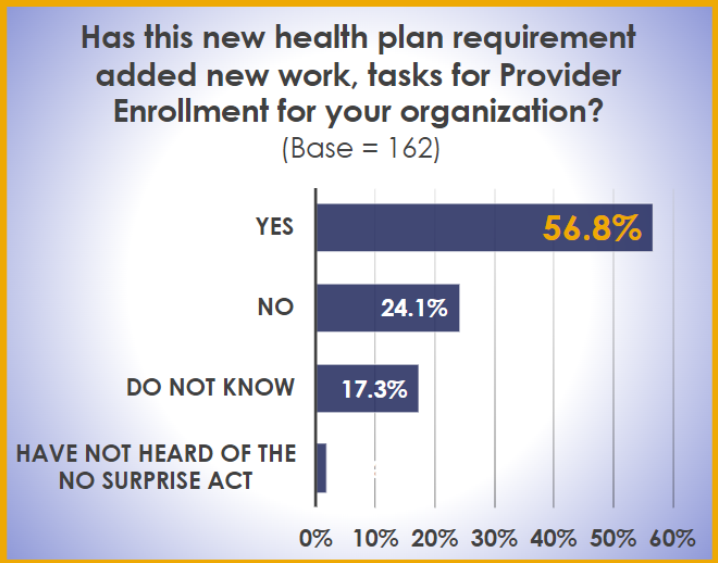
Those who were impacted by The Surprises Act were also asked to estimate how much time is being spent on the newly required tasks.
Interestingly enough, while enrollment organizations have seen an increase in the hours attributed to The No Surprises Act, 74.7% indicated that they have not added any new Full Time Employees (FTEs) to their organization, making it more important than ever to have automation in place to complete the work. Credentialing professionals will continue to work through a new system with many unanswered questions for the foreseeable future, as we are still waiting for The Centers for Medicare & Medicaid Services (CMS) to provide their rules and regulations.
In summary, the demands of the No Surprises Act are challenging credentialing and enrollment professionals to do more with their existing resources. Directory accuracy has always been an important aspect of information to the public, but ensuring accuracy is now more critical than ever before. And without additional resources, our experts will need to lean heavily into developing the most efficient process as possible to complete the work.
This year's annual survey uncovered many additional findings on pending claims, integrating with external services such as CAQH or PECOS and meaning provider data. Get the full scoop by downloading the report, or watch the webinar uncovering the results. We hope you find this information as valuable as we did, and if you have any questions, we're only a phone call away.

Learn how to turn scheduling information into action with ShiftWizard in this HealthStream webinar recap on smarter healthcare staff scheduling strategies.
This blog is from a recent webinar, "Scheduling Strategies: Turning Information Into Action." The webinar was moderated by Sarah Enders, Senior Product Marketing Manager, and featured presenters Terri Epler, RN, Solution Consultant Manager and Sloane Johnson, RN, Solution Executive.
In a rapidly changing industry, staffing challenges have been constant. Not only does this leave healthcare leaders overwhelmed and concerned, but it creates a feeling of disconnect between leadership and staff. As a manager, it's daunting to continually ask nurses to work more shifts, manage a budget, and create a diverse, fair schedule.
"Scheduling is a core function of the health system, scheduling is complex, but it shouldn't have to be difficult," said Sloane Johnson, RN, Solution Executive, during a recent webinar about creating a transparent, effective schedule using tangible, actionable information.
Whether your unit is still using the old-school method of pen and paper or has moved on to mass texts or Facebook groups, these processes have some serious issues, including:
With these issues in mind, the webinar outlined a new way of scheduling that not only removed many of these obstacles but created a more favorable work environment.
"Scheduling also has a downstream effect from patient safety and patient outcomes, burnout, nursing shortages, agency spend, and last but not least, nurse retention," said Johnson.
After outlining some of the challenges facing managers, leadership, and nurses, including the overall implications like wasted resources and unnecessary spending, Terri Epler, RN, Solution Consultant Manager outlined the three main ways ShiftWizard™, a HealthStream™ scheduling solution, empowered her and her team. From leadership to staff, ShiftWizard helped utilize vital information, create better communication, and elevate staff satisfaction.
Epler shared three of ShiftWizard's key features.
"Essentially, any information housed in Human Resources can be shared with ShiftWizard to ensure safe staffing - a critical feature when leaders need to be sure that they have the right mix of experience on a shift," shared Epler.
By integrating your EMR, HR, and Timekeeper systems, ShiftWizard can quickly and clearly show historical, real-time, and project productivity calculations based on your department's needs.
From inside the app, your team can quickly and easily see what shifts they're working and who they're working with; request PTO or swap shifts; self-schedule, and easily message managers or team members. And with easy-to-use icons, your staff can update managers on if they're available, sick, or not open to calls, helping you to create better work-life balance and job satisfaction.
"Complicated features and functionality are a requirement today, but not at the expense of ease of use. For example, rules-based guidance and intuitive navigation help managers make informed decisions," said Johnson.
ShiftWizard was built to empower nurses and leaders, create better communication, and be user-friendly across the multigenerational staff.
Another innovative feature that truly elevates ShiftWizard for healthcare leaders is that it provides next-level detailed reporting.
By seamlessly integrating with your facility's EMR and other systems, ShiftWizard can create near-real-time dashboards displaying information on staffing, patient acuity, census, and other vital metrics. Just like the other features in ShiftWizard, these dashboards can be personalized and tailored to your department's unique needs. It's simple and easy for users to build a variety of staffing reports, such as productivity reports, patient acuity reports, overtime reports, predictive census reports, and custom reports.
ShiftWizard is a comprehensive, customizable scheduling solution that can help your organization improve productivity, facilitate targeted communication, and provide reporting to help leaders better manage staffing.

Examine the essential role certifications play in healthcare careers. Discover how they enhance skills and improve patient care today.
This blog is taken from a recent HealthStream webinar entitled "Why Are Certifications So Important? Expand CE with CertPrep." The webinar was moderated by HealthStream's Jill Terry, Product Marketing Manager, Clinical Staff Development and featured:
The webinar addressed continuing education (CE) and its importance as more than just mandatory training. Healthcare organizations can empower nurses by creating a culture and environment where lifelong learning is supported with the very best tools and resources. Healthcare leaders must be able to address a wide array of learning needs. This webinar answers the question: "Why are certifications so important?"
White began by sharing that every nurse's journey is unique - the journey to certification and the choice of certification will be different for every nurse. "Certification is nationally-recognized by the American Nurses Credentialing Center (ANCC) as a measure of a nurse's ability to provide competent care and demonstrates specialty expertise in a clinical area," said White.
White went on to share that during her time as a nurse on a pediatric oncology bone marrow transplant unit, the expectation was that every nurse on the unit would achieve certification within 2 years. It contributed to a strong sense of pride in their patient care which was apparent throughout the unit as evidenced by high patient satisfaction scores, lower employee turnover and high employee morale despite the real difficulties of working on a challenging unit with high levels of patient acuity.
Continuing education can simply be a tool for ensuring that your organization's mandatory training requirements are met, or it can become a tool in your ongoing efforts to attract and retain top industry talent. Randall described how healthcare organizations can transform every milestone in a clinical career path into an opportunity to engage and retain that employee. Beginning with Basic Life Support (BLS) training all the way through to Preceptor and Nurse Manager training, employers can create, not just an opportunity to meet requirements and build skills but demonstrate to employees that the organization is committed to their professional development. "If you can engage your employees at each one of these milestones, you may be able to retain them longer," said Randall.
HealthStream's CE Unlimited with Jane® is both efficient and effective. In addition to having a comprehensive library with thousands of multi-disciplinary titles, it is able to reward learners for prior knowledge and allows them to test out of certain topics based on their expertise thereby reducing their time to completion. They are able to move more efficiently along their timeline to validate their skills without relying on the cumbersome and difficult-to-manage paper checklist process. With CE Unlimited with Jane®, those paper checklists can be digitized, making them mobile-friendly with automatic reminders of expiry dates.
CE Unlimited with Jane® helps you differentiate your organization from others by offering unlimited access to a large (more than 2,000 titles) library of high-quality CE courses. Staff can self-enroll in an unlimited amount of courses which puts them in control of their career path. In addition, there are more than 40 certification preparation programs to support career advancement. Managers may also assign courses at the user, department, discipline or facility level. There are courses for RNs, CNAs, and LPNs as well as courses on leadership and soft skills.
HealthStream's CE Unlimited with Jane® leverages artificial intelligence (AI) and delivers competency insights that will help tailor training to each student's specific needs. Staff take an annual assessment with questions based on their job and specialty. Based on their performance, Jane will then assign up to two courses for each question answered incorrectly by the student. "This creates a completely customized education plan for every member of your staff and removes any guesswork on your end," said Randall.
HealthStream introduced CertPrep, a mobile app, in February of this year. The mobile app puts practice tests and study cards at the users' fingertips making it easy to study during breaks or on the go. The material can be used on its own or in conjunction with textbooks or other material. The app works with both Apple and Android mobile devices.
Recently, HealthStream partnered with Advocate Aurora to pilot the CertPrep mobile application. Users reported finding the app easy to use and great for on the go studying. They also reported feeling more confident in their knowledge going into their exams.

Learn how ongoing and periodic professional practice evaluation (OPPE/PPE) improves provider performance, patient safety and organization-wide quality.
One of the most effective ways for a healthcare organization to keep their patients safe is through ongoing periodic practice evaluation (OPPE) or periodic practice evaluation (PPE). PPE programs and processes are how healthcare organizations meet the regulatory and accreditation requirements for peer review. HealthStream shares industry-leading best practices to evaluate performance that can be implemented within your healthcare systems to leverage the PPE program as a valuable and strategic contributor to both individual provider performance and organizational quality.
PPE programs enable healthcare organizations to accurately meet the regulatory and accreditation requirements for peer review. As is the case with most processes in the medical field, PPE requirements vary depending on the agency. Here's a quick summary of the details:
Centers for Medicare and Medicaid Services (CMS)
CMS has requirements that all healthcare organizations need to meet unless they have more stringent state requirements/accreditation body requirements. Those would need to be met as well while ensuring that the highest regulations and standards are met.
TJC accreditation applies to hospitals, ambulatory surgery centers, and Federally Qualified Health Centers (FQHCs). Regardless of which Joint Commission program you are accredited under, there are PPE standards that apply.
TJC will want to see both qualitative and quantitative criteria or data requirements which have been approved by the medical staff and designed into the OPPE process.
Healthcare Facilities Accreditation Program (HFAP)
The Healthcare Facilities Accreditation Program (HFAP) accreditation program applies to hospitals, ambulatory surgery centers, and physical rehab facilities.
Det Norske Veritas, Inc. (DNV)
DNV accreditation applies to hospitals.
Accreditation Association for Ambulatory Healthcare (AAAHC)
Accreditation applies to freestanding ambulatory centers such as surgery and pain management centers.
Many healthcare systems throughout the country have failed to recognize the full potential of having a PPE program and the impact it can have on providers, patients, and the overall quality of care throughout an organization. PPE has been primarily viewed as an administrative function belonging to the medical staff services department, but it's much more than that. PPE can be one of the most effective programs we have within the medical staff services department to make a significant impact on quality.
A PPE program is evidence that the medical staff has made a commitment to providing safe, kindly, efficient, effective, equitable, and patient-centered care in today's complex healthcare environment. It is through physician-supported and led programs and initiatives that performance expectations are established, and it provides assurance that the organization will exceed established standards of care for all patients. It is also one of the few mechanisms that allow the medical staff to proactively, concurrently, and retrospectively identify their combined and individual strengths, weaknesses, opportunities, and threats. In order to realize its full potential, we must make concerted efforts to move our PPE programs forward through standardization and optimization.
STANDARDIZATION OPTIMIZATION Standardization ensures the PPE processes and procedures follow established industry best-practice recommendations that support results that are relevant, reliable, comparable, and consistent. Optimization ensures those processes and procedures function as efficiently and effectively as possible, and continuously evolve not only to maximize the value of the PPE program but contribute to the transformation of quality in healthcare.
There are many i's to dot and t's to cross to ensure PPE is done effectively, but that doesn't mean it's impossible. With a solution like CredentialStream®, you have everything you need to request, gather, and validate information about a provider. Learn all about it and request a demo today!

Psychological safety and belonging matter to nurses. Learn how nurse leaders can build both on their unit in this HealthStream webinar recap.
This blog is taken from a recent HealthStream webinar titled "Building Psychological Safety and Belonging in Your Unit." The webinar was moderated by HealthStream's Beth Pfeifer, Product Marketing Manager and featured Cindy Cain, DNP, RN, CNS, CCRN-K, Clinical Practice Specialist for the American Association of Critical Care Nurses (AACN).
The term "quiet quitting" is one of the latest workplace buzzwords. Quiet quitting really looks like a loss of engagement and results in employees setting boundaries around their work duties - essentially setting a "work-to-rule" policy that limits their activities to just those in their job descriptions to avoid working longer hours and extra assignments. The webinar focused on practical tools to help healthcare leaders embrace strategies that will help strengthen staff engagement, retention and satisfaction.
Cain began by acknowledging that quiet quitting can be a double-edged sword. Some see it as a means of self-care - people are simply pulling back and giving themselves time to heal and that eventually they will re-engage. "Conversely, there are those that see it as quite alarming as it points to a level of disengagement that we have not seen in a very long time," said Cain.
Regardless of how quiet quitting may be perceived, there are some undeniable consequences to ignoring the importance of psychological safety and belonging. Cain cited the recently published AACN National Nurse Work Environment Report1. Although not surprising, the results indicated that improvements in the work environment are critical.
Healthcare leaders manage multiple priorities, so why should building psychological safety be one of those priorities? Simply put, psychological safety and belonging are critical to the safe and effective delivery of healthcare. Psychological safety results in:
In a unit where nurses feel like they belong, they will have a feeling of security and support along with a sense of acceptance and inclusion. When psychological safety is combined with belonging, nurses feel like they can bring their authentic selves to work which results in improved performance and higher levels of engagement.
Leadership matters when creating psychological safety and belonging. Leaders need to be transparent and willing to admit mistakes when appropriate. Leaders will need to be patient, vulnerable, and accepting of different points of view.
In addition, Cain gave some specific recommendations on how managers can help to build psychological safety and belonging on their units.
Leadership matters when creating psychological safety and belonging, but employees should contribute too. They should be encouraged to praise their colleague's work as appropriate. They should also be urged to provide timely and honest feedback for their colleagues and their leaders, and be willing to thank them for their contributions. Like their managers, they should also be respectful of everyone's opinions.
AACN has established some standards to help leaders assess the health of their work environments. You can begin with an assessment to evaluate the health of your unit. The assessment will help you evaluate: skilled communication, true collaboration, effective decision making, appropriate staffing, meaningful recognition, and authentic leadership.
Cain also recommended psychological safety assessment tools from both Google and Magnet. In addition to these tools, she recommended that leaders take the time to better understand their own leadership styles through the use of leadership style assessment tools. Results from tools that assess team and leadership strengths can help inform the process for building psychological safety and belonging.
1 https: //doi.org/10.4037/ccn2022798

Simplify your healthcare policy management with automation to ensure compliance and enhance efficiency. Improve patient safety and minimize admin burdens.
The most fundamental description of healthcare policy management is that it is a set of guidelines for an organizations' guidelines. It is a deceptively simple definition that, while essentially accurate, belies the complexity of the issues associated with a well-executed plan for policy management in a healthcare organization.
Healthcare is a highly-regulated industry covered by a wide variety of regulatory agencies. Healthcare organizations are regulated at the local, state and federal levels. In addition there are accreditation bodies that accredit hospitals as well as specific specialties and programs. All require strict adherence to what an extensive list of standards for literally every aspect of healthcare organization's operations.
While the various policies may feel cumbersome and the processes for managing those policies may feel unwieldy, the reasons for these policies are compelling. They help prevent medical errors and errors in communication and have been developed with the goal of providing safe, effective, high-quality and error-free medical care to patients.
Because every aspect of healthcare (from cleanliness to reimbursement to patient safety) is regulated, the resulting list of regulators and accrediting bodies is lengthy and the corresponding number of regulations can run to the thousands. To further complicate the issue, policies change regularly and they must be documented and shared with staff to ensure compliance. The sheer volume of policies and procedures renders the task of maintaining, updating and distributing them nearly impossible. So, how should healthcare organizations go about policy management to ensure compliance, monitor changes in the regulatory landscape and provide optimal patient care?
HealthStream's Policy Manager can help simplify your organization's approach to the management of policies and procedures. Policy Manager can replace some of the most daunting tasks associated with policy and procedure management.
Paper and spreadsheets simply do not work when managing policies and procedures in healthcare, but automation can help your organization do more than just reduce paperwork. The most meaningful reasons to automate these processes are quality, safety and the reduction of medical errors.
Automation can enhance internal communication. To be effective, healthcare policy management needs to ensure that the right policies and procedures are in the hands of those frontline staff that need them. And leaders in healthcare organizations need to be confident that staff is aware of changes to policies and procedures.
Regulatory agencies and accrediting bodies regularly inspect and verify that policies and procedures are being reviewed and updated. Policy Manager provides reporting that makes it easy to demonstrate compliance with policy review requirements.
Another huge benefit to automating policy management is the significant improvement to operational efficiency. Policy Manager fully automates the processes to update, review, revise and approve thousands of policies and procedures - most of which must be reviewed on an annual basis. Policy Manager can reduce the time required for this process by hundreds of hours per year - saving time and money for your organization.





