Explore expert insights from HealthStream on healthcare compliance, credentialing, clinical education, scheduling, and leadership. Find practical guidance to help healthcare organizations train, retain, and support their workforce.
Practical insights on healthcare compliance, workforce development, and clinical education from the experts at HealthStream.

Learn tangible ways to support, develop and retain nurse leaders in this HealthStream webinar recap, with resources to invest in your nursing leadership.
This blog was taken from a recent HealthStream webinar entitled "Invest to Retain: Developing Effective Nurse Leaders." The webinar was moderated by HealthStream's Drew Casteel and featured:
Healthcare leaders face a number of mission-critical issues, but perhaps there is no more significant issue than that of retention and recruitment. Nurturing and retaining nurse leaders is a meaningful way in which to demonstrate your commitment to the development of your nursing staff. The panel shared some idea on how to best accomplish this.
Gedeon began by addressing the critical nature of the role of a nurse leader. Nurse leaders are expected to be both the face and the influencer of the executive team. "They need to be innovative and relatable while still maintaining an executive presence," said Gedeon. Dr. Glover also pointed out that we ask a great deal of our nurse leaders and she encouraged healthcare leaders to think about ways in which they could invest in the development of highly effective nurse leaders. She also had some specific development recommendations.
The presenters then turned their attention to retention strategies. Dr. Glover encouraged a holistic approach to building retention strategies and both presenters consider recognition a key component of that strategy. She stressed that nurse leaders who often have 24 hour accountability along with a broad span of control need to be recognized for their efforts and for the ways in which they are supporting their teams. While it is often overlooked, Dr. Glover shared that nurse leader retention can also be strongly contributory to frontline nurse retention.
In addition to recognition, both Gedeon and Dr. Glover also shared the importance of well-being and supporting and celebrating a healthy work-life balance. Burnout, exhaustion and a poor work-life balance are frequently cited by managers leaving their jobs. Gedeon also pointed to studies that cited poor sleep health as contributory to burnout. Offering mental health and wellness benefits can help along with supporting an infrastructure where managers can have uninterrupted time off. In addition, protected time for professional development and offering resources such as HealthStream can also build retention.
Gedeon went on to stress the importance of early development of nurses and leaders along with the importance of mentorship and building real opportunities to grow based on a solid understanding of your own strengths and weaknesses.
She also shared the essentials of the framework for development and retention - support, develop and accomplish. Healthcare leaders need to support the processes and infrastructure that will offer work-life balance and support the professional development that is critical to the development of leaders and a personal and organizational journey to excellence. Senior leaders also need to recognize and reward accomplishments as well as educational and career milestones.

Discover effective diversity, equity, and inclusion training strategies that promote compliance and foster a supportive culture. Join us to learn how.
Diversity, equity and inclusion training is a regulatory requirement, but it needs a different approach than most other regulatory requirements. Managing DEI requires more than just a "check the box" approach to bring about and maintain meaningful change. Meeting and exceeding those requirements will necessitate a program that provides the structure, content, support and measurement for real change.
In the 1960s there were two statutes that revolutionized employment practices - the Equal Pay and the Civil Rights Acts. The acts sought protection from ethnic and gender-based inequalities in salaries, hiring practices and advancement opportunities. Initially, little changed in gender-based pay gaps and other measures, but protected groups now had recourse in pursuing litigation related to employment inequity. It is only recently that organizations have begun to understand the importance of creating a culture to support these and other initiatives, to meet requirements, create sustainable compliance, and really embrace the spirit of this legislation.
By now, it is hard to imagine a leader that is unfamiliar with the Peter Drucker quote - "Culture eats strategy for breakfast." Most healthcare leaders can readily give an example of how the culture of their organization determined the success, failure or effectiveness of a particular strategy. There are a lot of moving parts in an effective DEI program which further complicates the development and deployment of these programs. Leaders need to address diversity, equity, inclusion, psychological safety, burnout, stress and other mental wellness issues as it is a critical component of their compliance program. It is also essential to retention. So, what can leaders do to build an award-winning culture that truly nurtures a care-forward environment that builds equity, diversity, and inclusivity?
At the heart of every well-executed, sustainable compliance initiative is a leadership team that is committed to building a culture that can sustain compliance. Leaders will need to be prepared to demonstrate both an organizational commitment to compliance as well as a personal commitment to the issue. Leaders set the tone for the entire organization on this and other initiatives. Leading by example is the best strategy for any initiative. Simply telling employees what they need to do is insufficient. Most of us can remember an inspiring or engaging leader. They likely led by example.
Leaders should plan regular communication on the issue of compliance and provide real examples of what compliance looks like - preferably from inside their own organizations. They also need to have an accountability program for themselves and the rest of the organization to demonstrate the importance of compliance and the consequences of non-compliance. It is also important to provide the right tools to support employees.
Professional development education can better prepare leaders to model these behaviors and develop clear programs for accountability. Engaging, interactive and industry-specific education is critical to the success of compliance efforts. Leaders should ensure that the education is ongoing in order to maintain the proper level of focus on the issues. It should also be updated on a regular basis to ensure that it accurately reflects current laws, regulatory requirements and best practices. HealthStream's Leadership Development Program is dynamic. It is not simply content; it grows and changes as the needs of your organization and the healthcare industry grow and change.
There are a number of mission-critical issues facing healthcare organizations in the post-pandemic world, but perhaps none is more pressing than recruitment and retention. Culture contributes directly to retention and the pandemic has put increased pressure on leaders to create the kind of culture that embraces, not just compliance, but a truly safe and welcoming environment. Additionally, leaders need to be able to demonstrate that the organization understands the importance of work-life balance and, more importantly, they need to support it with policies and resources.
Mental wellness matters and it is critical in the healthcare workplace. In a recent HealthStream webinar, Deryk Van Brunt, DrPH - CEO, CredibleMind stated that "The mental well-being of your organization is not an HR issue, it is a CEO issue." In addition, addressing mental wellness requires a strategy to provide resources for employees, training leaders to recognize signs of distress and how to connect employees with wellness resources.
Creating an organizational culture that embraces health equity and belonging is an essential component of a culture of compliance. Addressing bias and embracing diversity, while promoting health equity has intrinsic value, but it also optimizes employee retention and enhances the organization's reputation in the community. HealthStream's Health Equity and Belonging solution can help your leaders feel confident that the organizational strategy for health equity and belonging is the right fit for the organization while helping to create meaningful change.
Promoting a safety-focused culture is an essential part of a compliance initiative. Improving safety, reducing errors, and improving the quality of patient care are essential to risk reduction and improved outcomes. HealthStream's SafetyQ can do more than just meet regulatory requirements. It provides interesting, engaging, and up-to-date content that can educate your staff on the latest patient safety processes. It can help prevent medical errors and adverse events while improving both patient safety and satisfaction.
In addition, SafetyQ ensures organizational compliance with learning plans that are mapped to federal regulations such as OSHA and CMS's Conditions of Participation. The content is delivered in micro-learning modules making it easy for employees to incorporate the education into their busy schedules, and more importantly, it improves knowledge retention.
The fluid nature of healthcare regulation makes compliance challenging. HealthStream's ComplyQ can help mitigate risk and avoid the fines and penalties from violations by ensuring that your employees are compliant with the most recent federal regulations. It features adaptive learning which gives credit for knowledge, and engaging videos and infographics that create a more lively and engaging learning experience.

Learn seven strategies for adopting The Joint Commission's appointment period change from two to three years smoothly and keep your MSP workflow on track.
Medical Services Professionals (MSPs) share a variety of responsibilities, including that of reappointment, the process of re-evaluating a provider's current competency and qualifications to provide care. Reappointment is a critical component of ensuring patient safety, as it is an opportunity to verify a provider's performance, medical judgment, clinical skills, and professional behavior in order to ensure they continue to meet your organization's standards.
In 2021, the National Association of Medical Staff Services (NAMSS) hosted a roundtable demonstrating the shortfalls that a two-year reappointment cycle, alongside continuous monitoring, had on healthcare organizations, and requested a solution. As a result, The Joint Commission (TJC) announced a change to the reappointment process timeline in November 2022, extending it from two to three years.
Extending the practitioner reappointment timeframe is effective immediately, which means organizations with plans to adopt the change must develop a reliable course of action to move through the transition period effectively and without compromising patient safety.
Organizations will all have different factors to consider when assessing whether moving to a three-year cycle is beneficial. These include:
With all this information considered, you'll have what you need to develop a clear recommendation for medical leadership to obtain support required for change.
After determining it's time to start the transition process and creating a work distribution plan, you can employ different reappointment methodologies to ensure a seamless progression.
All these methodologies come with their benefits, and challenges too, like heavier appointment months or lack of standardization. This is why it's important to assess which methodology is right for you. To get a clearer picture of what this transition entails, contact us. Our experts will walk you through all the details you need to be successful.

Effortlessly comply with the No Surprises Act. Discover how CredentialStream simplifies the credentialing process and empowers your health plans.
Medical Services Professionals (MSPs) have a lot to keep up with. Whether it be data management or resource management, MSPs are tracking multiple components that are critical to the success of a health plan's operation. One major challenge health plans face today is navigating the No Surprises Act. But the good news is, they don't have to tackle it alone, Network with CredentialStream can help.
The No Surprises Act
Congress passed the No Surprises Act as part of the Consolidated Appropriations Act of 2021 to eliminate surprise medical bills. It requires health insurers and healthcare practitioners to work together to ensure consumers are informed and protected from unexpected out-of-network bills.
The act also enacted a directory verification mandate for fully insured group health plans, individual health plans, and self-funded employer plans. The legislature aligns with the existing Centers for Medicare and Medicaid (CMS) mandates related to directory accuracy requirements, which require directory information to be updated every 90 days. Specifically, upon receipt of a practitioner or facility change, the plan has two days to update the directory. And, all consumer inquiries must be responded to within one business day upon receipt of the request.
Easily Meet the Requirements of the No Surprises Act
CredentialStream® is an easy-to-engage with software solution for credentialing, enrollment, privileging, and evaluation, that enables MSPs to cover every angle of the provider lifecycle. CredentialStream's Network module directly addresses payer needs with a focus on provider data management and the creation of downstream efficiencies. Separate workflows designed to support key demands include:
More importantly, Network provides support for the No Surprises Act with its unique data structure, which establishes a dependable relationship between individuals, organizations, and the line of business.
Specifically, Network allows individual practitioners to be linked to your organization with a variety of different attributes, including:
And, more specifics can be added, such as:
Serving MSPs and Providers
Network allows credentialing specialists, provider relations staff, and network management staff the flexibility to login to manage practitioners, organizations, and lines of business from one centralized location.
CredentialStream also includes a Provider Hub, where providers can manage their own data. With access to a secure online portal, providers, individual practitioners, or their delegates are able to apply for initial credentialing, review re-credentialing details, and keep their own information up to date.
Automation and Reporting Delivered
Successfully managing the No Surprises Act starts with the ability to easily access and update directory information, which Network facilitates. Should provider or facility information change, key individuals at your organization will receive an email notification linking them straight to the Provider Hub, where they can review and accept changes as they filter in. The database is updated based on workflows you set up, ensuring data is updated accurately and in real time, within your required parameters.
Mass updating elements within CredentialStream and across workflows is also possible. Using the quick-edit functionality, you may select either one or 1000 records, and assign an attribute to them, for example, update their effective dates, and then save.
But the reporting capabilities within CredentialStream is where the solution really shines. So long as you have the data in CredentialStream, you can report off of it. That includes dashboard reports on your home page or an additional view section for dashboards. Better yet, you can share these links outside of CredentialStream, making it easier to share details with executives and other stakeholders. These details are updated and refreshed regularly, which means team members can access the same information from their own home screens.
Network Continues to Evolve as Your Business Evolves
Network is a one-stop shop for managing and monitoring provider networks for health plans, and it's always being updated and improved! The next set of updates to be released include:

In November 2022, The Joint Commission changed the reappointment timeline. See what MSPs should expect from the new reappointment process guidelines.
In November of 2022, The Joint Commission announced a change to the reappointment timeline. As a Medical Service Professional (MSP), you know that reappointment is the process of re-evaluating a practitioner's qualifications and current competency to provide services for a healthcare organization after they've been appointed to the medical staff.
One of the many responsibilities MSPs share is that of reappointment, the process of re-evaluating a provider's current competency and qualifications to provide care. Reappointment is critical for patient safety as it's an opportunity to ensure the provider's performance, medical judgment, clinical skills, and professional behavior continue to meet the organization's standards.
In 2021, the National Association of Medical Staff Services (NAMSS) hosted a roundtable, Focused Revision: Moving to a Three-Year Practitioner Reappointment Cycle and Enhancing Continuous Monitoring, that brought stakeholders together to discuss reappointment and continuous monitoring alignment and duplication. The Roundtable conversation shed light on the inefficiencies and shortfalls that a two-year reappointment cycle, alongside continuous monitoring, had on healthcare organizations.
At the roundtable, NAMSS 2021 President, Aimee Wooley-Randall detailed the amount of time and resources MSPs must dedicate to simultaneously reappoint and continuously monitor practitioner competency, "Both reappointment and continuous monitoring evaluate practitioner competency—and share similar processes and measures. The overlap creates administrative duplication, stretches resources, and prevents MSPs from working at the top of their scopes." In November of 2022, The Joint Commission extended the practitioner requirement from two years to three years, stating "This change was made to better align with the standard practice of evaluating licensed practitioners every three years."
Extending the practitioner reappointment time from two years to three years is effective immediately unless laws and regulations require a shorter period. This change enables MSPs to perform continuous monitoring and quality assessment, as well as help reduce duplicative credentialing/re-credentialing processes. These updated guidelines apply to:
Under these updated guidelines, due dates and governing body approval dates have also changed. Per The Joint Commission:
Due Dates
Reappointment/re-privileging is due no later than three years from the same date from the previous appointment or reappointment, or for a period required by law or regulation if shorter. For example, if the reappointment period is July 1, 2021, through June 30, 2024, the reappointment date would be July 1, 2024.
Governing Body Approval Dates
The reappointment/re-privileging dates do not need to match the governing body approval dates. The governing body should be approving effective periods in advance of the expiration date. For example, in June, the board would approve all July reappointments/re-privileging effective periods and in July the board would be approving all August reappointments/re-privileging effective periods. It would not be necessary to keep changing the effective period to match the date the board actually met and approved the appointment/reappointment or privileges.
The biggest benefit of this change is that the new timeframe will better align with the standard practice of evaluating licensed practitioners every three years, but there's much more. In fact, during the NAMSS roundtable, Focused Revision: Moving to a Three-Year Practitioner Reappointment Cycle and Enhancing Continuous Monitoring, they outlined a variety of reasons an extension would be favorable, including:
Learn how AI and automation are enhancing revenue cycle management with insights from expert Susan Gurzynski-Wells. Join the conversation today.
Automation and artificial intelligence can help healthcare organizations navigate staffing shortages while maximizing financial outcomes - but only if personnel are trained and skilled appropriately.
This blog post is taken from a recent Healthcare Insider podcast featuring Susan Gurzynski-Wells, MS, RHIA, director of product management at HealthStream, who discusses opportunities for AI and Automation to be leveraged in revenue cycle management and explores strategies for ensuring the workforce is prepared to use these technologies most effectively. Gurzynski-Wells is a subject matter expert in the areas of ICD-10 and CPT coding, evaluation, and management, as well as patient access and revenue cycle management. She regularly works with clients to align revenue cycle solutions with both clinical and business objectives.
Susan was inspired to get into healthcare by her father, who was the head of the Department of Public Assistance in Pennsylvania. He had worked on a project to eliminate fear of payment from patient care, which opened up her knowledge of hospitals and healthcare. This long exposure to the needs of various stakeholders in healthcare, and particularly the revenue cycle management aspect of healthcare, has provided insight into the current urgency to address automation in revenue cycle management.
"I think given our current and potentially future staffing shortages, organizations are going to need to leverage automation for routine tasks. That automation can speed up processes, enhance accuracy, and free up our revenue cycle staff to focus on the tasks that require critical thinking and human intervention, thereby giving more attention to those complex claims," Gurzynski-Wells explained.
She acknowledges the task of operationalizing AI in revenue cycle management can be daunting, but advises organizations to remember, "Automation is not a substitute for effective revenue cycle process design … Automation and AI can enhance efficiency. It can identify trends and it could even cut costs, but it's important to note there isn't a one-size-fits-all."
The balance of automation against staff intervention and monitoring to catch errors or anomalies is essential to success. For this reason, Gurzynski-Wells says it is important to "build a talent base" that understands this.
This begins with understanding and documenting your current processes prior to implementing any automation or AI tools. It is a big transition, and to get the most out of it, organizations need to have a firm grasp on what they are currently doing so they are prepared to adapt to new technologies. Gurzynski-Wells says that "overreliance" on technologies may introduce new risks or negative outcomes. "These technologies really require that continuous monitoring, [because] they can produce errors that require human intervention to identify and resolve. And I think those skills may be new to some of our current revenue cycle staff. Data analytics is essential in monitoring output and then identifying those risks and trends. So specialty proficiency and things like analytics, cybersecurity, and denials management can be beneficial in optimizing those tools and resources that are available with the new technologies."
Of course, competency in problem-solving and social skills will also be critical, because staff will be working with anomalies or special cases that will require a little detective work and interaction with the patient or guarantors to resolve any issues. As an example, Gurzynski-Wells mentioned her dad, who is now "that 89-year-old who is seeking healthcare and has some special needs when it comes to understanding the technologies."
She goes on to say that the time is now to bring in the next generation of revenue cycle management professionals to build their skills and participate in training opportunities that incorporate these new technologies from the start. This will also give them opportunities to develop their own areas of specialty expertise, potentially growing their careers. In terms of Gen Z workers, Gurzynski-Wells explains, "They're more comfortable working in organizations that utilize advanced technologies more so than the generations that preceded them. They also embrace opportunities to take on new responsibilities, to continue their professional development and career growth. So I think organizations can motivate this younger generation by capitalizing on their skills, supporting the new technologies, soliciting input on the process design and monitoring, and providing paid opportunities for certification and continuing education." She noted the certifications and options for continuing education offered through HealthStream that are perfect learning opportunities such as Clinical Documentation, Insurance & Billing, and Denials Management, to name a few.
The bottom line: Organizations can't implement these new technologies and assume that they will be integrated in a way that is efficient but also patient-centric. There will be a learning curve for staff as well as patients, but organizations will need to rely on staff to ensure a smooth transition. "Automation should not be a substitute for human engagement," Gurzynski-Wells warns, adding, "I think leveraging technology's potential under human review is of utmost importance. Having a clear picture of the current state in addition to where the technologies can take us, and then allowing our staff to continue to develop their skills while mastering the new technologies is going to go a long way in minimizing the disruption and then maximizing the financial outcomes for the organizations that have adopted AI and automation."
During this interview, Gurzynski-Wells shares critical insights about operationalizing AI in revenue cycle management, ensuring the smooth integration of new tools, and helping the next generation of professionals achieve their career goals.
You can listen to the full episode here.
If you'd like to learn more about HealthStream's Revenue Cycle Management, click here.

Employee retention and engagement in healthcare have been challenged since COVID-19. Learn how managing staff has changed and what leaders can do now.
Written by
Back in April 2022 I authored an article entitled "Life Amid COVID: How Managing Staff Has Changed". It discussed the impact of the COVID-19 pandemic along with what we were beginning to understand as the ‘Great Resignation (1)' which was coined by Anthony Klotz a professor at the UCL School of Management. The ‘Great Resignation' which began in early 2021 continued until April 2023. COVID-19 resulted in many medical staff offices moving to be fully remote for the first time. All at once COVID-19 changed how we worked and how managers had to manage their staff. What we didn't realize at the time though was that the subsequent great resignation would leave many medical staff offices with unfilled openings. With the data collected over the past year and a half we can now start to see where organizations are headed.
Our 2023 Annual Report on Medical Staff Credentialing found that 62.8% of the 444 respondents to the survey had to recruit staff in the last 12 months with the two biggest recruitment challenges being candidates with the skill set for the position (75.1%) and finding experienced candidates (74%). Yes, the number of applicants is up, sometimes dramatically, however the pool of qualified candidates is limited. To a certain extent this isn't terribly surprising. During the early days of COVID-19 we saw many medical staff offices furloughing staff, some of which never returned. In 2021, 23.3% of survey participants of our annual survey on medical staff credentialing reported credentialing staff had been furloughed or permanently laid off. However, in our 2022 survey, only 43.3% of participants reported that their organization had added this furloughed or laid off staff back (3). Throughout 2021 and into 2022 we also saw employees pivoting to other roles or other fields all together. Even now, healthcare workers continue to resign, however, not at the rate we saw during the ‘Great Resignation' when 4.5 million resignations were recorded in November 2021 at the highest level in governmental records dating back to 20004 . It's fair to say that many of these resignations came from front line staff, however as anyone who works in credentialing or enrollment can tell you, our offices were not immune to this phenomenon.
As we head into 2024, where do we stand in terms of the employment landscape and how has managing staff changed? Throughout 2022 and into 2023 we saw many organizations, including in healthcare, asking employees to return to the office (RTO), at least a few days a week, if not fully. On the other hand, some organizations blazed ahead with a fully remote workforce. They no longer have offices and are looking to a new, fully virtual future. When we think about Medical Staff operations or credentialing there isn't necessarily a clear-cut answer on the best approach. Not only is each organization different, but the processes they are performing can also vary widely. This often comes across when I talk to my colleagues about what their organization is doing as they search for a path forward. Managers are looking to balance the needs of their organizations while considering what is needed to retain staff and recruit new employees.
WFH Research conducts a monthly Survey of Working Arrangements and Attitudes and has found that in 2023 the percentage of paid full days worked from home appears to have stabilized.
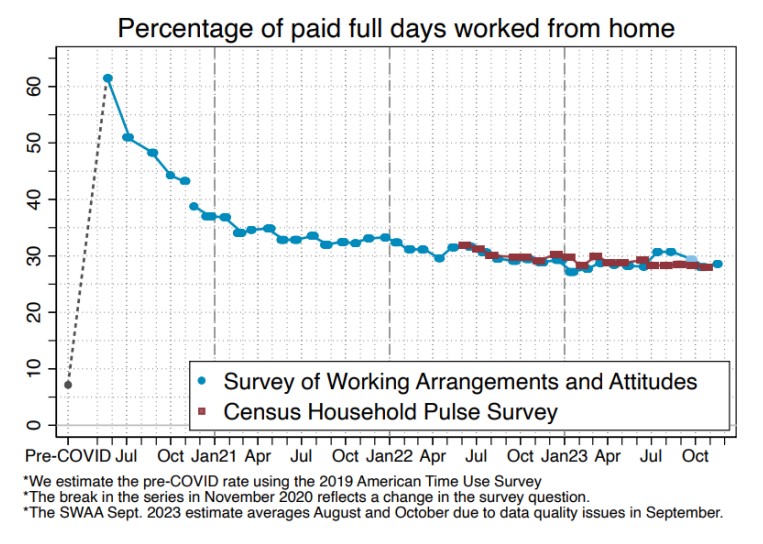
These results indicate that most organizations have determined whether they are going to be office based, hybrid or remote. In our 2023 Annual Report on Medical Staff Credentialing, we did not include any questions asking respondents what their current work model is. However, we plan to ask this question in 2024 so we can better understand where healthcare organizations are landing. This information may help provider further insights for leaders who are still undecided or interested in seeing what other organizations within the industry are doing. Keep an eye out for our 2024 survey which should be hitting your inbox in early 2024!
As organizations look to better manage their staff in this new work environment, they should look to implement some of the following, if they have not already:
While these are just a few suggestions, hopefully they will further discussions within your organization not only amongst leadership, but your employees as well. These can also be good considerations even if your organization requires employees to be onsite. Having this data may help give your organization an edge when it comes to recruiting or filling open positions in what has become an increasingly competitive market for experienced talent.

HealthStream Consultants passed the NAMSS CPCS exam. Learn about NAMSS certifications for medical services professionals and how to get CPCS certified.
The National Association of Medical Staff Services (NAMSS) has two Certifications which Medical Services Professionals (MSP) can obtain. The Certified Provider Credentialing Specialist (CPCS®) and the Certified Professional in Medical Services Management (CPMSM®) certifications are designations which provide the public and employers the assurance that the MSP has the necessary skills, knowledge and experience to perform his/her job to the utmost capability. The CPCS® certification assesses knowledge and skills regarding basic credentialing, privileging, and ongoing monitoring of providers, as well as supporting departmental operations on a day-to-day basis.
These certifications are developed by the Certification Commission of NAMSS (CCN), which is an autonomous arm of the NAMSS. The CCN must hold independent authority to protect against undue influence that could compromise the certification program. This independence is also required since the certification program is accredited by the National Commission for Certifying Agencies (NCCA) which provide standards for certification examinations across the country, similar to Joint Commission or the Center for Medicare and Medicaid Services (CMS). The CCN's policies, procedures, and processes are reviewed every 5 years to assure compliance with NCCA standards and exam credibility.
You may not realize it, but the CCN doesn't just get together to have a meeting and pick the questions out of the air. There are several steps that go into creating either of these exams:
As you can see, the exams are very rigorous, but those who successfully pass are examples of MSPs with proficient knowledge in the Medical Staff Services arena. Passing the exams require many hours of study, in addition to actually working in the medical services arena for several years. Being a certified MSP is a huge accomplishment!
Lisa Rothmuller, CPCS®
Associate Vice President, Consulting
Lisa began her career in the healthcare industry over 22 years ago, providing support and training for HealthLine clients. Over the 22+ years, Lisa has worked with hundreds of hospitals and organizations including the HealthStream Credentialing CVO on credentialing, privileging, enrollment and quality/peer review processes. Lisa is highly sought after for her expertise and industry knowledge, both internally at HealthStream and by clients.

Kay Lynn Akers, CPCS®
Director, Consulting
Kay Lynn has over 40 years in the health care field with the last 25 years at HealthStream in a variety of roles before currently serving as Director, Client Success Services and Consulting. During her tenure, she has worked with a wide variety of customer organizations sharing solutions knowledge, best practices, and process optimizations with the goal of maximum customer benefit. Prior to joining HealthStream, Kay Lynn worked at Sharp HealthCare, Rady's Children's Hospital San Diego, Medical University of South Carolina and served in the U.S. Navy as a hospital corpsman.

Dawn Anderson, PESC, CPCS®, CPMSM®
Senior Consultant
Dawn has spent more than twenty years in the healthcare industry. Dawn is known for her skills in working with medical group as well as hospital clients on use of CredentialStream software products for credentialing, payer enrollment, revenue cycle, and process optimization and improvement. Dawn enjoys assisting CredentialStream clients as they create value and optimize the use of their software and achieve greater efficiencies in their processes.

Nicole Otte, CPCS®
Director, Client Success Services
Nicole began her career as the Echo Database Specialist at St. Luke's Health System in Boise, Idaho, in 2012, where she was first introduced to the concept of credentialing. In 2015, she left St. Luke's after relocating out of the Boise area and joined Echo (now HealthStream). Nicole is now a key contributor to the success of the consulting team and is highly skilled in navigating health systems through enterprise implementations.

Katy Ann Young, MBA, CPCS®
Senior Consultant
Katy has seven years in the health care field and five years in the Credentialing and Privileging industry. She has been with HealthStream for three years. Before coming to HealthStream she was at Texas Children's Hospital, Ben Taub General Hospital, and the US Army. Since coming to HealthStream, Katy has worked with clients in several capacities, conducting business process reviews and assisting in strategic planning to help support organizational and system wide goals of her customers. Katy is passionate about the optimization of current solutions to reduce expenses and errors as well as streamlining in order to save resources.
CPCS and CPMSM are registered trademarks of National Association Medical Staff Services.

Discover how standardized sedation practices enhance patient outcomes and training for non-anesthesiologists. Gain valuable insights.
This blog is based on a recent HealthStream webinar entitled "Preventing Unfavorable Outcomes with Standardized Modern Sedation Practices." The webinar was moderated by Daniel Pawlus, HealthStream's Senior Manager of Digital Events and featured presenters:
The shortage of anesthesiologists has reached a critical point and it requires new and creative solutions of healthcare leaders. Recently, there has been an emergence of moderate sedation procedures that are being performed by non-anesthesiologists outside of the operating room. While it is a lifeline for patients, it is important to ensure that providers administering moderate sedation have received the best education on the topic.
Dr. Singletary began by describing the role of the American Red Cross Scientific Advisory Council (ARCSAC). ARCSAC is an independent advisory group that consists of about 60 physicians, paramedics, nurses, and other healthcare professionals who evaluate emerging scientific evidence related to resuscitation, disaster medicine, first aid, and aquatics. After the evidence is reviewed and summarized, the council provides the American Red Cross with recommendations regarding program content. ARCSAC includes experts from every field including adult and pediatric emergency medicine, critical care, trauma surgery, and others; many of which use procedural sedation. ARCSAC is also focused on the science of education. They wanted to be sure that they were using optimal education methods to teach this content.
Dr. Singletary shared that there had been a virtual revolution over the last 10 to 20 years in how physicians approach performing procedures that can provoke anxiety or produce pain. "Procedural sedation allows us to manage a patient's pain and anxiety in order to facilitate therapeutic and diagnostic interventions," said Dr. Singletary. Procedural sedation makes it easier for parents of pediatric patients as well and makes it less likely that adult patients will avoid certain medical and dental procedures due to concerns about pain. Dr. Singletary also shared that there has been a corresponding interest from patients seeking procedural sedation for procedures where sedation may not have been offered just a few short years ago. This has resulted in a mismatch between the supply and demand for procedural sedation as there are simply not enough anesthesiologists to meet the increasing demand.
While anesthesiologists are well-educated on procedural sedation, other healthcare practitioners will now need to learn procedural sedation practices. The presenters pointed out that there is currently quite a bit of variance in how this training is delivered with facilities relying on seminars and homegrown courses. This has resulted in very little consistency in the training. "Providing consistent, safe education to our colleagues that do procedural sedation is the right thing to do for the patients, for the hospital and for the anesthesia department," said Dr. Martin.
The Red Cross Sedation program includes modules for adult and pediatric patients. The American Red Cross Procedural Sedation courses were developed in collaboration with ASA and include the most current clinical information and procedural sedation best practices.
Presenters also addressed the importance of understanding the differences between adult and pediatric patients. They pointed out that in addition to the different doses required by pediatric patients, they may also have age-dependent developmental differences in how they metabolize sedatives and analgesics. In addition, there are anatomical differences in the airway that providers will need to understand.
The use of sedation in dentistry may also reduce the number of emergent dental problems that can be a result of neglecting dental care due to fears associated with the perceived pain of dental procedures. Presenters also shared that it can be useful in interventional radiology for procedures that require patients to remain still for long periods of time.

See how myClinicalExchange helps healthcare organizations like Logan Health take control of student onboarding and streamline clinical placement.
HealthStream recently had the opportunity to host a webinar entitled myClinicalExchange Empowers Logan Health to Transform Student Onboarding. Moderated by Daniel Pawlus, HealthStream's Senior Manager of Digital Events, the conversation featured:
During the webinar, Randall-Jones shared how myClinicalExchange allowed Logan Health to transform their entire clinical rotation workflow, while reducing the overall costs and resources dedicated to the student onboarding process.
Logan Health is a 590-bed health system in Montana with six hospitals and 68 provider clinics. Their service area includes the east and west side of the state, covers 20 counties, and includes 700,000 people. It supports 170 graduate-level students, 350 undergraduates, and their instructors each year.
Gangadharan began by introducing myClinicalExchange, a secure, online workflow application that seamlessly connects students, schools, and healthcare organizations while giving users real-time visibility into each student's onboarding process. Streamlined clinical rotation management helps ensure that resources are available to students as they grow into full-time clinicians and provides resources throughout their entire clinical journey.
Manual student onboarding processes, including email, phone, and fax communications, are time-consuming, overwhelming, and can lead to gaps in compliance. "Our ultimate goal is to bring everyone together to work in unison, transforming the student journey from one of chaos to control," said Gangadharan.
Randall-Jones shared her observations of the pitfalls associated with a manual process, describing it as chaotic and inefficient. Inconsistencies between programs and schools meant that information was often misdirected and sent to the wrong person, fax machine, or email. Using unsecured communication methods also created the potential for students' private information, including health records and social security numbers, to be inadvertently revealed.
She noted that retrieving program metrics was nearly impossible. "Simply knowing how many students were on our campus was time-consuming, labor intensive, and potentially error prone," said Randall-Jones. These risks eventually drove Randall-Jones and her teammates at Logan Health to evaluate systems to standardize and streamline the entire process. They needed a comprehensive solution to provide onboarding, scheduling, checklists, and compliance information, which led them to select myClinicalExchange.
Logan Health started onboarding myClinicalExchange as the pandemic was winding down so there was a natural sense of "change fatigue" for all parties. Randall-Jones and her team connected with each of their partner academic institutions early in the process to onboard them to the new solution, set expectations, and communicate the overall timeline. While some academic partners were hesitant to change, shifting to a more streamlined workflow allowed for more efficiency across the board. Additionally, Logan Health was able to easily access data that could help schools grow their programs.
Randall-Jones and her team scheduled meetings and training sessions with their academic partners and posted valuable information online for additional support during the implementation process. Beyond implementation, the Logan Health team continued to hold weekly meetings with academic partners to answer questions and ensure a successful launch.
When asked to share some of the benefits of transitioning to myClinicalExchange, Randall-Jones readily shared what she described as "two big benefits."
First, she cited the easily accessible data on their undergraduate programs. As healthcare leaders recognize that they need more undergraduate nurses to take care of increasingly medically complex patients, they are looking to their academic partners to grow their programs. Randall-Jones is now able to tell partners precisely how many slots are available versus how many the academic partners are actually using. That data can also be used by the system's compliance team to know how many students are on the campus, where they are on any given day or time, and check compliance information.
The transition to myClinicalExchange less than a year ago has freed up a significant amount of time for Randall-Jones and her colleagues. They can focus on other important initiatives and have already been able to significantly grow their job shadowing program.
myClinicalExchange empowers leaders to be more nimble at a moment's notice. Academic partners re-assign a student or move them to a different area, while administrators can easily see what is available and provide the best match for a student's clinical journey.
Gangadharan also highlighted that myClinicalExchange helps build a robust workforce pipeline by providing students with an efficient onboarding experience. Healthcare organizations give future clinicians a great first impression and are able to build stronger relationships with potential new employees.

Learn what's new in the ENA's Emergency Severity Index Handbook, 5th Edition, now simpler and better organized, with each chapter labeled by decision point.
This blog is taken from a recent HealthStream webinar entitled "Understanding the Emergency Nurse's Association's (ENA) Emergency Severity Index Handbook, 5th Edition." The webinar was moderated by HealthStream's Dan Pawlus and featured presenters:
The Emergency Severity Index (ESI) triage system is used by more than 94% of U.S. hospitals. Despite this, research has found wide variance in triage accuracy rates. Recently the ENA released the fifth edition of its ESI Handbook and the ESI 2.0 online course which is now offered exclusively through ENA and HealthStream.
Triage is a multi-faceted and complex process. McCallum explained that it was clear that there was a lack of understanding about how to apply ESI which resulted in less-than-desirable triage accuracy. She went on to share that the tool's algorithm is valid, reliable and has been well-researched across all age groups and in many different countries. ENA has updated the ESI education to help healthcare organizations feel more confident in the education and the ways in which they use it.
McCallum shared some of the updates that were included in the fifth edition of the handbook. Some of the research supporting the evidence was updated. In fact, more than 75 of the references are either new or have been updated to demonstrate that the algorithm tool is and remains valid and reliable. The update provides additional clarity aimed at improving understanding and reducing misinterpretations. The handbook includes detailed explanations for each decision point and updated decision point presentations for more accurate identification of levels 1 and 2 patients. In addition, a new part of the handbook addresses the role of racism, bias, and stigmas - all of which can impact the accuracy of a triage decision.
McCallum shared that the update clarifies what nurses need to know as well as where they can find it in the handbook. Further, she recommended that a copy of the handbook be kept at the triage desk and at every nurse's station for quick reference.
The algorithm itself did not change, however, McCallum pointed out a wording change that would add clarity to the decision-making process and help nurses better understand when to re-evaluate triage decisions.
In addition, the handbook has updated vital signs by age group and has added additional age groups that include the standard vital sign ranges. Also included are the temperature ranges that support the sepsis criteria.
The updated handbook also includes a section on frequently asked questions.
Next, presenters addressed the updates to HealthStream's ESI 2.0 course. All of the updates from the handbook are included in the course which now incorporates a voiceover - a feature that many learners will find beneficial. Knowledge checks to evaluate retention are still included and have been updated to reflect the content of the new handbook.
Additionally, there were some changes to the exams. The ESI Pediatric 2.0 now has pediatric-specific knowledge checks and exam questions and there are 25 new exam questions addressing the age-specific vital signs. A new exam structure now requires learners to answer 100% of Level 1 and Level 2 questions correctly.
McKone shared the three ESI course components:
The courses have a mobile first design with engaging and interactive modules designed to ensure that each patient receives high-quality, specialized emergency care. This proven approach can help your organization lower morbidity and mortality rates in the emergency department. In addition, the course has a pre-built curriculum that covers the updated handbook. CEUs are automatically tracked and recorded in the system and are easy to retrieve and report. McKone recommended that nurses review this course annually.
Finally, McKone urged customers to check to make sure that they are using the most recent ENA courseware and to check in with HealthStream if they are not using the 2.0 version of the courses.

See how HealthStream Learning Center revolutionizes healthcare training with a specialized LMS and innovative features designed for modern learners.
This blog is taken from a recent HealthStream webinar entitled "Discover Modernized Learning with HealthStream Learning Center." The webinar was moderated by HealthStream's Daniel Pawlus, and featured presenter Emily Dee, HealthStream's Learning and Performance Solution Executive.
The webinar explored how the HealthStream Learning Center is transforming the ways in which healthcare organizations approach learning and development with engaging content and integrated tools. Specifically, the webinar explored the advantages of a Learning Management System (LMS) that is dedicated exclusively to healthcare.
Dee began by sharing some observations about the evolution of learning management systems over the last 30 years. While LMSs are currently fairly ubiquitous across many industries, they are a relatively recent innovation.
In healthcare and many other industries, learning was delivered via instructor-led, classroom-based sessions and participation and evaluation was managed with paper and binders. The process could be described as uneven at best in terms of results and ease of management. Thirty years ago, HealthStream's CEO had the idea to improve both the efficiency and the efficacy of the process by moving to a digital platform and improving the availability of content, the ability to deliver that content and to measure its effectiveness.
Delivering educational content digitally makes sense. It is efficient, effective and can be easily updated to reflect changing industry practices and regulations. Dee confirmed that it makes even more sense when one considers that nurses graduating from nursing programs now are digital natives. They likely do not remember a time when there was no Internet and likely already have experience tracking and completing assignments and testing online. They are well accustomed to the changing nature of how digital content is delivered. "The HealthStream Learning Management System has constant updates, not just in content, but in the functionality of using the platform as a whole," said Dee.
Using a LMS that is purpose-built for healthcare has many advantages, and Dee highlighted just a few. She began by pointing out that when employees are able to log into a portal that has all of their information, including to-do lists, mandatory training, clinical checklists, compliance requirements, etc. It speaks to how that organization is providing for employees and helps give them confidence in the security of their chosen career - a significant benefit in an age of decreasing retention and worsening staffing shortages in the healthcare industry.
Leaders will also appreciate the efficiency of the reporting and analytics and the ability to see real-time data. The reporting can provide insights into completions and performance, and it can also provide data that will help quantify the cost of deploying the training.
She also pointed out that HealthStream's LMS gave users access to an entire ecosystem of healthcare-specific applications and content, allowing users to reduce their vendor footprint and manage multiple processes more efficiently. Simultaneously, users are able to reduce the employee effort, improving continuity and creating cost savings. In addition, integration with other systems is easy with HealthStream's LMS. HealthStream has a very efficient system for connecting to existing Human Resources Information Systems (HRIS).
She also shared the importance of this approach to mobile natives. HealthStream has a mobile-friendly approach making it more attractive and engaging for staff while giving them the opportunity to meet their learning goals anywhere at any time.
Innovation drives the development of HealthStream's Learning Center. LMSs typically cannot deliver information on license verifications and expiry dates for example, but HealthStream's does. This is the kind of feature that can only be found in an LMS that is specific to healthcare. Dee shared that the license verification service is integrated into various parts of the LMS giving employees and leaders direct access to real-time information on licensing.
Developers from our customers and partners have built automation based on learning application programming interface API) which enables greater flexibility to leverage the strengths of HealthStream's technology to further optimize workflows and processes.
This learning solution is tailored to the needs of people - people delivering healthcare. HealthStream's team builds the LMS to the specific needs of your organization. They have brought together an impressive roster of partners to provide an expansive list of content across, specialties, settings and the continuum of care. HealthStream's partner network covers everything that your organization needs to meet annual training requirements. The courses are regularly updated by subject matter experts to ensure that they remain relevant and up-to-date.





