Explore expert insights from HealthStream on healthcare compliance, credentialing, clinical education, scheduling, and leadership. Find practical guidance to help healthcare organizations train, retain, and support their workforce.
Practical insights on healthcare compliance, workforce development, and clinical education from the experts at HealthStream.

Data breaches disrupt patient care and cost millions. Learn why healthcare organizations should switch to longer passwords to strengthen cybersecurity.
Robin L. Rose, MBA
Randy L. Carden, EdD
HealthStream
Data breaches are creating massive headaches for the healthcare industry. They not only have the potential to disrupt patient care, but they can also lead to millions (and sometimes billions) of dollars in reparations, ransom, and HIPAA fines. Healthcare organizations are working diligently to address these threats, but the truth is it takes the cooperation of every healthcare employee to ensure a secure working environment. Organizations can be at the mercy of their weakest password. Are you doing all you can to keep your company safe?
Data breaches have become an enormous problem for healthcare organizations over the past 14 years. The chart below, which is based on HIPAA records, shows the upward trend in breaches the healthcare industry has experienced during this time (Murray-Watson, 2023).
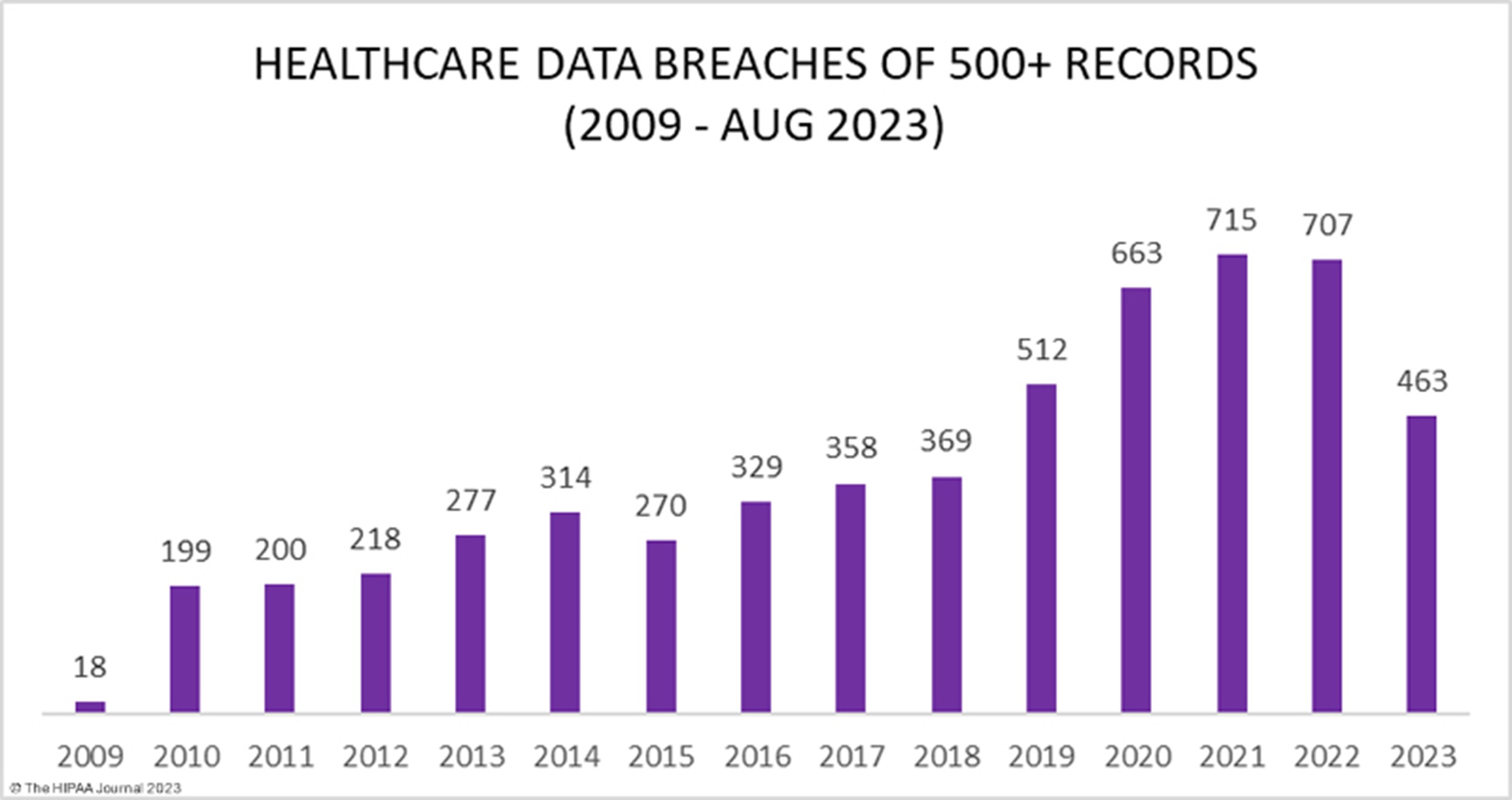
These breaches have resulted in the exposure or impermissible disclosure of 382,262,109 healthcare records which equates to more than 1.2x the population of the United States. In 2018, healthcare data breaches of 500 or more records were being reported at a rate of around 1 per day. Fast forward 5 years and the rate has more than doubled. In 2022, an average of 1.94 healthcare data breaches of 500 or more records were reported each day (Murray-Watson, 2023).
The richness of data housed by healthcare entities has been cited as a primary reason that healthcare is susceptible to high data breach and financial risks. Healthcare organizations usually possess a high volume of sensitive data. Data containing names, date of birth, social security number, address, and credit card information are abundant in healthcare records. Moreover, hackers prefer focusing on healthcare organizations because healthcare data is more valuable than data from other industries in the black market. An electronic health record (EHR), for instance, is worth between 10 and 100 times more than credit card information in the black market (Bhuyan, 2020).
The COVID-19 pandemic created a unique environment that fueled the incidence of data breaches in the healthcare industry. COVID-19 has been dubbed the world's biggest cybersecurity threat, with healthcare and banking industries being the most vulnerable to cyber-attacks (Nabe, 2023). Several factors contributed to this increase in the number of cybersecurity breaches and cybercrime attacks since 2019. The first factor is the increased demand for healthcare services due to the pandemic, which has led to a strain on resources and reduced the amount of time and resources available to dedicate to cybersecurity measures. This has made healthcare organizations more vulnerable to cyberattacks, as they have been unable to protect themselves adequately from cybercriminals.
The shift to remote working due to the pandemic has also increased the risk of cybercrime attacks, asremote workers need to be adequately trained in cybersecurity best practices and may be using insecure devices or networks vulnerable to attack. According to a recent study by Deloitte, some 47% of individuals fell for a phishing scam while working from home (Nabe, 2023). Cyber-attackers see the pandemic as an opportunity to step up their criminal activities by exploiting the vulnerability of employees working from home and capitalizing on people's strong interest in coronavirus-related news (e.g. malicious fake coronavirus related websites). Finally, the increase in the use of telemedicine due to the pandemic has created new opportunities for cybercriminals, as it has increased the amount of data being transmitted over the internet, which cybercriminals can intercept and exploit.
"Compromised passwords are one of the most concerning risks for hospitals and other healthcare organizations," reports Karin Balsley, Senior Director of Information Security at HealthStream. In fact, over 80% of data breaches are due to compromised passwords in some capacity (Enzoic, 2023).
Passwords are one of the most difficult areas in which to enforce effective security because they are selected by the user. According to Google, 52% of people openly admit to reusing passwords across multiple, if not all, accounts and sites. And like most people, healthcare staff reuse passwords. Even if an employee has a very complex password, reusing it on multiple sites can create a major vulnerability (Enzoic, 2023).
Weak passwords are also a major issue. Clinical staff often follow the path of least resistance when it comes to passwords. They often opt for passwords that are simple to type in and easy to remember. This includes creating passwords that use the name of the hospital or common dictionary words with simple substitutions. Unfortunately, cybercriminals are aware of typical substitution patterns, so these are very risky habits.
Password sharing is also a significant issue in hospitals and other healthcare settings. According to a study by Healthcare IT News, 73.6% of surveyed hospital staff had obtained the password of another medical staff member.
"Most incidents of unintended access start with an individual account that has an easily guessed pass-word," says Matthew Wilson, VP, Technology - Platform at HealthStream. "Organizations have established data access policies, and it is critical to adhere to those policies. It is also important to apply a common-sense approach to security. When it comes to people's behavior regarding IT systems, people should ask themselves: ‘Would I be comfortable if an employee of my bank did the same thing?'"
Commonly used passwords are often weak and easily hacked. According to SafetyDetectives.com, fifty percent of the most common passwords in the U.S. are also among the most hacked (Dydra, 2023). The cybersecurity firm analyzed more than 18 million passwords worldwide to identify the top 10 most hacked passwords:
A team from Cybernews examined 56 million breached and leaked passwords in 2022.The researchers discovered medical terms in breached and leaked passwords. Among the most commonly used were "ache" (31,287 times), "liver" (17,360), and "heart" (12,707).Source: Egle Kristopaityte, 2022
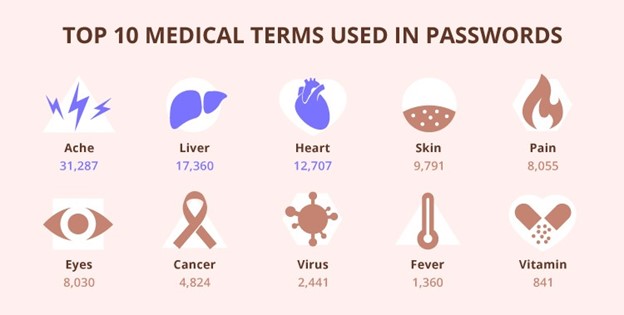
Source: Egle Kristopaityte, 2022
Hive Systems, a Richmond, Virginia based cybersecurity firm, has calculated the amount of time it takes a hacker to decipher a password based on its complexity. Their conclusions are that a simple, numbers only 4-character password can be instantly deciphered given the state of hacker technology in 2023. However, an 18-character password using a combination of numbers, letters, and symbols might take 2 quadrillion years.

Maximum time required to crack randomly generated passwords with 5,000 iterations using an RTX 4090.
As the above table shows, the longer the password, the longer it takes for a hacker to decipher it. "To me, length trumps complexity every time," says Balsley. "I recommend employees use a pass phrase instead of a password. Something like, ‘I went to the store' written as one word with some special characters mixed in—not just an exclamation point at the end."
Here are some guidelines to consider in hardening your own passwords: (Password Protection, 2020)
Multi-factor authentication (MFA; two-factor authentication, or 2FA) is an electronic authentication method in which a user is granted access to a website or application only after successfully presenting two or more pieces of evidence (or factors) to an authentication mechanism. MFA protects personal data—which may include personal identification or financial assets—from being accessed by an unauthorized third party that may have been able to discover, for example, a single password.
According to Jeff Cunningham, Sr. VP & Chief Technology Officer at HealthStream, it is important to implement security measures in addition to strong passwords. "The direction we want to go, is to have strong passwords, ensure that we are changing passwords regularly, and are using multi-factor authentication on top of that.
"Certainly, the first step is securing the complexity of the password. How hard do we make it for a hacker to break that password? I know it sounds simple, but basically the greater length and the more variety that we have in the password, the harder it is to break."One of the best ways to ensure password hardening is to make sure that we are not relying completely on the password. I am going to look at multiple ways of securing that password, and multifactor authentication is a way of doing that That's basically saying that not only am I relying on the password, but for you to get access to a system, I am going to validate through some other mechanism that you are who you say you are."
In conclusion, hackers are on the prowl, wreaking havoc wherever possible. As employees in the highly targeted healthcare industry, we need to do our part to keep our organizations safe. It is time to harden those passwords.
Bhuyan, Soumitra Sudip et al., "Transforming Healthcare Cybersecurity from Reactive to Pro-active: Current Status and Future Recommendations," Journal of Medical Systems (2020) 44:98, https://pubmed.ncbi.nlm.nih.gov/32239357/.
Burrell, Darrell Norman, "CYBERSECURITY IN HEALTHCARE THROUGH THE 7-S MODEL STRATEGY," Scientific Bulletin, 2023, Vol. 28 Issue 1, https://intapi.sciendo.com/pdf/10.2478/bsaft-2023-0003.
Dyrda, Linda, "10 most hacked passwords," Becker's Hosppital Review, June 28th, 2023, https://www.beckershospitalreview.com/cyber security/10-most-hacked-passwords.html.
Employee Password Security in the Healthcare Sector, Enzoic, Accessed September 2023, https://www.enzoic.com/blog/employee-password-security-in-the-healthcare-sector/.
Kristopaityte, Egle, "Weakest Passwords of 2022: Most Often Used Medical Terms," November 22, 2022, Weakest Passwords of 2022-Most Often Used Medical Terms.docx (sharepoint.com).
Murray-Watson, Rebecca, Healthcare Data Breach Statistics, The HIPAA Journal, September 2023, HIPAA Journal, https://www.hipaajournal.com/healthcare-data-breach-statistics/.
Nabe, Cedric, "Impact of COVID-19 on Cybersecurity," Deloitte, accessed September 20, 2023, https://www2.deloitte.com/ch/en/pages/risk/articles/impact-covid-cybersecurity.html.
Neskey, Corey, "Examining the LastPass Breach Through our Password Table," Hive Systems, September 13, 2023, https://www.hivesystems.io/blog/examining-the-lastpass-breach-through-our-password-table.
"Password protection: Guarding against surge in attacks amid COVID-19," Revenue Cycle Advisor, June 2020, https://revenuecycleadvisor.com/search/node/Password%20protection%3A%20Guarding%20against%20surge%20in%20attacks%20amid%20COVID-19?type=All.

Learn what EMS training involves and how the right program helps your organization attract and retain EMS staff while supporting providers in the field.
A typical day for an Emergency Medical Services (EMS) provider can be anything from providing pre-hospital care for a patient who is being extricated from a mangled automobile, to managing a severely mentally ill patient, to retrieving a Cheerio from the nose of an adventurous toddler. They provide emergency medical services in an array of situations that almost defies description.
Career Path
There are a number of ways by which someone might enter the field of EMS. Currently, the Committee on Accreditation for EMS Professions (CoAEMSP) does not require a college degree as part of their minimum standards for accreditation. However, in 2013 the National Registry of Emergency Medical Technicians (NREMT) did identify four types of pre-hospital providers: Emergency Medical Responders, Emergency Medical Technicians, Advanced Emergency Medical Technicians and Nationally Registered Paramedics. The training hours required for each of these providers range from approximately 60 hours to over 1,000 hours.
Job Outlook
Not surprisingly, the outlook for EMS jobs is good. In their Occupational Outlook Handbook, the Bureau of Labor Statistics (BLS) anticipates an 11% increase in jobs between 2020 and 2030, or an increase of 261,300 jobs.
EMS organizations understand the importance of recruitment and retention. Turnover rates are in the 20%-30% range and their position on the front lines during the COVID-19 pandemic has caused a slight increase in turnover amongst these providers.
EMS providers have great career options. They may choose to seek higher levels of certification to rise to the rank of paramedic or the nascent field of specialty paramedic. They may also choose to pursue EMS leadership roles at a local, state, or national level. Or they may choose to continue into other related fields such as EMS educator, nursing, physician assistant or physician. It is also possible to pursue administrative or clinical roles in other healthcare organizations such as urgent care centers, and emergency departments, hospitals, ambulatory care centers, etc.
The Right Resources for EMS Training
The Commission on Accreditation for Pre-Hospital Continuing Education (CAPCE) provides content that helps to ensure that pre-hospital providers get the required training regardless of their designation. HealthStream's EMS Program offers more than 70 hours of CAPCE-approved courseware. In addition, the platform also gives leaders the option of customizing the training experience by uploading their own courses and offers a flexible template that will help meet any organization's unique training requirements.
The platform is rich in engaging and relevant content and the virtual format makes it easily accessible for providers.
EMS Training - Real Solutions
EMS is no different from any other point on the continuum of care in that ongoing training to build competency, address changes in best practices and to maintain credentials is a part of every pre-hospital provider's career. And, just like their colleagues on other stages of the continuum of care, they need practical and efficient ways to maintain those certifications.
HealthStream can help your organization optimize competency while reducing EMS training costs. The EMS Program is easy to navigate and can be accessed from any device, allowing your providers a convenient way to access education whenever and wherever they are. It also helps leaders to monitor performance and completion rates for students to ensure regulatory and organizational compliance.

The OIG's first General Compliance Program Guidance update in nearly 30 years took effect Nov. 6, 2023. See what it means for healthcare compliance programs.
The first updates to the Office of the Inspector General (OIG) General Compliance Program Guidance (GCPG) in nearly 30 years took effect on November 6, 2023. While the guidance does not create new laws or legal obligations, the GCPG does modernize the original OIG guidance and makes it more accessible.
It should also be noted that there is more to come. This release is specifically directed to federal healthcare providers, but it will likely be followed by industry-segment specific CPGs (ICPGs) with the next areas of focus expected to be managed care plans and skilled nursing facilities. It is anticipated that the next round of guidance will be available in 2024.
The GCPG provides information about relevant Federal laws and acts as a reference guide for the healthcare compliance community and other healthcare stakeholders. The GCPG provides guidance for hospitals, home health agencies, clinical laboratories, third-party medical billing companies, durable medical equipment and supply companies, hospices, Medicare Advantage plans, skilled nursing facilities, physicians, ambulance companies, and pharmaceutical manufacturers. The GCPG offers voluntary guidance that discusses general compliance risks and programs. The GCPG is not binding on any individual or entity.
What follows are some highlights from the recent updates.
The new guidance recommends that compliance programs include quality and patient safety within their scope. This has been an often-discussed topic in healthcare compliance; however, many compliance programs still do not include quality and patient safety. The OIG now recommends that healthcare organizations include quality and patient safety in their compliance programs to provide more insight into quality and patient safety issues and to help the organization reduce the risks associated with incidents resulting in patient harm.
In addition, the new guidance recommends that compliance committee members receive regular reports on quality and patient safety issues as well as information on the adequacy of patient care. It also recommends establishing and implementing a regular process for performing quality audits, including an assessment of if staffing levels are sufficient to reduce risk and ensure patient safety. The OIG recommends risk assessments be conducted annually and that the Compliance Committee be responsible for the audits, rather than the Compliance Officer, in order to better demonstrate an organizational focus on these issues. In addition, upon the completion of the audit, it is recommended that findings be reviewed and used to develop an action plan to address the findings.
The OIG has emphasized that compliance is completely voluntary and not binding on individual organizations. In addition, it offers resources that are designed to be flexible regardless of the size of the healthcare organization. A section of the GCPG update is devoted to ways in which the compliance program can be "right-sized" to the needs and size of any organization and even recommends specific strategies that will help all organizations implement the guidance. The additional focus on right-sizing compliance programs to meet the needs of the entity is helpful for compliance departments when assessing and prioritizing resources and budget requests.
The new guidance includes links to a wide variety of compliance resources. The U.S. Department of Health and Human Services (HHS) OIG's official release of the new guidance includes an entire section of helpful, free resources. Resources include compliance toolkits, advisory opinions, healthcare fraud and enforcement standards, recommendations for your compliance program's infrastructure, provider compliance training and more.
While the OIG provides resources in support of this new guidance, the process of building a culture of compliance is an evolving process with many moving parts. HealthStream has compliance solutions that can help your organization build a culture of compliance that prioritizes clinical quality and safety while satisfying federal requirements.
HealthStream can help support your compliance program with innovative technology, adaptive learning, and organizational management tools. The compliance education tools can identify any gaps in compliance and assign a personalized employee learning program to address the gaps with engaging content. HealthStream also provides reporting on course completions and proficiency. Contact HealthStream today to learn more about the tools that can help your organization build a culture of compliance.

Telehealth keeps growing, and so does the need for consistent provider privileging. Learn why a standardized telehealth privileging process is critical.
We're now three years past the height of the COVID-19 pandemic, and it's safe to say we're all aware of what telehealth is: remote healthcare visits via telecommunications technology. While telehealth was essential during the pandemic to allow for accessible healthcare while fostering safety, trends show its use will continue to expand as patients and physicians become more comfortable and the technology continues to improve. This is why having a standardized telehealth provider privileging process is critical.Standardizing privileges ensures you have consistent criteria for privileges across a health system and equips you to deliver next-level patient care and provider experiences. Standardization also means everybody on the medical staff can access the same information, eliminating redundancies, inefficiencies, and confusion.
Of course, during the pandemic, telehealth was a necessity. Now that the crisis is under control, it may seem unnecessary, but its use continues to gain traction. There are many reasons for this growth:
Telehealth can also help lower costs for patients and physicians, can be more accessible to those with inflexible schedules, and has the potential to help reduce healthcare disparities by providing equitable access to underserved populations. Since telehealth is here to stay, privileging providers for telehealth will become increasingly important.
The more popular telehealth becomes, the more significant the need for a standardized telehealth provider privileging process. A standardized privileging process can help ensure all providers who deliver telehealth services are qualified and competent. This can help improve patient safety and reduce the risk of medical errors.
Privileging telehealth providers requires organizations to meet the requirements issued by states, Medicare, The Joint Commission and other accrediting bodies, private payors, and regulatory bodies. Organizations must also establish strategies to safely store, share, and maintain information on telehealth providers. And they must navigate the complexities that arise from providers being privileged to provide in-person care in some facilities, and telehealth in others. It's also critical to stay updated on the regulations that govern telehealth privileging today.
One way to tackle these hurdles is by implementing a streamlined system that seamlessly privileges, stores, manages, and shares information. With an automated system in place, like CredentialStream®, organizations can privilege telehealth providers:
By implementing a standardized privileging process for telehealth providers, organizations can help to reduce the risk of legal liability for telehealth organizations while demonstrating they have taken reasonable steps to ensure that their providers are qualified and competent. This can also help organizations increase the efficiency of the privileging process, with a clear and concise process in place, reducing the time and resources required to privilege new providers. Implementing an automated system that is comprehensive, scalable, and effective is easier than you think, and better yet, HealthStream will ensure everything goes according to plan. We're always here to help, simply reach out and we'll answer any questions you might have.

Learn how enhancing staff wellness can lead to better healthcare outcomes. Discover practical strategies to support your team's mental health.
This blog is taken from a recent HealthStream webinar entitled "Mind Matters: The Interplay of Staff Wellness in Quality Outcomes." The webinar was moderated by HealthStream's Caroline Acree and featured:
With 1 in 3 healthcare workers planning to leave their jobs due to anxiety, depression and exhaustion, at a point where the industry can ill afford to lose them, healthcare leaders need to create a strategic plan to address these stressors with the goal of supporting and retaining employees to produce quality outcomes.
Van Brunt began by framing the issue as a national mental health crisis that affects every organization and community in the country. Whether the workforce is largely remote or on-site, he stressed the importance of leadership taking an active role.
He recommended that organizations take a two-pronged approach that includes both qualitative and quantitative assessments. Human Resources professionals will likely be able to make qualitative assessments based on the kinds of complaints they are receiving, the nature and severity of those complaints, and the reviews that they see on boards.
He also encouraged leaders to evaluate quantitative data such as claims, PTO, complaints, and assessments. He supported assessments as a quantifiable way to establish a baseline for the organization that can be tracked over time and customized to meet the changing needs of the organization. He also encouraged leaders to look beyond the standard assessment questions about burnout and depression and include questions about psychological safety.
Acree asked the presenters to share some of the challenges that they and their customers had encountered and how to address those challenges. Poston shared an example of a high-stress behavioral health unit. In addition to the expected stressors that are found in a behavioral health unit, she reported that there was a lack of psychological safety throughout the organization that resulted in a reluctance to report negative staff interactions, a lack of accountability, and poor communication from leadership. Both the employee and patient experiences were impacted. Many employees resigned in frustration and eventually the manager was replaced, but it took months for the new leader to re-establish trust.
Stepney added that it was important to develop a proactive strategy by understanding the root causes of the kind of situation described above. She encouraged leaders to re-examine some of the policies that have led to situations where wellness has been compromised.
Van Brunt also shared an example of a manager who was concerned about burnout on his team and undertook a burnout assessment. As part of the process, the manager took the assessment and discovered that he was experiencing some burnout as well. After using some of the recommended mental wellness resources, he noticed a positive change in himself. He led by example and his team followed by participating in the assessment and using the resources.
When investing in staff wellness, it is important to measure the success of those initiatives. So, what should leaders be tracking? Poston encouraged leaders to ensure that they would be able to classify survey results by various demographic dimensions such as race, ethnicity, language, disability, sexual orientation, gender identity, etc. All these attributes can impact both wellness and performance and can help inform what the wellness initiatives should include. She also urged leaders to assess wellness at times other than the annual organizational review. Managers can seek feedback through quick pulse checks that provide intermediate feedback on wellness as well as the success of ongoing initiatives.
Leaders also need to ensure that the organization's approach to wellness is inclusive and adaptable. Where should leaders start? Van Brunt admitted that this was challenging and offered some best practices. He shared that creating psychological safety was foundational as these initiatives would rely on interactivity and collaboration, and allowing people to co-create how they want to interact increases buy-in.
Stepney added that while organizations may say that they want people to bring their full selves to work, they may not recognize that this means asking people to bring their lived experiences, which result in different cultural sensitivities and preferences. She also encouraged leaders to leverage employee resource groups as a means of creating opportunities to connect, identify differences, and bring differing experiences forward.
Seamlessly integrating mental health support systems into the daily operations of a healthcare organization can feel like an enormous task, but the speakers encouraged leaders to start small. Van Brunt encouraged leaders to remember that these initiatives really need to start at the top with leaders that recognize the importance of mental wellness and the impact of cultural differences. Leaders also need to develop accountability. All team members need to understand that poor behavior will not be tolerated. He also stressed the importance of both formal and informal types of recognition.
Managers also need to be educated to recognize mental health challenges within their teams and have resources available for those who need them. He also encouraged leaders to use the onboarding process to ensure that employees were familiar with the company's mental wellness resources.
When building strategies to facilitate collaboration between HR and other departments, Stepney encouraged leaders to begin with leadership accountability. Who will own the responsibility of driving the strategy tied to wellness? Once that has been established, collaboration can be more effective. "True collaboration will allow us to align with key performance indicators from a wellness perspective," said Stepney. She also urged leaders to evaluate internal communication strategies to ensure that employees receive consistent messages about wellness initiatives regardless of the language spoken or the employee's literacy level.
HealthStream can help your organization create safe, welcoming care for patients while developing a culture that supports mental wellness for staff. Visit HealthStream's Health Equity and Belonging solutions to learn more. A strong culture starts from the top. Are you investing in your existing leaders and preparing future ones? HealthStream also has resources to help your organization support rising leaders.

A credentialing and privileging solution can save you time and money by reducing administrative costs and improving operational efficiency.
In the ever-evolving landscape of healthcare, where patient safety remains paramount, there is another crucial aspect that often goes unnoticed - the financial health of healthcare organizations. While we all understand that credentialing and privileging processes are essential for patient safety, what may come as a surprise is their significant impact on the bottom line. In this blog post, we'll explore the importance of decreasing time to revenue in the healthcare industry and how a solution like CredentialStream®, by HealthStream®, can help save money and generate revenue for your organization.
Approximately 400,000 hospitalized patients in the U.S. will experience some type of preventable harm each year, which can cost a healthcare organization $20 billion. For any healthcare institution, ensuring patient safety is a fundamental obligation. Credentialing and privileging processes are the backbone of this commitment, ensuring that only qualified and competent healthcare professionals are granted privileges to provide care. However, these processes aren't just about safety; they are also about the organization's financial health.
It's common knowledge that an efficient credentialing and privileging solution can save you time and money by reducing administrative costs and improving operational efficiency. But did you know that it can also generate revenue for your organization? The credentialing process can take anywhere from 90-120 days depending on delays, while facilities can lose up to$1.2 million in revenue. So, choosing the right software is vital to accelerating your organization's credentialing cycle and boosting its revenue outcome.
According to Merritt Hawkins, physicians generate 2.4 million for affiliated hospitals each year, with the highest being interventional cardiologists who generate $3.48 million a year. As physician turnover rates increase due to more clinician burnout, the financial health of organizations proves to be at risk. The Association of American Medical Colleges projects that there will be a shortage of up to 124,000 physicians by 2034. Losing a physician prevents hospitals from receiving the revenue associated with those cases until the physician is replaced. Revenue lost from the vacancy of a physician is dependent on the specialty but could mean a loss of $130,000 per month until the vacancy is filled. There are many reasons linked to why a physician experiences burnout, but one of the top reasons is too many administrative tasks. The 2023 Medscape Physician Compensation Report reveals that on average, physicians are spending 15.5 hours a week on administrative chores.
With a solution like CredentialStream, there are several key ways to improve administrative productivity and decrease the time to revenue. By going beyond credentialing, CredentialStream offers an integrated, comprehensive approach to the entire time-to-revenue process. This includes credentialing, privileging, enrollment, onboarding, compliance training, and EMR provisioning, all within a unified, user-friendly application.
Two new enhancements to the platform, the Roster Generator and Library solution, are noteworthy as they offer advanced payer roster functionality. And, an upcoming launch of "My Learning for Providers" will enable seamless access to compliance courses within CredentialStream, enhancing efficiency by allowing providers to complete necessary training as they fulfill their credentialing tasks.
Other functionality supporting improved time-to-revenue includes:
In the healthcare industry, credentialing and privileging processes are more than just administrative tasks; they are strategic opportunities to improve your bottom line. By investing in solutions like CredentialStream that focus on efficiency and revenue generation, you ensure patient safety and strengthen your organization's financial health. It's a win-win that can reshape the way you approach credentialing in healthcare. Schedule a demo to learn more.
Uncover vital features of healthcare Learning Management Systems that boost training efficiency and compliance. Enhance employee performance today.
In our fast-evolving world, learning and performance management systems play a pivotal role. Nowhere is this more critical than in the dynamic healthcare sector, where top-notch patient care, regulatory compliance, and adapting to industry shifts are imperative.
A recent study by HealthStream highlights essential features of healthcare-specific Learning Management Systems (LMS) that are vital for HR leaders and professionals in healthcare. For example, access to an ecosystem of healthcare content, integration with Electronic Health Records (EHRs), and tracking of healthcare-specific skills and competencies are mentioned.
The surveyed HR leaders showed that users of Learning or Performance Management Systems place highest value on tracking and analyzing employee performance. At the most basic level, they want to be able to track each employees' compliance with continuing education and licensure requirements. Additionally, they expect their system to have good reporting and analytic tools to support their executive decision-making.
When asked about new functionality for their Learning or Performance Management System, HR leaders mention better training for new users/administrators and more information about what their compliance obligations are and whether or not their organization is in compliance.
A healthcare-specific LMS can bring many valuable benefits with industry-specific features. For more information about HealthStream's Learning Center, click here.
In March of 2023, HealthStream interviewed a group of HR leaders. Respondents were asked to rate the importance of various features that might be included in a Learning or Performance Management System and to indicate the importance they placed on having healthcare-specific content in these systems. The following graphics offer a snapshot of the key findings from this illuminating study:
Based on the ratings, the feature noted as most important is:
The least important feature is:
The following table shows the rating of each of the features, from most important to least important.
Q. Rate the following features on a scale of 1 being most important and 10 being least important.
Mean Score
3.33
Reporting and analytics: includes features that enable tracking of user progress, course completion rates, and learner performance
4.50
Access to an ecosystem of healthcare specific applications and content
4.50
Integration with other systems such as HRIS, EHRs and other tools
4.58
Competency tracking: track employees' competencies to ensure they have the necessary skills to perform their job duties
4.67
Mobile Native designed to enable employees to access content and applications on their mobile device
5.67
Role-based access control: restrict access to certain features or content based on job role content or seniority
6.17
Virtual simulation: practice procedures and treatments in a safe and controlled environment
6.50
Gamification such as badges, rewards, and leaderboards to increase learner engagement and motivation
7.08
Patient education: enable healthcare professionals to create and distribute patient education
8.00
Eight of the 12 HR leaders interviewed (67%) strongly agree that healthcare-specific functionality is important when choosing a Learning or Performance Management System.
Q. When considering a Learning or Performance Management System, healthcare-specific functionality is a top consideration in the decision-making process.
Number of Respondents
Percentage of Respondents
Strongly Agree
8
66.7%
Agree
3
25.0
Disagree
0
0.0
Strongly Disagree
1
8.3
TOTAL
12
100%
When asked to name additional healthcare-specific features or functionality they would like to see in an LMS, Performance Management, or similar application, the responses indicated a wide variety of needs, making it all the more important to understand included features when choosing a new LMS:

Read how Asante cut $600K a year by humanizing safety and compliance training in this customer spotlight.
When your employees think about safety and compliance training, what are the first words that come to mind? Boring? Repetitious? Disengaging? To make matters worse, do decision makers think of these training programs as costly and time consuming? Improving patient safety and ensuring compliance with state and federal regulations are vital initiatives in any organization, but too often they are thought of as taxing activities employees and leadership alike are resigned to carry out.
Fortunately, it doesn't have to be this way - by humanizing the training process and meeting your employees where they are in terms of flexibility and reduced seat time, you can create a program that's efficient, enjoyable, and even saves time and money. If you are looking for a way to shake up a stale safety and compliance training routine, check out SafetyQ and ComplyQ. These programs help meet educational goals by focusing on three important characteristics:
Several HealthStream clients have had tremendous success in achieving their safety and compliance goals and requirements. In one example, healthcare provider Asante switched from a homegrown training program to ComplyQ and SafetyQ. They wanted to reduce training costs without sacrificing the capability to provide individual learning workflows and intuitive learning options for staff members. During the initial rollout, they effectively replaced more than 50% of the system's homegrown content for their annual, required training. In addition, use of the two programs has saved Asante more than $600,000 a year in costs and 200+ hours of time related to training development and implementation. Reaction from staff members has been positive, thanks to the interactive course material and pre-assessments to guide content selection to areas of need.
According to Yvonne Padilla, the IS Training & Program Manager with Asante Talent Management, "HealthStream has improved our organization's ability to present our staff with high quality training that is engaging and evidence-based. It has improved competencies in all areas of our organization, from clinical care to compliance. When we learned about SafetyQ and ComplyQ, it was like, ‘why haven't we done this before?'" The content is more engaging and allows our learners to learn things they hadn't learned before."
You can read more about Asante's success story by reading the customer spotlight, "Asante achieves $600,000 Annual Savings with Safety and Compliance Training."

Learn how leaders can staff more safely and effectively by incorporating census and acuity with ShiftWizard, with a look at regulations and union needs.
This blog is taken from a recent HealthStream webinar entitled "From Regulations to Realities: Nurse Staffing, Unions, and the ShiftWizard Advantage." The webinar was moderated by Sarah Enders, HealthStream's Senior Product Marketing Manager and featured Gia Milo-Slagle, HealthStream's Senior Product Director, Scheduling and Terri Epler, RN, MSN, Solutions Consultant Manager.
Navigating the complexities of staffing mandates while ensuring compliance with union standards is challenging, but in this webinar, HealthStream leaders provide real strategies that can help organizations do just that.
Milo-Slagle set the stage by pointing out that the staffing shortages that have plagued healthcare remain prevalent across every setting and throughout the entire continuum of care. She stressed the importance of addressing enterprise-wide needs, preparing for the increasing demands from an aging population, and the challenges of aligning resources to fluctuating demand and acuity while remaining focused on delivering high-quality patient care and preserving nurse satisfaction, retention, and engagement.
Milo-Slagle shared some of the history of staffing mandates and regulations. In 2004, California became the first state with staffing regulations. The process to implement the California regulations began in 1999 and by 2009, 14 additional states and the District of Columbia had enacted nurse staffing regulations, and 17 more states were in the process of crafting legislation. With nearly 30 states working towards staffing regulations, California remains the only state with minimum staffing ratios in place.
While efforts to mandate staffing ratios are ongoing, a study published in June of 2023 in Nurse.org found that 79% of nurses reported that their units were not adequately staffed. The same study found that the intent to leave nursing increased from 35% in the Fall of 2022 to 40% in March of 2023.
Safe staffing is one of The American Nurses Association's (ANA) core federal policy priorities and includes three approaches: 1. Staffing committees: nurse-led efforts to create unit-level staffing plans based on the patient population's acuity matched with staff's skills and experience, 2. Mandated nurse to patient ratios or standards, and 3. Mandated public disclosure of staffing levels to the public and to regulatory bodies.
The ANA supports a model incorporating nurse-driven staffing committees to support flexible staffing levels.
Milo-Slagle went on to point out that the ongoing nursing shortage is being exacerbated by a set of persistent factors:
The high and increasing turnover rates should not come as a surprise as a July 2023 study conducted by the ANA found that:
In addition, 20% of all nurses are enrolled in a union. Unionization in healthcare is on the rise, particularly since the pandemic. Healthcare workers are seeking to use the power of collective bargaining to improve wages, benefits, workloads, and to address patient and employee safety issues.
Healthcare leaders are seeking solutions that will optimize staffing, meet staffing guidelines and regulations, and meet union requirements. Leaders need solutions that help proactively match the needs of patients with the talents of their staff. Milo-Slagle admitted that there will always be staffing challenges that arise, but being able to predict needs based on historical data and identify the credentials of the staff that will care for them is an important part of the solution. HealthStream's ShiftWizard can help leaders accomplish.
Epler highlighted just a few of the features that users will find within ShiftWizard and how they can help address staffing mandates. ShiftWizard features a dashboard that is both intuitive and interactive. From the dashboard, users are able build a staffing matrix that will show which areas are over or under-staffed and help match patient needs to nurses' skills. The dashboard may also be configured to show a single unit, the entire facility, or an enterprise-wide view.
The reporting is based on census data that can be refreshed as often as every 15 minutes. "ShiftWizard also uses the last two to three years of census data, applies machine learning, and is then able to predict census up to 120 days out allowing leaders to build a more dynamic schedule," said Epler.
In addition, nurses can self-schedule using ShiftWizard which has been shown to be a significant satisfier and can contribute to a better work life balance. There is also a flexible messaging function that allows leaders to communicate with staff about available shifts or any other topics as needed.
HealthStream's Acuity and Assignment Manager can be used with ShiftWizard and allows leaders to match a patient to a particular caregiver. Leaders can make safe and equitable assignments ensuring that the right nurse has been assigned to the right patient. In addition to the census data, nurse certification and licensure data is accessible within ShiftWizard so that leaders can feel confident in the assignments.
A mobile app for both iPhone and Android users is available for leaders and staff to be able to connect with scheduling reports and open shifts at a time and place of their convenience.

Gain insights from HealthStream's medical staff professionals on their vital contributions and aspirations within the healthcare system. Celebrate with us.
In celebration of National Medical Staff Services Awareness Week, we sat down with a handful of MSPs from team HealthStream to discuss the profession, its importance, its future and more! Read on to learn everything we love about MSPs!

Tawna Knight, CPCS, Director, Credentials Verification Organization

Jackie Jones, CPMSM, Senior Consultant

Thomas Heitz, CPCS, Clinical Solutions Consultant

Brandi Zevenbergen, CPCS and CPMSM, Senior Director, Product Management

Katy Young, MBA, CPCS, Senior Manager, Customer Support
[Katy] Certification reflects the unwavering commitment of the holder. Whether earned voluntarily or mandated by their role, the rigorous examination demands weeks of diligent study and preparation. While a certified MSP may not possess every answer, their determination and resilience empower them to seek and find solutions.
[Brandi] Certified or not, being an MSP holds immense weight as we carry profound responsibility and dedication to the patients we serve. Credentialing and Privileging act as the driving force behind ensuring that healthcare practitioners deliver competent and qualified care within the healthcare delivery system. While everyone in the healthcare system shares the responsibility for patient safety, it genuinely commences with the onboarding, credentialing, and privileging processes.
[Thomas] Maintaining my MSP certification is a testament to my unwavering commitment to upholding excellence in the oversight of the credentialing and privileging process. My Certified Provider Credentialing Specialist (CPCS®) certification serves as a potent symbol, not only conveying my dedication to clients but also showcasing my profound understanding of these intricate processes. This becomes especially valuable in the context of our industry-specific webinars and publications, including my contribution to the 2023 Annual Report on Medical Staff Credentialing earlier this year.
[Jackie] I'd like to see a distinct Human Resources designation, acknowledging the multifaceted responsibilities we undertake within our organizations. The National Association Medical Staff Services has been diligently working towards this goal for years.
Additionally, I envision the establishment of a separate national certification specifically for privileges. As the development and maintenance of privileges grow in complexity, and with the expanding roles of advanced practice providers, a dedicated certification would be more crucial than ever. Let's work together to bring these aspirations to reality and further elevate the MSP profession.
[Tawna] Thank you for your dedication and the tireless work you do. What we do is oftentimes underappreciated, know that you make a difference every day and to all the patients out there, you are their hero, whether they know it or not.
Again, Happy National Medical Staff Services Awareness Week. We are grateful for each and every one of you!

Explore a typical day for a medical staff credentialing professional, from processing applications and verifying credentials to managing privileging.
Medical Staff Credentialing Professionals have a myriad of responsibilities, from processing applications and verifying credentials, to managing clinical privileging, overseeing the approval process, and ensuring continuous performance improvement. As this is a profession that is consistently growing, we thought it would be beneficial to review a day in the life of a Medical Staff Credentialing Professional. Let's dive in!
Here at HealthStream, we work with Medical Staff Credentialing Professionals representing different organizations, including hospitals, Credential Verification Organizations (CVOs), and Managed Care Organizations (MCOs). Each professional manages varying credentialing requirements depending on the type of organization they work for.
HOSPITALCVOMCO
A hospital's operational structure depends on its size as well as the type of hospital it is, like a pediatric hospital versus one that provides acute care.
Generally speaking, credentialing in hospitals is impacted by a variety of factors, including:
The credentialing process for a CVO is influenced by its contracts, policies, and procedures; federal and state laws; and regulations and accreditation standards.
The most common accrediting bodies governing CVOs are:
MCO is an industry term used to collectively describe commercial third-party payers, healthcare networks, and health plans.
Their credentialing processes are influenced by:
Regardless of the type of organization that a Medical Staff Credentialing Professional works for, they have several key responsibilities. Their big, general focus is on processing applications and verifying credentials.
After the application is complete, the department chair or medical director (depending on the organization: hospital, CVO, or MCO) reviews the application and makes a recommendation. It's common for hospital staff to use a credentials committee for evaluations. This committee reviews the application and any supporting documents, along with the chairperson's/medical director's recommendation, and uses all that information to make their own recommendation to the medical executive committee (MEC).
In smaller hospital settings, or non-departmentalized hospitals, the application is usually presented directly to the MEC. The MEC then presents its final recommendation to the board, and the board makes the final decision. It's important to note that though MCOs do not grant privileges, they do determine the applicant's eligibility for membership/participation, and process requests for privileges to ensure compliance with regulatory standards.
The work done by Medical Staff Credentialing Professionals can be complicated and time-consuming. When tasks require so much diligence, it's helpful to have tools in place to help keep one organized and on-target. HealthStream Credentialing solutions can simplify the process through automation. CredentialStream®, for example, provides the most comprehensive provider lifecycle management solution available. With CredentialStream, Medical Staff Credentialing Professionals can use a single solution to manage initial and re-credentialing, enrollment, onboarding, expirables management, privileging, evaluation, network management, and much more. Request a demo today, and start improving patient care on your terms.

Explore the expanding field of nursing informatics and its influence on patient care and overall healthcare efficiency. Start your journey today.
Nursing Informatics is a specialized area of nursing and branch of the profession that is seeing much growth. This blog post's purpose is to be an elementary introduction to this burgeoning specialty.
According to the American Nursing Association, "Nursing informatics (NI) is the specialty that integrates nursing science with multiple information management and analytical sciences to identify, define, manage, and communicate data, information, knowledge, and wisdom in nursing practice. NI supports nurses, consumers, patients, the interprofessional healthcare team, and other stakeholders in their decision-making in all roles and settings to achieve desired outcomes. This support is accomplished through the use of information structures, information processes, and information technology" (ANA, 2015).
Squarely focused on information, data, and communication, a nurse informatics career looks closely at how to use numbers to boost performance, both for patients and for an organization as a whole. This role's goals are to "boost efficiency, cut costs, and boost patient care quality" (Nurse Journal, 2019). Nursing professionals within this specialty are positioned at the intersection of nursing science, computer science, and information science, where they are able to "better manage and communicate information, data and knowledge in the practice of nursing. Nursing informatics specialists facilitate data integration, information and knowledge so that they provide better support to patients, nurses and other health care providers" (Nurse Journal, 2019). One thing on which they spend a lot of their energy is documentation, because "high quality care is fully dependent upon strong communication among the wide variety of health care providers. As health care providers communicate via notes on a chart, a nurse informatics analyst wants to increase the speed and accuracy of the charting process. This means that health care workers have better access to patient notes, and can mean better decisions about care" (Nurse Journal, 2019).
Typical employers for nursing informatics employees include facilities across the care continuum, from hospitals to medical practices, as well as a wide range of consulting firms, universities, and corporations. Job titles that match this professional competency include:
The demand for nursing informatics isn't going to abate any time soon. Not only will the aging U.S. population require more caregivers, but we'll need all the help we can get to control healthcare costs. That'll require a growing number of nursing informatics analysts. Nurse Journal cites an American Medical Informatics Association finding that as many as 70,000 nursing informatics specialists or analysts may be needed in the next five years, with the surge in related to data gathering and analysis required by the Health Information Technology for Economic and Clinical Health Act (HITECH) of 2009 and the Patient Protection and Accountable Care Act (PPACA) of 2008.
A typical route to becoming a nursing informatics expert starts with being a registered nurse. After a BSN, many get a master's degree, either as a master of science in nursing (MSN) or a master's in information or computer science. Nurse Journal advises those considering this direction that the "career is demanding in terms of project management, critical thinking and creativity. It is important to be able to work with a vast variety of people. You also must have skills to resolve demands that conflict, which can happen as you develop information systems to meet everyone's needs" (Nurse Journal, 2019).





